









Warsaw-Rijeka Railway Connection Launches June 27: A New Gateway from Central Europe to the Adriatic
On June 27, a new international rail service will depart from Warsaw, heading directly to Rijeka – one of Croatia’s key seaports on the Adriatic Sea. The seasonal route by PKP Intercity offers passengers from Poland and Central Europe a convenient and sustainable alternative to reach the coast, with the added potential to strengthen tourism and regional maritime connectivity.
In brief
PKP Intercity is launching a seasonal rail connection from Warsaw to Rijeka in Croatia, one of Croatia's most important seaports, on 27 June. The route covers 1,240 kilometres through Poland, the Czech Republic, Austria, Slovenia and Croatia, and the journey takes 19 hours 58 minutes. The train runs four times a week, with the last departure from Poland on 29 August and from Rijeka on 31 August. Promotional ticket prices start at around 200 zlotys, and the service can carry 172 passengers at a time.
Polish rail operator PKP Intercity is launching a new seasonal service connecting Warsaw with Rijeka – Croatia’s third-largest city and one of its most important maritime hubs. This cross-border route responds to growing passenger demand for rail access to the Adriatic, especially from Polish holidaymakers for whom Croatia remains a leading summer destination.
The first train will depart on June 27, with services operating four times a week: Tuesdays, Thursdays, Fridays, and Sundays from Warsaw, and return journeys on Mondays, Wednesdays, Fridays, and Sundays. The route will operate until the end of the holiday season, with the final departure from Rijeka on August 31. Promotional fares start at just PLN 200 (approx. €45), positioning the offer as a viable and competitive alternative to long road or air journeys.
Spanning 1,240 km and crossing five countries – Poland, Czech Republic, Austria, Slovenia, and Croatia – the journey begins shortly after 14:00 in Warsaw. Major stops include Opoczno, Katowice, and Wodzisław Śląski before reaching Vienna at around 22:00. From there, additional carriages will be detached and continue southward as a separate train. After midnight in Slovenia, the service merges with the overnight "Istria" train from Budapest to Rijeka. The train arrives in Rijeka just after 9:00 the next morning.
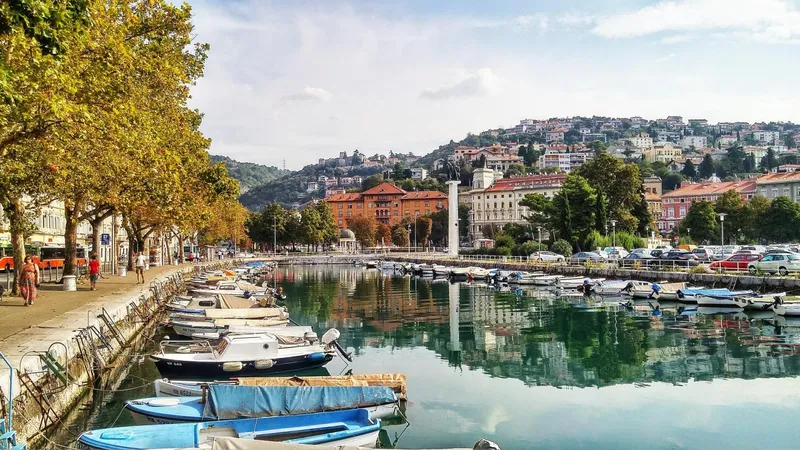
Rijeka? That’s just the end of the line – or the beginning. With stops in Vienna, Ljubljana, Postojna and Opatija, passengers can plan flexible journeys to some of Central Europe’s most iconic destinations. Whether it's the cultural elegance of Vienna, the green capital of Slovenia, the famous karst caves of Postojna or the Austro-Hungarian charm of Opatija – all are now accessible on the same route.
The train offers second-class compartments and couchettes with four-person berths. All cars are air-conditioned, and passengers in couchettes are provided with bedding and the assistance of onboard staff throughout the journey. Between Warsaw and Vienna, a full-service Wars restaurant car is available, serving fresh meals prepared onboard. Capacity for each train is set at 172 passengers.
The project is the result of extensive international coordination, requiring cooperation between the national rail operators of Poland, the Czech Republic, Austria, Slovenia, Croatia, and Hungary, as well as the respective ministries of transport. The new service stands as a model for European rail integration and connectivity between inland capitals and key maritime ports.
19 hours and 58 minutes. That’s how long it takes to travel from Warsaw to Rijeka by train. Is that long? Maybe. But it's comfortable. And what about the cost? PLN 350 (approx. €80) if booked last-minute – or as little as half that for early bookings. A family of four can make a round trip for around PLN 1,400 – cheaper than flying, far more scenic, and considerably more climate-friendly. In an era of decarbonization and multimodal logistics, this new corridor is more than just a summer link – it’s a step toward a more connected, accessible Adriatic.
Source: Gazeta Morska · Compiled by: Kamil Kusier
Related articles
 Sailing and water sports GB1's America's Cup AC75 reaches Naples, swapping cyclors for batteries
 Safety and rescue From lightships to solar power: 160 years of the Grundkallen light station
 Shipbuilding industry Lionel Messi orders a Sunreef catamaran. The Ultima 88 is being built at the Gdańsk firm’s UAE yard
 Investments A Szczecin firm is to design the world's tallest Christ statue. A 207-metre core in 40 days
 Sailing and water sports A century-old Inga Lisa and Czarny Diament after 32 years at sea. Over 30 classic yachts in Gdynia
 Sailing and water sports Eleven years of trying and metres at the finish. Witold Karałow's Scamp 4 wins the 75th Blue Ribbon
Comments (0)
The discussion is moderated by the editors: a comment appears after review. Your e-mail address is not published.
Nobody has commented on this article yet.