









Van Oord orders next-generation subsea rock installation vessels
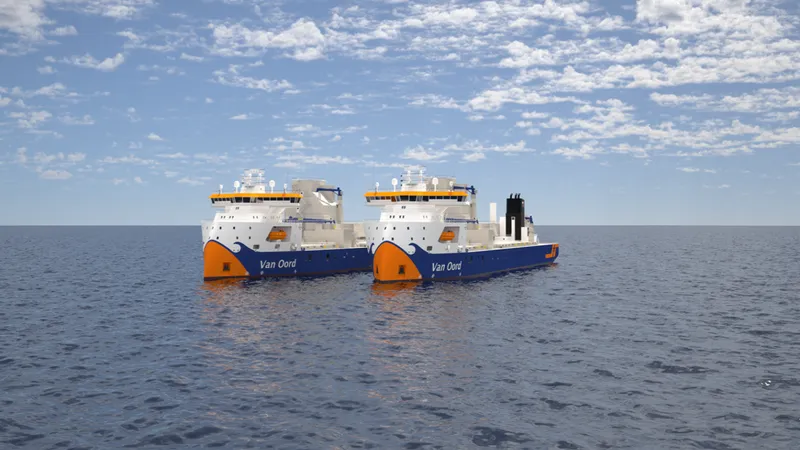
Van Oord, a global leader in subsea rock installation (SRI), has announced a major fleet expansion with the order of two next-generation SRI vessels. This strategic investment responds to rising global demand for offshore energy infrastructure and further consolidates Van Oord’s market position. The first vessel is scheduled for delivery in 2028, with a second following within 12 months.
In brief
Van Oord has ordered a new generation of subsea rock installation vessels, with the first ship scheduled to enter service in 2028 and the second within a year of that date. The new vessels will have a carrying capacity of 35,000 tonnes and a DP-2 dynamic positioning system, with propulsion adapted to biofuels and methanol, a DC grid and battery energy storage. Construction has been entrusted to the Yantai CIMC Raffles Offshore shipyard in China. Maurits den Broeder, Managing Director Offshore Energy at Van Oord, linked the investment to the protection of critical subsea infrastructure.
Enhancing offshore seabed protection
Subsea rock installation plays a critical role in stabilising and protecting subsea assets such as cables, pipelines, and foundations for offshore wind farms. Van Oord, a pioneer in SRI since the 1970s, brings decades of experience and innovation to the field. The new vessels are designed to build on the capabilities of the company’s existing flexible fallpipe fleet, introducing a new standard for performance, sustainability, and automation.
High capacity, low environmental impact
The upcoming vessels will feature a substantial loading capacity of 35,000 tonnes and will be equipped with DP-2 dynamic positioning systems to ensure precise operations even in challenging sea conditions. Their ability to carry large volumes of rock over long distances will reduce the number of round trips required, lowering both fuel consumption and the carbon footprint per installed tonne of rock.
- Van Oord is at the forefront of the energy transition. Through innovation and long-term investment, we contribute to energy security and independence. In a time when safeguarding critical subsea infrastructure is paramount, these vessels reflect our commitment to safety, sustainability, and operational excellence, said Maurits den Broeder, managing director offshore energy, Van Oord.
Designed for a net-zero future
Sustainability is central to the design of the new vessels. They will be powered by dual-fuel engines capable of running on biofuels and methanol, supported by a DC-grid with significant battery storage. Energy-efficient hull designs and optimized rock handling systems further reduce emissions and operational costs, aligning with Van Oord’s net-zero targets.
Building on proven platforms
Van Oord currently operates three state-of-the-art SRI vessels — Stornes, Nordnes, and Bravenes. The new vessels will be an evolution of this proven platform, enhanced to meet the demands of the next generation of offshore projects. Construction will be undertaken by Yantai CIMC Raffles Offshore in China.
Source: Gazeta Morska · Compiled by: Kamil Kusier
Related articles
 Energy and offshore Equinor takes over Bałtyk 2 and 3 O&M base in Łeba. Port to serve 1.44 GW of offshore wind for 30 years
 Navy and defence Port Gdański Eksploatacja secures NATO NCAGE code. Gdańsk port company lines up for defence tenders
 Shipbuilding industry Ex-Enterprise towed to Mobile under $418.5m contract. Test case for Nimitz-class disposal begins
 Energy and offshore Energa renames Gdańsk gas plant company as foundations for 6,000-tonne turbine and boiler are laid
 Equipment and technology WB Group takes Polish drones from Tokyo to SOFEX in Jordan in a single week
 Ports and logistics PGE books Gdańsk’s T5 terminal for the long haul: Baltica 2 first, then more offshore wind farms
Comments (0)
The discussion is moderated by the editors: a comment appears after review. Your e-mail address is not published.
Nobody has commented on this article yet.