









Ustka, Łeba and Władysławowo. Three Polish fishing ports switch to servicing offshore wind
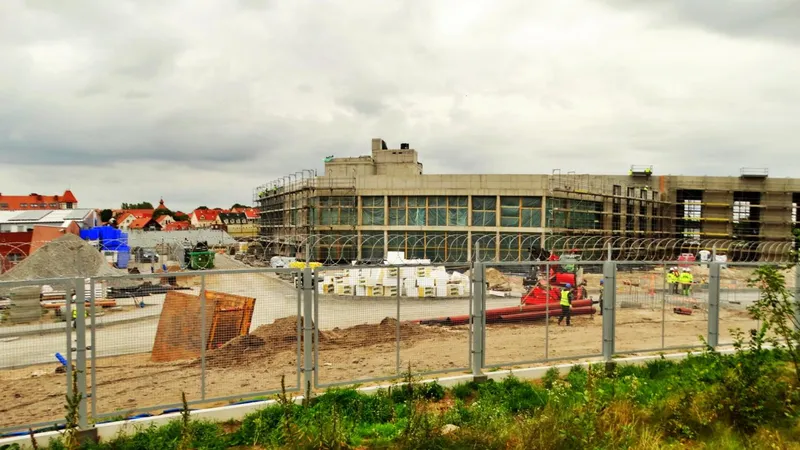
In the western part of the port of Ustka, on more than two hectares once occupied by the Korab fish processing plant, PGE Baltica is building an operations and maintenance base. The facilities are due for completion in the fourth quarter of this year, and the first wind farm served from Ustka will be Baltica 2, developed by PGE together with Denmark's Ørsted. This is not a single investment but part of a shift that within a few years is converting three Pomeranian ports to a new line of work. In Łeba a service base is already operating, in Władysławowo construction has just begun, and Ustka is the largest of the three.
In brief
PGE Baltica is building an operations and maintenance base covering more than 2.3 hectares in the port of Ustka for the Baltica 2 wind farm, due for completion in the fourth quarter of 2026. The general contractor for the Ustka base is Korporacja Budowlana Doraco, and work began on 3 June 2025. The Orlen Group base in Łeba for the Baltic Power wind farm has operated since 20 May 2025 and cost about PLN 62 million. Ocean Winds laid the foundation stone in Władysławowo on 23 September for a base serving the BC-Wind farm.
What is being built in Ustka
The base covers a site of more than 2.3 hectares. It comprises an administrative and welfare building, a warehouse, a manoeuvring yard and a quay where fast crew transfer vessels will berth, carrying technicians and spare parts to the farm. An internal car park is included, along with around 5,500 square metres of green areas around the buildings.
The investor is PGE Baltica, the main contractor is the Gdańsk-based Doraco construction group and the engineer is Sweco Polska. The final building permit was obtained in January 2025, the construction contract was signed during the PowerConnect Energy Summit in Gdańsk and work began on 3 June 2025, with completion scheduled for the fourth quarter of 2026.
The base will serve two purposes. First it will support the offshore construction phase, as crews assisting the installation will sail from Ustka. It will then move into its service role as the permanent centre for turbine maintenance.
Baltica 2 and PGE's portfolio
The Baltica 2 wind farm is being built north of Ustka with a capacity of around 1.5 GW and commissioning planned for 2027. Together with Baltica 3 it accounts for 2.5 GW in a single area.
PGE Baltica's activity is wider still. Its portfolio covers eight Baltic projects with combined capacity above 6 GW, with a plan to build at least 4 GW with partners by 2035 and to reach at least 6.5 GW offshore by 2040. The Ustka base is therefore not a single-project facility but a hub intended to serve further farms.
For the town it means a change of profile. Ustka has been associated mainly with fishing and summer holidays, and port work has been largely seasonal. Turbine maintenance has no season.
Łeba: a base already working
Poland's first offshore wind operations and maintenance base has been running in Łeba since 20 May 2025. It was built by the Orlen Group for the Baltic Power wind farm developed with Canada's Northland Power, at a cost of around 62 million zloty.
The site covers about 1.1 hectares and includes a reinforced quay with two cranes, berths for crew transfer vessels, high-bay warehouses, workshops, offices and welfare facilities for technical crews. The building also houses a Marine Coordination Centre, which supervises vessel traffic, personnel and equipment transfers and weather conditions in the wind farm area around the clock.
Around sixty technicians are to work there, with the base planned for thirty years of operation, matching the expected life of the farm. Baltic Power, of 1.2 GW, is being built some 23 kilometres offshore on 76 monopiles and is to deliver around 4,000 GWh a year.
Władysławowo: the smallest, but closest to its farm
In Władysławowo, Ocean Winds laid the cornerstone on 23 September for the base serving the BC-Wind farm. A building of around 1,200 square metres will stand at the corner of Portowa and Władysława IV streets, employing around thirty people once the farm is operational.
Distance is the deciding factor. The port lies about 37 kilometres, or roughly 20 nautical miles, from the wind farm, a passage a crew transfer vessel covers in about 70 minutes. That allows technicians to be taken out and brought back the same day. The main contractor is Przembud Gdańsk, the building was designed by Haskoning Polska, and the farm will comprise 26 turbines with a capacity of up to 390 MW.
The common factor: year-round work
Three bases, three scales and three different investors, but the mechanism is identical. A fishing or holiday port gains a function that does not depend on the season, because a turbine needs inspection and repair in November and February as much as in July.
For a town that means permanent skilled jobs, service vessel movements all year, orders for local companies and demand for services from catering to worker accommodation. For a port it means investment in quays, yards and infrastructure that remains regardless of what happens to any single project.
There is also a less discussed effect. Each of these investments pulls Polish construction and engineering firms into the supply chain, companies such as Doraco and Przembud, and in the service phase local workshops, transport operators and technical services as well.
Workforce is the bottleneck
The hardest part is not concrete or quay walls but people. Wind turbine technicians, masters and engineers for crew transfer vessels, offshore work coordinators and rope access specialists are trades Poland has not trained at scale.
The three bases are starting within a short span of each other, while shipyards running naval programmes and the nuclear plant under construction at Choczewo compete for similar qualifications. Along the same stretch of coast, between Ustka and Władysławowo, several thousand jobs requiring training, certification and sea experience will appear within a few years.
That is the real question hanging over the sector. Turbines can be bought, quays built and bases delivered on time. Training the people who will work in them for the next thirty years is considerably harder.
Source: Gazeta Morska · Compiled by: Kamil Kusier
Related articles
 Energy and offshore Equinor takes over Bałtyk 2 and 3 O&M base in Łeba. Port to serve 1.44 GW of offshore wind for 30 years
 Navy and defence Port Gdański Eksploatacja secures NATO NCAGE code. Gdańsk port company lines up for defence tenders
 Shipbuilding industry Ex-Enterprise towed to Mobile under $418.5m contract. Test case for Nimitz-class disposal begins
 Energy and offshore Energa renames Gdańsk gas plant company as foundations for 6,000-tonne turbine and boiler are laid
 Equipment and technology WB Group takes Polish drones from Tokyo to SOFEX in Jordan in a single week
 Ports and logistics PGE books Gdańsk’s T5 terminal for the long haul: Baltica 2 first, then more offshore wind farms
Comments (0)
The discussion is moderated by the editors: a comment appears after review. Your e-mail address is not published.
Nobody has commented on this article yet.