









Ukraine maintains a safe maritime corridor amid ongoing war
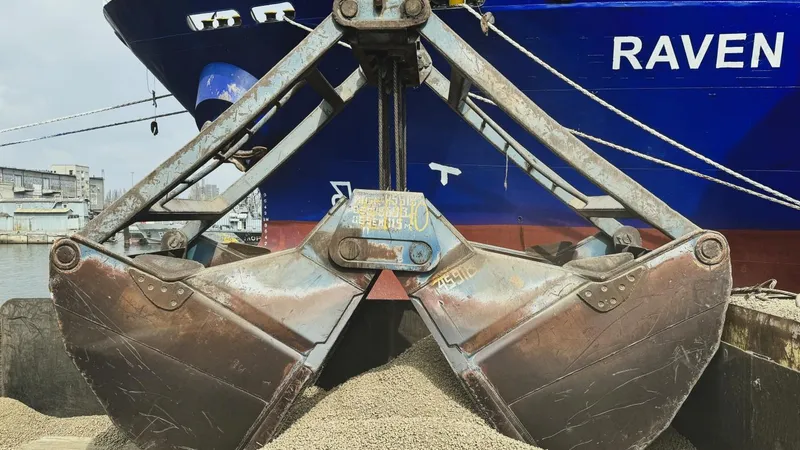
Despite ongoing hostilities and security risks in the Black Sea, Ukraine continues to ensure the uninterrupted maritime export of agricultural commodities, reinforcing its role as a key pillar of global food security. The Ukrainian maritime corridor has emerged as a vital shipping route for grain exports.
In brief
Ukraine is maintaining maritime grain exports through the Ukrainian Sea Corridor, launched after Russia withdrew from the agreement in July 2023. Since August 2023, more than 100 million tonnes of grain and agricultural cargo have been shipped through the corridor from the ports of Odesa. The earlier Black Sea Grain Initiative, signed on 22 July 2022 in Istanbul, allowed 1,004 ships to carry 32.8 million tonnes of agricultural products to 45 countries. Maritime exports account for more than 90% of Ukrainian agricultural exports.
Ukraine’s strategic role in global food supply
Historically known as the “breadbasket of Europe,” Ukraine has become one of the world’s leading grain exporters. In 2021, prior to Russia’s full-scale invasion, Ukrainian agricultural production was sufficient to feed approximately 400 million people worldwide, excluding its domestic consumption.
In a peacetime scenario, Ukraine could have supplied food for up to one billion people by 2030, positioning itself as a cornerstone of global food security.
Port blockade and maritime security risks
Following Russia’s invasion on 24 February 2022, Ukrainian seaports were effectively blocked. Dozens of foreign merchant vessels and hundreds of crew members were stranded, while commercial navigation in the Black Sea faced unprecedented military risks.
With over 90% of Ukraine’s agricultural exports traditionally transported by sea, the blockade severely disrupted global grain supply chains.
The Black Sea Grain Initiative
On 22 July 2022, Ukraine, the United Nations, and Türkiye signed the Black Sea Grain Initiative in Istanbul.
Between August 2022 and July 2023, 1,004 vessels exported 32.8 million tonnes of agricultural products from the ports of Odesa, Chornomorsk, and Pivdennyi to 45 countries, helping stabilize global food prices.
Ukrainian maritime corridor – a national solution
After Russia’s unilateral withdrawal from the agreement in July 2023, Ukraine established its own Ukrainian maritime corridor, enabling civilian vessels to safely access the ports of Greater Odesa.
Since its launch in August 2023, more than 100 million tonnes of grain have been exported via this corridor.
Implications for the maritime industry
Despite continued attacks on port infrastructure, Ukraine has demonstrated remarkable operational resilience. For shipowners, charterers, and port operators, the Ukrainian maritime corridor represents a stable bulk cargo flow in the Black Sea region and continued access to key export markets in Africa and Asia.
Source: Gazeta Morska · Compiled by: Oskar Wojciechowski
Related articles
 Energy and offshore Equinor takes over Bałtyk 2 and 3 O&M base in Łeba. Port to serve 1.44 GW of offshore wind for 30 years
 Navy and defence Port Gdański Eksploatacja secures NATO NCAGE code. Gdańsk port company lines up for defence tenders
 Shipbuilding industry Ex-Enterprise towed to Mobile under $418.5m contract. Test case for Nimitz-class disposal begins
 Energy and offshore Energa renames Gdańsk gas plant company as foundations for 6,000-tonne turbine and boiler are laid
 Equipment and technology WB Group takes Polish drones from Tokyo to SOFEX in Jordan in a single week
 Ports and logistics PGE books Gdańsk’s T5 terminal for the long haul: Baltica 2 first, then more offshore wind farms
Comments (0)
The discussion is moderated by the editors: a comment appears after review. Your e-mail address is not published.
Nobody has commented on this article yet.