









Two navies, two rescue ships: what Spain's Poseidón says about the Baltic timetable
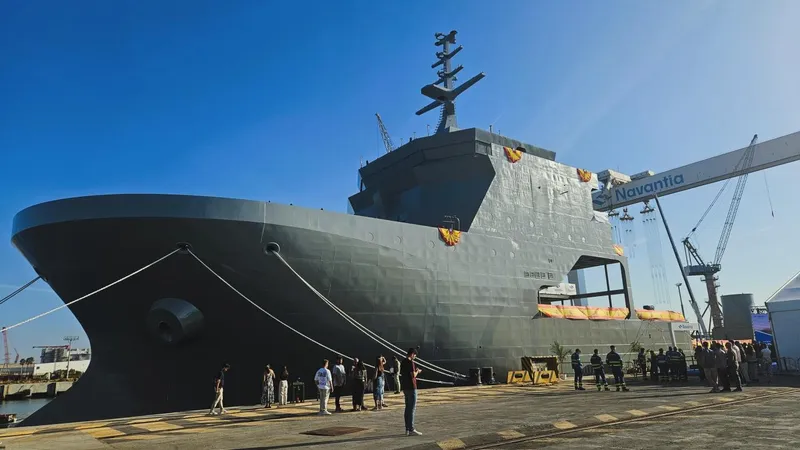
Every navy that buys submarines eventually has to answer a separate question: who pulls the crew out if something goes wrong. Spain answered it on 18 September, when Navantia held the naming ceremony for A-21 Poseidón at its Puerto Real yard near Cádiz, days after the vessel was floated out. Poland is answering the same question in Gdynia, where the rescue ship Ratownik is under construction at PGZ Stocznia Wojenna, with delivery scheduled for the fourth quarter of 2029.
In brief
Navantia christened the rescue ship A-21 Poseidón, built for the Spanish Armada since 2021, at Puerto Real near Cádiz on 18 September. Poseidón is to run remotely operated vehicle inspections down to 3,000 metres and is the first Armada ship MOSHIP-certified for the NSRS and the US Submarine Rescue Diving and Recompression System. Poland's Ratownik rescue ship, being built in Gdynia under a 27 December 2024 contract worth PLN 1.257 billion gross, is due to join the Polish Navy in the fourth quarter of 2029. Ratownik is to be certified to 300 metres and will replace ORP Lech and ORP Piast.
The two programmes were launched for the same reason and around the same class of requirement. Both are tied directly to a new submarine fleet, both replace vessels that have been in service for decades, and both are sized at roughly 6,000 to 7,000 tonnes. What separates them is the water they will work in and the point each navy has reached on its timetable.
What Spain is putting in the water
The Underwater Intervention Maritime Action Vessel, BAM-IS in the Spanish abbreviation, succeeds the rescue and salvage vessel Neptuno and becomes the Spanish Navy's primary platform for underwater operations. The programme responds to the operational requirements of the S-80 submarine fleet, providing dedicated support and rescue capability for submarine crews across their service life.
Navantia states that the vessel will be able to deploy a submarine rescue vehicle and to conduct inspection and intervention work with remotely operated vehicles at depths of up to 3,000 metres. The mission list runs wider than rescue and covers mixed-gas diving at depth, underwater repair, recovery of submerged objects, search and identification, hyperbaric treatment of diving accidents, protection of submerged archaeological heritage and support to the training and certification of the Military Diving School. Construction began in 2021.
The ship was sponsored by María Dolores Higueras Rodríguez, Spain's first underwater archaeologist, a choice that matches one of the less conventional entries on that list.
The certification that matters to allies
The most significant element of the programme for other navies is the MOSHIP certification. A-21 Poseidón is the first ship in the Spanish Navy able to act as mother ship for both the NATO Submarine Rescue System, known as NSRS, and the United States Navy's Submarine Rescue Diving and Recompression System. Allied rescue equipment can therefore be embarked and operated from her under a defined and rehearsed procedure rather than improvised on the day.
Admiral Antonio Piñeiro, Chief of Staff of the Spanish Navy, described the programme as a clear demonstration of commitment to national technological development and said that cooperation between the navy and Spanish industry constitutes a strategic capability in its own right.
The ceremony in Puerto Real drew the full chain of Spanish defence procurement, including Admiral Aniceto Rosique, Director General of Armament and Material, Belén Gualda, President of the state holding company SEPI, Aurora Salvador, Mayor of Puerto Real, and from the shipbuilder Ricardo Domínguez, Chairman of Navantia, and Alberto Cervantes, Director of the Corvettes and Maritime Action Vessels business line.
Ricardo Domínguez placed the ship within Spain's longer-term fleet planning.
He said that Poseidón possesses capabilities that make her truly unique, that she results from close collaboration between Navantia, the Ministry of Defence and the Spanish Navy, and that the vessel reflects a commitment to the Navy 2050 Plan and to strengthening European defence and strategic autonomy.
The Polish programme, and the Baltic numbers
Poland signed the executive contract for Ratownik on 27 December 2024, with a value of PLN 1.257 billion gross. The work is being carried out by a consortium of Polska Grupa Zbrojeniowa, PGZ Stocznia Wojenna and the Research and Development Centre for Maritime Technology, to a design by the Gdynia office MMC Ship Design & Marine Consulting. Steel cutting took place on 26 November 2025 and the keel was laid on 4 February 2026, with launch planned for 2027.
The vessel measures roughly 96 metres in length and 19 metres in beam, with a full displacement of about 6,500 tonnes, a range of 6,000 nautical miles and a crew of 100 plus berths for nine additional specialists. She will join the Support Ships Squadron of the 3rd Ship Flotilla at the naval port in Gdynia and replace ORP Lech and ORP Piast, both commissioned in 1973 and 1974.
Ratownik is being certified to 300 metres rather than 3,000, and the difference reflects the operating area rather than ambition. The Baltic averages around 55 metres in depth and the deepest points in the Polish zone stay under roughly 120 metres, so saturation diving capacity matters more there than deep ROV reach. Nine divers will be able to work in three shifts for 14 days at depths down to 300 metres, with the diving bell lowered through a moonpool inside the hull rather than over the side.
How the Polish ship plugs into NSRS
NSRS is a transportable system maintained by JFD, part of James Fisher and Sons, on behalf of the British, French and Norwegian navies. The complete system fits on 23 road loads, weighs around 300 tonnes and is designed so that a rescue operation can begin within 72 hours of a call, with crew evacuation possible from depths far beyond anything the Baltic presents.
The Polish approach is to use the ship's own hyperbaric complex during a rescue, which limits the NSRS mobilisation mainly to the rescue vehicle and the necessary support modules. That shortens the time to first evacuation, because the full decompression set does not have to be moved and rigged. JFD is supplying the submarine rescue and saturation diving system for the Polish vessel, and the Polish Navy is expected to join the group of navies operating within NSRS in the coming years.
Where the timetables meet
Poland signed its submarine package on 29 June 2026 in Gdynia, in the presence of the Polish and Swedish prime ministers, covering three A26 submarines and an interim capability. The Ministry of National Defence had selected the Swedish offer on 26 November 2025.
That sequence puts the rescue ship ahead of the submarines, which is the order any navy would prefer. Spain is closing the same gap from the other direction, with its S-80 boats already in service and the dedicated rescue platform arriving now, five years into construction. For operators around the Baltic the practical conclusion is narrower and more immediate: from the end of the decade there will be a certified rescue mother ship based in Gdynia, within the same sea area as the critical underwater infrastructure that has been the subject of repeated incidents over the past two years.
Source: Gazeta Morska · Compiled by: Kamil Kusier
Related articles
 Energy and offshore Equinor takes over Bałtyk 2 and 3 O&M base in Łeba. Port to serve 1.44 GW of offshore wind for 30 years
 Navy and defence Port Gdański Eksploatacja secures NATO NCAGE code. Gdańsk port company lines up for defence tenders
 Shipbuilding industry Ex-Enterprise towed to Mobile under $418.5m contract. Test case for Nimitz-class disposal begins
 Energy and offshore Energa renames Gdańsk gas plant company as foundations for 6,000-tonne turbine and boiler are laid
 Equipment and technology WB Group takes Polish drones from Tokyo to SOFEX in Jordan in a single week
 Ports and logistics PGE books Gdańsk’s T5 terminal for the long haul: Baltica 2 first, then more offshore wind farms
Comments (0)
The discussion is moderated by the editors: a comment appears after review. Your e-mail address is not published.
Nobody has commented on this article yet.