









Turkey uncovers major gas discovery in the Black Sea, boosting energy ambitions
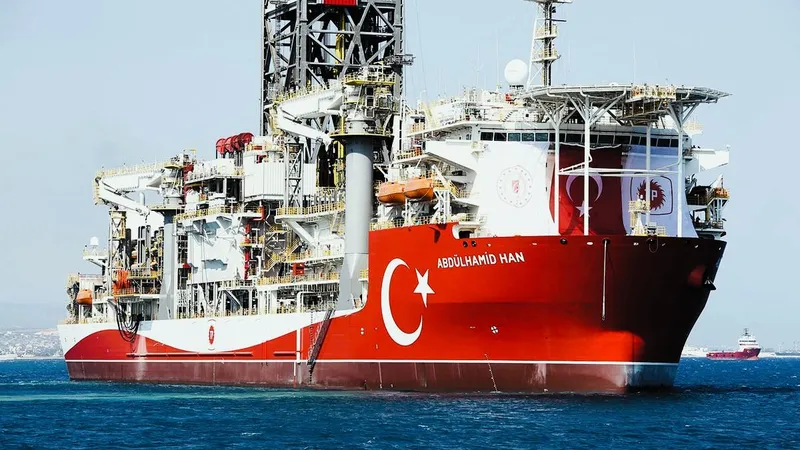
In a significant development for the Eastern Mediterranean energy landscape, Turkey has announced a new offshore natural gas discovery in the Black Sea. The latest find, located at the Goktepe-3 well at a depth of 3,500 meters, is estimated at 75 billion cubic meters (bcm). According to President Recep Tayyip Erdoğan, this volume could meet the energy needs of Turkish households for approximately 3.5 years, with a market value exceeding USD 30 billion.
In brief
Turkey announced in May 2025 the discovery of a natural gas field at the Goktepe-3 well in the Black Sea, at a depth of 3,500 metres, estimated at 75 billion cubic metres. President Recep Tayyip Erdogan said the gas could cover the needs of Turkish households for about 3.5 years and that its market value exceeds 30 billion dollars. The Sakarya field currently produces about 9.5 million cubic metres of gas per day, and an increase to 15 billion cubic metres a year by 2026 would cover up to 30 percent of domestic demand.
This discovery marks another milestone in Turkey’s long-term strategy to reduce its reliance on imported energy. Over the past few years, Turkish offshore operations have intensified, with earlier discoveries such as the Sakarya field (initially 405 bcm, later revised to 652 bcm) and Çaycuma-1 (58 bcm) confirming the Black Sea’s growing resource potential.
Turkey is currently producing around 9.5 million cubic meters of gas per day from the Sakarya field, with plans to increase annual production to 15 bcm by 2026—enough to cover up to 30% of domestic demand, currently around 60 bcm per year.
Infrastructure and logistics remain critical
Despite the promising numbers, unlocking the full value of these reserves will require significant investment in subsea infrastructure and pipeline capacity. The Turkish Petroleum Corporation (TPAO), supported by the government, is ramping up development efforts. However, industry observers note the need for accelerated investment, potentially including international partnerships, to meet production targets on time.
Deepwater development presents its own set of challenges, from high operational costs to complex geological and hydrological conditions specific to the Black Sea basin.
Strategic and geopolitical significance
Beyond the economic benefits, Turkey’s energy discoveries are part of a broader geopolitical strategy. Ankara aims to transform the country into a regional energy hub—not only by supplying gas from its own fields but also by facilitating the transit of hydrocarbons from Central Asia and the Middle East to Europe. Domestically sourced gas is seen as a key tool to reduce dependence on Russian, Iranian, and Azerbaijani imports and to strengthen Turkey’s hand in diplomatic and economic negotiations.
Implications for the maritime and offshore sector
The expansion of Black Sea gas projects signals rising demand for offshore vessels, subsea engineering, seismic survey capabilities, and skilled maritime personnel. European—particularly Polish and Scandinavian—offshore companies may find new opportunities in Turkey’s energy drive, whether as technology providers or subcontractors for complex deepwater development.
Source: Gazeta Morska · Compiled by: Kamil Kusier
Related articles
 Energy and offshore Equinor takes over Bałtyk 2 and 3 O&M base in Łeba. Port to serve 1.44 GW of offshore wind for 30 years
 Navy and defence Port Gdański Eksploatacja secures NATO NCAGE code. Gdańsk port company lines up for defence tenders
 Shipbuilding industry Ex-Enterprise towed to Mobile under $418.5m contract. Test case for Nimitz-class disposal begins
 Energy and offshore Energa renames Gdańsk gas plant company as foundations for 6,000-tonne turbine and boiler are laid
 Equipment and technology WB Group takes Polish drones from Tokyo to SOFEX in Jordan in a single week
 Ports and logistics PGE books Gdańsk’s T5 terminal for the long haul: Baltica 2 first, then more offshore wind farms
Comments (0)
The discussion is moderated by the editors: a comment appears after review. Your e-mail address is not published.
Nobody has commented on this article yet.