









The world's largest mountains hidden underwater
Beneath the surface of the oceans, where human sight never reaches, lies something that could change our perception of the scales of nature: the mid-ocean ridge. It is the largest mountain range on Earth, almost entirely hidden beneath the water. Isn't it paradoxical that the largest mountain system on our planet still awaits full discovery?
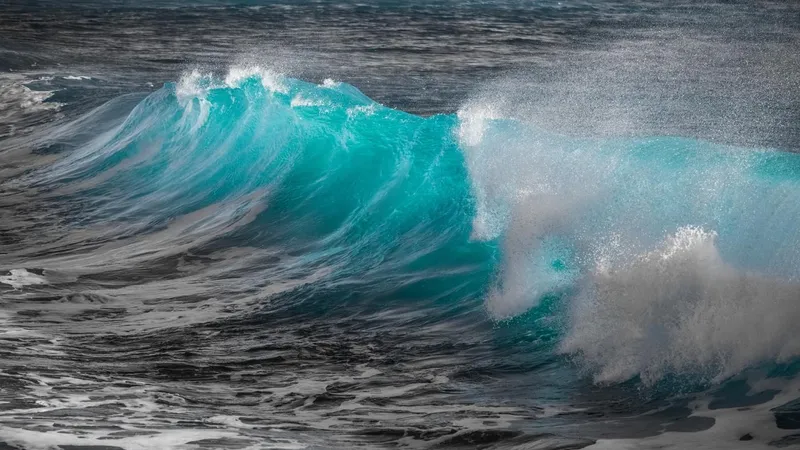
In brief
The mid-ocean ridge, around 65 thousand kilometres long, is the largest mountain range on Earth, almost entirely hidden under water. The mid-ocean ridge forms where tectonic plates spread apart, and its best-known section, the Mid-Atlantic Ridge, rises above the surface in Iceland. The highest known elevation of the ridge is the Mauna Kea volcano in Hawaii: its summit reaches 4,207 metres above sea level, and its total height from the ocean floor is around 10 thousand metres. Ecosystems independent of sunlight live beside hydrothermal vents, from which water at temperatures above 300 degrees Celsius flows out.
Earth's submarine backbone
The mid-ocean ridge is a colossal geological structure stretching approximately 65,000 kilometers. It runs through all the world's oceans, like the backbone of the planet, forming at the boundaries of tectonic plates that are drifting apart. This movement allows magma to flow from the Earth's interior, which then solidifies to create new crust—a process known as seafloor spreading.
The most well-known segment of this system is the Mid-Atlantic Ridge, which traverses the Atlantic Ocean and even rises above the surface in Iceland. Here, you can observe the process of new crust formation—a phenomenon that has been shaping our planet for millions of years.
Do we know the tallest peak?
Just like terrestrial mountain ranges, the mid-ocean ridge is home to peaks, valleys, and elevations. But do we know which of them is the tallest? The highest elevation of the ridge is Mauna Kea, a volcano in Hawaii. While its summit rises 4,207 meters above sea level, its base lies on the ocean floor, giving it a total height of about 10,000 meters, surpassing Mount Everest!
However, most underwater peaks remain undiscovered, and accurately measuring them is extremely challenging. The ocean depths remain shrouded in darkness, and technologies for their exploration are still under development. Advanced probes and robots capable of enduring long-term operations in extreme conditions are needed. Moreover, the great depths—often several kilometers—make precise exploration prohibitively expensive.
Geological might beneath the surface
Each segment of the mid-ocean ridge has its own characteristics. The East Pacific Rise, one of the most active sections, is characterized by rapid spreading, which gives it gentler slopes. In contrast, the Mid-Atlantic Ridge features steeper slopes and well-defined rift valleys.
Most fascinatingly, many parts of the ridge host hydrothermal vents, which emit water exceeding 300°C and rich in minerals. Unique ecosystems form around these vents, unlike anything else on Earth. Here, life is not dependent on sunlight but on chemical energy—processes such as the oxidation of hydrogen sulfide. This discovery has revolutionized our understanding of life and its limits.
Hidden islands of giants
Some underwater peaks of the ridge are high enough to rise above the ocean's surface, forming islands. The best example is Iceland, which is part of the Mid-Atlantic Ridge. Other sections, though equally impressive, remain entirely hidden.
While sonar surveys and ocean floor mapping are creating increasingly detailed images of these mountains, we are still at the beginning of this journey. So far, only a small percentage of the ocean floor has been mapped, and fully understanding the structure and dynamics of the ridge will require decades of research.
Life and mysteries in the depths
The mid-ocean ridge plays a crucial role not only in geology but also in biology and Earth's climate. The formation of new crust affects the heat circulation in oceans and, by extension, the global climate. Moreover, scientists explore these extreme deep-sea conditions to seek answers about the origins of life on Earth and the potential existence of life on other planets.
Earth's greatest unknown giant
Imagine a world without water. In such a world, the mid-ocean ridge would become the Earth's most spectacular geological attraction—a massive mountain range visible from space. Thanks to advances in science and technology, more and more secrets of these underwater mountains are coming to light.
The mid-ocean ridge proves that our planet still harbors countless mysteries. It is the largest mountain system on Earth—hidden, yet no less fascinating than the Himalayas or the Andes. Exploring it is not just a journey into the depths of the ocean but also into the depths of our understanding of the world. Perhaps beneath the water lie answers to humanity's greatest questions.
Source: Gazeta Morska
Related articles
 Sailing and water sports GB1's America's Cup AC75 reaches Naples, swapping cyclors for batteries
 Safety and rescue From lightships to solar power: 160 years of the Grundkallen light station
 Shipbuilding industry Lionel Messi orders a Sunreef catamaran. The Ultima 88 is being built at the Gdańsk firm’s UAE yard
 Investments A Szczecin firm is to design the world's tallest Christ statue. A 207-metre core in 40 days
 Sailing and water sports A century-old Inga Lisa and Czarny Diament after 32 years at sea. Over 30 classic yachts in Gdynia
 Sailing and water sports Eleven years of trying and metres at the finish. Witold Karałow's Scamp 4 wins the 75th Blue Ribbon
Comments (0)
The discussion is moderated by the editors: a comment appears after review. Your e-mail address is not published.
Nobody has commented on this article yet.