









The whole first section of the road to Poland's nuclear plant is under construction
The Pomeranian Voivode issued on 14 September the road investment permit for the remaining part of the national road between Lubiatowo and provincial road 213. With work on the so-called last mile already under way since April, the entire first section of the route to the Lubiatowo-Kopalino nuclear power plant is now in construction.
In brief
The ZRID permit issued on 14 September by the Pomeranian voivode means the entire 11.2 kilometre national road section from Lubiatowo to DW213 is under construction. The section is being built by a consortium of Polimex Infrastruktura, Polimex Mostostal and Mosty Łódź for more than PLN 177 million, with completion due in the second quarter of 2028. The whole road to the Lubiatowo-Kopalino nuclear power plant is 26 kilometres long. The five-kilometre last mile, under construction since April, is more than nine percent complete.
It is the most tangible element of the whole nuclear project. The reactors will start in the next decade, but the road is being built now and will reshape traffic across the north-western part of Wejherowo district.
The last mile, past nine per cent complete
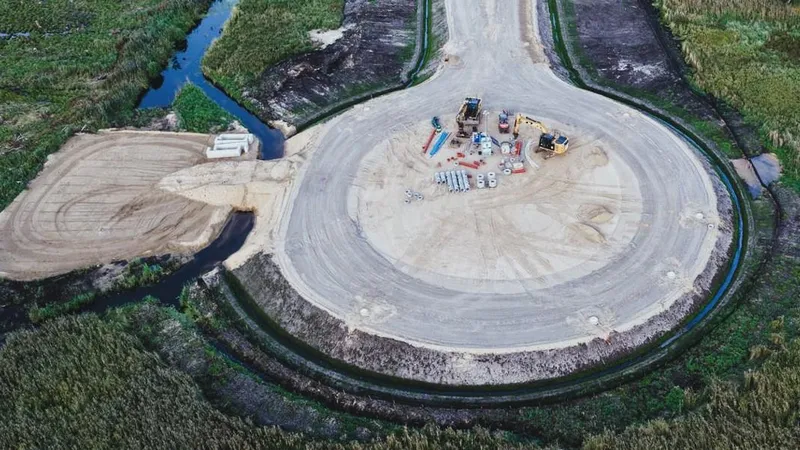
A five-kilometre stretch will connect the power plant site, through a fire access road, with the existing public road network. Work started in April and has passed nine per cent completion.
The scope shows what ground the contractors are dealing with. Earthworks and drainage are under way, along with replacement of weak soils and ground improvement using displacement columns and piles. Embankments, cuttings and ditches are being formed, and the frost protection layer and improved subgrade prepared. Pier foundations have been completed on the bridge near the Biebrowski Canal, and one amphibian crossing is finished. This stretch is due for completion in the second quarter of 2027.
Two sections, 26 kilometres, close to 380 million zloty
The national road to the plant runs 26 kilometres and has been split into two construction sections.
The first, 11.2 kilometres long, runs from Lubiatowo to provincial road 213. It is being delivered under a design and build contract by a consortium of Polimex Infrastruktura, Polimex Mostostal and Mosty Łódź, worth more than 177 million zloty. With the permit now issued, the contractor is preparing to move onto the remaining six kilometres. Completion of the whole section is planned for the second quarter of 2028.
The second section, 15 kilometres, will run from provincial road 213 to the Łęczyce interchange on the S6 expressway. It is being built by a consortium of Aldesa Construcciones Polska and Aldesa Construcciones under a contract worth close to 200 million zloty. Its permit is expected at the turn of the third and fourth quarters of this year, with completion in the fourth quarter of 2028.
The route follows a new alignment, single carriageway with two lanes, in the class of a main fast traffic road. The pavement will take vehicles with an axle load of 11.5 tonnes. As part of the S6 works between Leśnice and Bożepole Wielkie, a link will also be built between the district road at Łęczyce and the expressway.
Why the plant needs its own national road
Building a nuclear facility means years of traffic that local roads could not absorb, either in capacity or in axle loads. It covers construction materials, concrete and steel structures, as well as access for several thousand workers at peak construction.
Oversized components for the plant itself, arriving by sea, are a separate matter. The access route has to allow them to be moved from the point of unloading to the site, which requires suitable curve radii, bridge capacity and clearances free of restrictions.
The investment is included in a multi-year government programme supporting infrastructure for key energy projects in Pomerania.
What remains after construction
The road matters beyond the construction site. It will add capacity, relieve the local road network and shorten journeys between the Tricity and the seaside villages of the Choczewo municipality.
In summer it will offer an alternative to congested routes to the Baltic coast, and for residents it means less heavy traffic through built-up areas, with lower noise and vibration. In practice the region gains a new road to the sea, built alongside an energy investment.
Two calendars worth comparing
The road is due in the second quarter of 2028 on the first section and the fourth quarter of 2028 on the second. The power plant is to deliver first power to the grid in 2036, with main construction starting once the nuclear regulator's licence and the building permit are in place.
The road preparations therefore run ahead of the plant itself, which is the correct order. What remains open is the logistics of seaborne deliveries and where oversized components will be unloaded, because that will decide how much of the flow passes through Polish ports.
Source: Gazeta Morska · Compiled by: Kamil Kusier
Related articles
 Energy and offshore Equinor takes over Bałtyk 2 and 3 O&M base in Łeba. Port to serve 1.44 GW of offshore wind for 30 years
 Navy and defence Port Gdański Eksploatacja secures NATO NCAGE code. Gdańsk port company lines up for defence tenders
 Shipbuilding industry Ex-Enterprise towed to Mobile under $418.5m contract. Test case for Nimitz-class disposal begins
 Energy and offshore Energa renames Gdańsk gas plant company as foundations for 6,000-tonne turbine and boiler are laid
 Equipment and technology WB Group takes Polish drones from Tokyo to SOFEX in Jordan in a single week
 Ports and logistics PGE books Gdańsk’s T5 terminal for the long haul: Baltica 2 first, then more offshore wind farms
Comments (0)
The discussion is moderated by the editors: a comment appears after review. Your e-mail address is not published.
Nobody has commented on this article yet.