









The same hull, sixteen suites fewer. Construction of Four Seasons II begins in Ancona
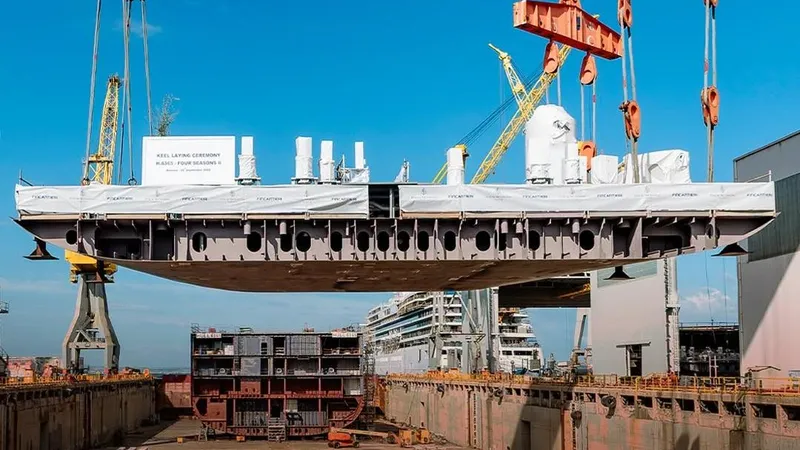
The keel was laid this week at Fincantieri's Ancona shipyard for Four Seasons II, the second ultra-luxury ship being built for the Four Seasons Yachts brand. The vessel will measure 34,000 gross tons and 207 metres in length, exactly the same as the first ship of the series. The difference is inside: 79 suites instead of 95.
In brief
Fincantieri laid the keel of Four Seasons II, the second ultra-luxury ship for the Four Seasons Yachts brand, at its shipyard in Ancona. Four Seasons II will measure 34 thousand GT and 207 metres in length, with 79 suites instead of the 95 on the first ship of the series. Delivery of Four Seasons II is scheduled for 2027 and the first cruises for 2028, at a value exceeding 400 million euros. Fincantieri handed the Four Seasons I over to its owner on 25 February.
In the same hull the owner is giving up sixteen suites, reducing the number of guests to increase the space available to each one. In a segment where the price per berth runs into thousands of euros a night, that is a commercial decision rather than cosmetics.
A coin welded to the bottom of the hull
The ceremony, impostazione in Italian, marks the formal start of construction in the dock. It was attended in Ancona by the yard's director Gilberto Tobaldi and the CEO of Four Seasons Yachts, Ben Trodd. Following tradition, a specially selected coin was welded to the bottom of the hull to bring the ship good fortune. At the keel laying of the first ship of the series, two years earlier at the same yard, there were three coins.
Four Seasons II is being built as an all-suite ship, with extensive outdoor terraces and the latest environmental protection technologies.
The first ship is already sailing
Fincantieri delivered Four Seasons I to the owner on 25 February this year. The ship measures 35,040 gross tons and 207 metres, with 95 suites and capacity for 222 guests. It carries eleven dining venues, a full spa, a transverse marina and a stern pool around twenty metres long, one of the largest at sea. Its signature accommodation, the Funnel Suite, covers 457 square metres.
More than two thousand people worked on outfitting the vessel in the weeks before handover. The owner claims the ship offers 50 per cent more living space per guest than anything previously available on the market.
A programme worth more than a billion dollars
The order was placed in July 2022, with the programme valued at the time at around 1.25 billion dollars and options for two further vessels. Fincantieri put the value of the first ship alone at more than 400 million euros.
The option for the second ship was firmed up in May 2025 once financing was secured, again at more than 400 million euros. Delivery is scheduled for 2027 and inaugural sailings for 2028. A third vessel is expected around 2030.
The project is led by Marc-Henry Cruise Holdings together with the investor Fort Partners, with the Four Seasons brand licensed. That is the standard model in this segment: the hotel brand supplies the name and service standard, while a specialised owner and operator carries the investment risk.
Why Europe builds these ships
The market for cruise ships looks nothing like the market for container ships or bulkers, where Asian yards dominate. Large cruise vessels and luxury ships are built above all in Europe, at Fincantieri in Italy, Meyer Werft in Germany and Chantiers de l'Atlantique in France.
The reason is straightforward. A ship like this is not a hull but hundreds of kilometres of installations, interiors designed by architectural studios, exhaust gas cleaning systems, pool hydraulics, a marina in the stern and the integration of all of it into a single structure. Value is created in design, outfitting and coordination, not in cutting steel.
The same relationship shows up in shipyard accounts. Ulstein, the Norwegian company that sells its own ship designs and fleet service, closed 2025 with an operating margin above 7 per cent. Damen, delivering 160 vessels a year, earned just under 2 per cent net. Meyer Werft, the best known brand in cruise shipbuilding, is still working off losses from years of contracts signed below cost.
What it means for Polish yards
Polish yards are present in this chain, but at its beginning. Hulls and sections built in Poland are completed in Norway, Germany and the Netherlands, and the margin stays where the design and outfitting happen.
The ultra-luxury segment shows exactly where the difference lies. Four Seasons II will carry fewer cabins in the same hull than its predecessor because the customer pays for space, not tonnage. A yard that can design and outfit such a product is selling something entirely different from a yard that can only weld it together.
That is why Ancona deserves closer attention than the ceremony itself. What is at stake is a market Europe still wins against Asia, and in which competitors from Italy, Germany and France hold the best positions.
Source: Gazeta Morska · Compiled by: Kamil Kusier
Related articles
 Energy and offshore Equinor takes over Bałtyk 2 and 3 O&M base in Łeba. Port to serve 1.44 GW of offshore wind for 30 years
 Navy and defence Port Gdański Eksploatacja secures NATO NCAGE code. Gdańsk port company lines up for defence tenders
 Shipbuilding industry Ex-Enterprise towed to Mobile under $418.5m contract. Test case for Nimitz-class disposal begins
 Energy and offshore Energa renames Gdańsk gas plant company as foundations for 6,000-tonne turbine and boiler are laid
 Equipment and technology WB Group takes Polish drones from Tokyo to SOFEX in Jordan in a single week
 Ports and logistics PGE books Gdańsk’s T5 terminal for the long haul: Baltica 2 first, then more offshore wind farms
Comments (0)
The discussion is moderated by the editors: a comment appears after review. Your e-mail address is not published.
Nobody has commented on this article yet.