









The Niederfinow ship lift. German investment, Polish opportunity
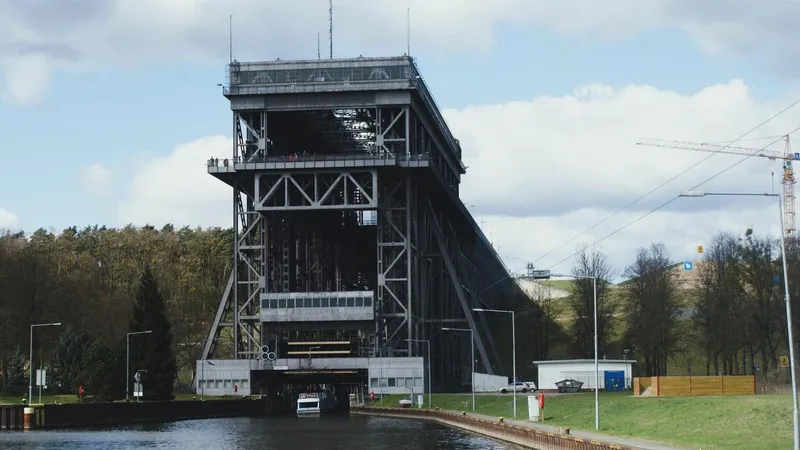
The construction of the new ship lift in Niederfinow, on the Oder–Havel Canal, became a showcase of both ambition and challenge in inland waterway infrastructure. Initially planned to be completed in 2014 with a budget of €285 million, the project eventually consumed more than €520 million and was inaugurated only in October 2022.
In brief
The new ship lift at Niederfinow on the Oder-Havel Canal cost more than 520 million euros against a planned 285 million euros and was commissioned in October 2022 instead of 2014. The Niederfinow ship lift handles vessels more than 110 metres long, linking Szczecin and the Oder with Berlin and the Rhine. The ports of Szczecin and Police gain more efficient transport of fertilisers, aggregates, steel and chemicals to Germany, the Netherlands and Belgium. Inland shipping in Poland accounts for less than 1 percent of freight transport, compared with well over ten percent in Germany.
Despite the delays and doubled costs, the lift plays a decisive role in Europe’s inland transport network, linking Szczecin and the Oder with Berlin and further with the Rhine corridor. For Poland, this is not just a German success story—it is a window of opportunity.
A strategic link for Polish ports and operators
The new lift accommodates vessels over 110 meters long, removing a long-standing bottleneck on the Oder–Havel Canal. This means cargo from the ports of Szczecin and Police can move more efficiently into Germany, and onward to the Netherlands and Belgium.
For Polish shipping companies and freight operators, this translates into access to larger convoys, modern pushed barge systems, and cheaper, more reliable cargo transport. Key commodities include fertilizers, aggregates, steel, and chemicals, but there is also added value for passenger shipping and water tourism—an area where Polish tour operators are increasingly active.
Poland must invest in the Oder and inland waterways
Germany’s investment directly benefits Poland only if the Polish side develops its own infrastructure in parallel. The Oder still requires modernization to meet European inland navigation standards. Without this, Szczecin’s role as a gateway to the West will remain underutilized.
Inland navigation accounts for less than 1% of transport in Poland, compared with over 10% in Germany. Investments are needed in locks, barrages, dredging, and navigational upgrades, while in the long run, Poland must also consider ambitious solutions of its own. The lesson from Niederfinow is clear: large-scale waterway projects are expensive, but they unlock strategic trade flows and long-term competitiveness.
Lessons for Poland
The Niederfinow ship lift demonstrates that inland waterways can be modern, strategic, and profitable—even when projects exceed original budgets. For Poland, the message is unambiguous: do not limit yourself to watching German infrastructure from the sidelines. Instead, invest in the Oder, strengthen inland connectivity, and actively use these transport corridors to penetrate European trade flows.
The faster Poland acts, the more it stands to gain—for its ports, for logistics operators, and for the broader maritime economy.
Source: Gazeta Morska · Compiled by: Michał Iwański
Related articles
 Energy and offshore Equinor takes over Bałtyk 2 and 3 O&M base in Łeba. Port to serve 1.44 GW of offshore wind for 30 years
 Navy and defence Port Gdański Eksploatacja secures NATO NCAGE code. Gdańsk port company lines up for defence tenders
 Shipbuilding industry Ex-Enterprise towed to Mobile under $418.5m contract. Test case for Nimitz-class disposal begins
 Energy and offshore Energa renames Gdańsk gas plant company as foundations for 6,000-tonne turbine and boiler are laid
 Equipment and technology WB Group takes Polish drones from Tokyo to SOFEX in Jordan in a single week
 Ports and logistics PGE books Gdańsk’s T5 terminal for the long haul: Baltica 2 first, then more offshore wind farms
Comments (0)
The discussion is moderated by the editors: a comment appears after review. Your e-mail address is not published.
Nobody has commented on this article yet.