The capture of President Nicolás Maduro: how U.S. maritime operations triggered a geopolitical turning point
Over the past months, the Caribbean Sea and the northern coast of South America have quietly transformed into a theater of escalating confrontation. The United States steadily expanded its maritime presence off the coast of Venezuela, intercepted and inspected vessels suspected of smuggling, conducted operations against drug cartels, and deployed a fully protected aircraft carrier strike group to the region. Against this backdrop, Washington’s declared capture of Venezuelan President Nicolás Maduro was not a sudden escalation, but the culmination of a long-term strategy unfolding at sea, in the air, and across the political domain. What began as counter-narcotics and “protective” maritime operations ultimately crossed into overt power politics.
security aviation navy worldwide politics news03 january 2026 | 12:01 | Source: Gazeta Morska | Prepared by: Kamil Kusier | Print
fot. U.S. Navy
The sea as an instrument of strategic pressure
From a maritime security perspective, U.S. actions toward Venezuela followed a deliberate and phased pattern. Initial steps included intensified patrols along key Caribbean shipping lanes, followed by inspections and temporary detentions of commercial vessels suspected of involvement in narcotics trafficking, fuel smuggling, or illicit trade. Over time, these measures evolved into a sustained forward naval presence.
Officially framed as law-enforcement and counter-drug operations, the practical effect was the progressive restriction of Venezuela’s maritime freedom of movement. For a country whose economy relies heavily on seaborne exports—particularly energy—any disruption at sea carries immediate strategic consequences. Port operations, offshore terminals, insurance rates, and charter availability were all affected.
In this sense, the maritime domain functioned as a de facto sanctions tool, operating faster and with greater flexibility than formal economic measures.
USS Gerald R. Ford as the strategic axis of escalation
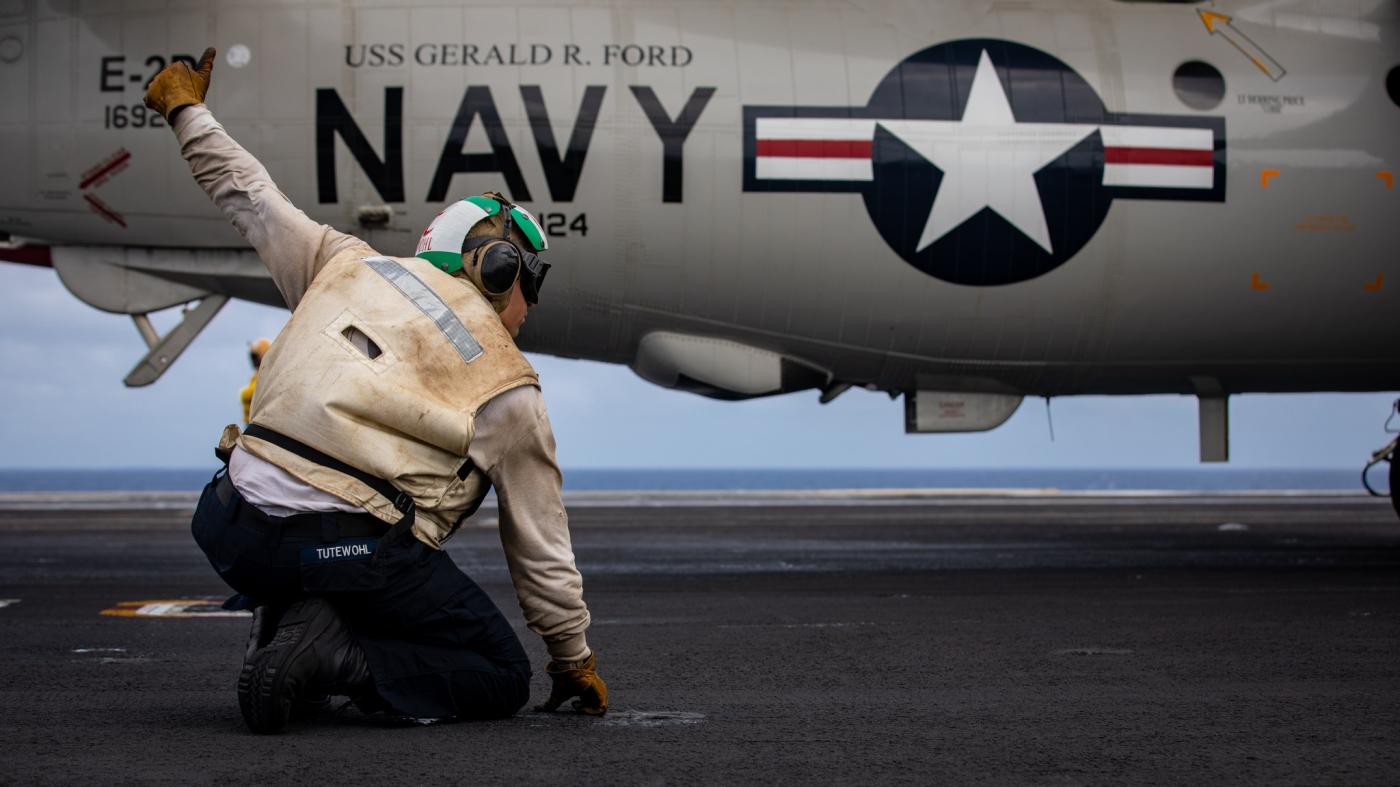
The centerpiece of this maritime escalation was the deployment of the nuclear-powered aircraft carrier USS Gerald R. Ford (CVN-78), the most advanced carrier in the U.S. Navy, operating with its full carrier strike group in the Caribbean region. This marked the most significant concentration of U.S. naval power near Venezuela in decades.
USS Gerald R. Ford is not merely a carrier—it is a command, surveillance, and power-projection hub, capable of establishing air superiority, securing maritime and airspace control, supporting special operations, enabling precision strikes ashore, and deterring third-party intervention.
For Caracas, the message was unmistakable: the operational infrastructure for escalation was already in place.
Cartels, the state, and the erosion of traditional boundaries
A central pillar of Washington’s justification was the fight against transnational drug cartels allegedly embedded within Venezuela’s state structures. Strategically, this narrative is highly consequential. It reframes the confrontation from a political dispute into a security threat, where military instruments become legitimate tools.
From the standpoint of maritime law and global shipping, this approach is deeply unsettling. If alleged cartel connections are sufficient to justify vessel interdictions, sustained naval deployment, and ultimately an operation targeting a sitting head of state, then the boundary between organized crime and sovereign authority becomes dangerously porous.
This logic, once established, may be replicated in other regions where maritime routes intersect with weak governance and strategic trade interests.
The capture of Nicolás Maduro as a strategic climax
Washington’s declaration that President Nicolás Maduro had been captured represents a decisive rupture with established norms. It signals a shift from indirect pressure to direct personal targeting at the highest political level.
The symbolic weight of this act rivals its operational significance. A sitting head of state was no longer treated as a diplomatic counterpart or sanctioned adversary, but as an operational objective. This marks a profound evolution in the conduct of modern power projection.
Marco Rubio’s statement and the rapid closure of operations
Equally significant was the speed with which the United States announced the end of military operations. U.S. Secretary of State Marco Rubio stated that American operations concluded immediately after the capture of Nicolás Maduro, as their primary objective had been achieved.
This declaration served multiple purposes. It reassured international audiences that no prolonged intervention or occupation was planned, framed the operation as limited, targeted, and time-bound, and underscored the role of maritime dominance in enabling swift political outcomes.
For the maritime sector, the message is clear: future operations may be short in duration yet strategically decisive.
Implications for shipping and energy security
Although military operations were formally concluded, their impact on maritime risk perception will persist. The episode demonstrates how rapidly shipping environments can change, how counter-narcotics missions can escalate into geopolitical confrontation, and how naval power can reshape commercial risk without the declaration of a formal blockade.
For energy markets, Venezuela’s case reinforces the vulnerability of maritime-dependent exporters. For shipowners, insurers, and port operators, it introduces a new variable: the political volatility of security-justified naval operations.
Dr. Łukasz Wyszyński from the Naval Academy analyzes the latest geopolitical events through the lens of the strategic importance of controlling maritime and air space. In an interview with Gazeta Morska, he points out how contemporary conflicts fit into the new U.S. doctrine of short and decisive interventions and what political consequences they carry for the international order.
- The attack can also be examined from two perspectives. First, despite discussions about weakening U.S. guarantees for allies in various parts of the world, the situation around Venezuela has shown that no other guarantees (e.g., Chinese or Russian) are effective if the adversary has the capability to control maritime and air space and deliver kinetic strikes without engaging ground forces. Second, the attack fits into the doctrine outlined in the new U.S. National Security Strategy of short and decisive interventions, for which the network of bases and the capabilities of the U.S. Navy and U.S. Air Force will be crucial. A separate issue is the political assessment. Here, the attack represents a breach of the international order based on neoliberal institutionalism and deepens the state of decomposition of the international system.
The maritime domain as an early warning of conflict
The Venezuelan case offers a clear lesson: modern conflicts increasingly begin at sea. Control of sea lanes, carrier deployments, and maritime security operations create the conditions under which political decisions can be executed rapidly and decisively.
The capture of Nicolás Maduro is therefore not merely a political event. It is a case study in contemporary maritime strategy. The sea is no longer a neutral backdrop of globalization. It has become the frontline of a new geopolitical era.
According to experts, the recent U.S. actions toward Venezuela should be analyzed not only in terms of a military operation but also through the lens of political and geopolitical strategy. The intervention in the Caribbean region demonstrates how the United States combines military measures with economic and political pressure tools.
- It is worth examining the U.S. intervention in Venezuela in the context of the recently published new U.S. National Security Strategy. Strategically, it signals that Americans regard the Western Hemisphere as an exclusive sphere of influence, and the actions in Venezuela effectively confirm this in practice. Additionally, the statement by Secretary of State Marco Rubio that the operation ended with the capture of Venezuelan President Nicolás Maduro aligns with the Strategy’s emphasis on conducting limited, relatively short, and goal-oriented conflicts. The very capture of Maduro also represents another step in the U.S. moving away from liberal institutionalism and the idea of America as a defender of the “law-based order.” In fact, the U.S. carried out this operation outside of any international law, not to mention UN sanctions. This case will almost certainly be used in the future to criticize the U.S. and portray it as a “predatory power” on par with others. What remains open, however, is what will happen next. Have the U.S. ensured how Venezuela’s political future will be shaped after Maduro? We will likely find out soon. Undoubtedly, the destabilization of Venezuela serves U.S. interests, says Dr. Paweł Kusiak from the Polish Naval Academy in Gdynia.
see also
Buy us a coffee, and we’ll invest in great maritime journalism! Support Gazeta Morska and help us sail forward – click here!
Kamil Kusier
redaktor naczelny
comments
Add the first comment
see also
Defence.Hub strengthens capabilities in technologies supporting maritime infrastructure security
Damen to build 13 SAR units for Turkey. Strengthening search and rescue in the Aegean Sea
Sebastian Kluska, director of MSPiR SAR: No room for improvisation at sea. Skills and judgment matter
MS Kapitan Poinc to deploy FRB 850 in Baltic SAR upgrade
105th life-saving mission. Naval Aviators conduct double "Heart Action" transport
Another successful medical evacuation over the Baltic Sea. Yet another intervention at offshore wind farms
Fishing trip on Vistula Lagoon cut short due to missing certificates
Drifting tanker near Malta highlights risks linked to the global “shadow fleet”
Cross-border SAR operation on the ice of the Gulf of Bothnia
Body recovered from the waters of Puck Bay near Babie Doły in Gdynia
ADVERTISEMENT
ADVERTISEMENT