









Szczecin rebuilds its shipyards. A 24,000-tonne dock, a Ratownik bow block and a 36 million zloty profit
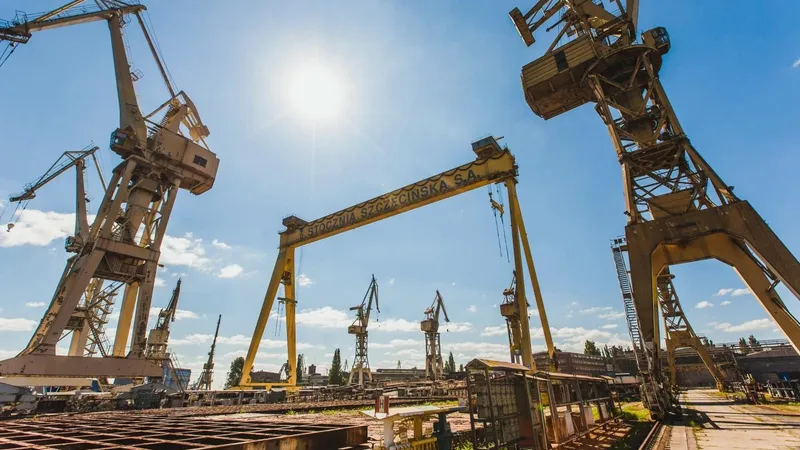
At Stocznia Szczecińska Wulkan the three modules of a floating dock for the MSR Gryfia repair yard have been joined into a single structure. The dock, with a lifting capacity of 24,000 tonnes and a value of around 240 million zloty, is due to start work in the third quarter of 2027 and will be the largest in the Baltic. Alongside it Wulkan is building the bow block of the rescue ship ORP Ratownik, its first defence contract, and steel structures for the offshore sector. Gryfia has already completed the modernisation of its dock infrastructure. After years of losses and unfinished projects, Szczecin's shipyards finally have what they lacked most: their own orders on their own quays. In fairness, it must be added that the dock has been under construction for five years and that the whole recovery rests on money from a state owner.
In brief
Stocznia Szczecińska Wulkan has joined the three modules of a 24 thousand tonne floating dock for MSR Gryfia worth about PLN 240 million, due to start work in the third quarter of 2027 as the largest on the Baltic. The dock has an overall length of 235.6 m and a width of 47.3 m, with classification supervision by Polski Rejestr Statków. Wulkan is also building for PGZ Stocznia Wojenna the bow block of the rescue ship ORP Ratownik, weighing more than a thousand tonnes, its first defence contract. After a loss of more than PLN 130 million for 2023, Wulkan posted a net profit of PLN 36 million in 2025. Both shipyards are owned by the state Fundusz Rozwoju Spółek.
Both yards belong to Fundusz Rozwoju Spółek (FRS), a state-owned company celebrating its tenth anniversary this year. FRS owns Wulkan, is the majority shareholder of Gryfia and co-owns the Szczecin Ship Recycling Plant. The fund has just launched its own social media profile to show what is happening in its companies. And a great deal is happening, by its own account.
A dock that was a problem and is becoming an asset
The dock's history is not a simple one. Steel cutting began in September 2021, and early announcements spoke of a 27,000-tonne capacity. For the following years the dock was Wulkan's main headache, and the yard closed 2023 with a loss of more than 130 million zloty. Only a change in market conditions, an inflow of offshore orders and the local content policy in defence procurement made it possible to speed up restructuring.
Today the parameters are settled: 235.6 m overall length, 213.1 m keel block length, 47.3 m beam, around 10,000 tonnes of steel and around 13,000 tonnes for the complete structure. The three modules were launched separately. The 3,600-tonne central section was moved into the water using a pontoon brought from Norway and self-propelled modular transporters from Belgium, in an operation described as the first of its scale in Poland. The last 80-metre module, weighing close to 4,000 tonnes, was launched on 7 and 8 August. Joining takes place afloat at the Drzetowskie Quay and, according to FRS, the third section is now connected to the other two. Classification is by the Polish Register of Shipping.
For Gryfia the dock, to be numbered 8, is an investment comparable only to dock no. 5 three decades ago. It will allow the yard to repair vessels more than 230 m long, around 36 m wide and up to 24,000 tonnes, a segment of the market currently beyond the Szczecin repair yard's reach. The yard has already completed the modernisation of the surrounding infrastructure and is waiting for the structure.
Szczecin's first defence contract
The second change is qualitative. Wulkan is building for PGZ Stocznia Wojenna the bow block of the rescue ship ORP Ratownik, weighing more than 1,000 tonnes. The block is to be delivered to Gdynia in 2027 and joined to the rest of the hull; the ship's launch is planned for autumn 2027 and its commissioning for 2029.
It is the first defence contract in the yard's history and the clearest signal yet that Szczecin is returning to the domestic supply chain for the Polish Navy. For years Wulkan delivered sophisticated structures, from dredgers to the hull of the Canopée, the vessel that carries Ariane 6 rockets, but they were completed in foreign yards. Ratownik stays in Poland.
The third pillar is offshore. Wulkan is building steel structures for offshore wind, and FRS says it is steering the yard in precisely that direction, alongside the development of environmentally sound ship recycling at the group's other company.
The FRS model: one company builds, the other gets the tool
The dock is at once an investment by the fund, an order for Wulkan and a working tool for Gryfia. Aleksandra Skibniewska, President of FRS, calls it the implementation of a strategy of investing in the maritime economy on the basis of the group's own potential and local content principles: one company builds, the other receives a tool for decades to come. The results show in the figures. After the 2023 loss, Wulkan closed 2024 in the black and in 2025 posted a net profit of 36 million zloty. Gryfia employs around 450 people, and several dozen companies operate on Wulkan's site with up to 2,500 workers. Both yards exhibited jointly at this year's SMM in Hamburg, and in August the sail training ship Dar Młodzieży entered Gryfia for servicing.
What still has to go right
The picture is clearly better than three years ago, but several things need saying plainly. First, the dock is years behind its original schedule and has different parameters from those first announced; a date of July or the third quarter of 2027 is still a promise, not a fact, and joining, outfitting and testing a structure of this size afloat is the hardest stage. Second, the entire recovery rests on capital from a state owner that is at once investor, customer and beneficiary, so the market test will only come when Gryfia starts earning on the new dock from external clients. Third, Ratownik is one block of one ship; an important beginning, but not a defence order book.
Despite those caveats the direction is right. For years Szczecin was the symbol of what went wrong in Polish shipbuilding. A 24,000-tonne dock, a first contract for the Polish Navy and a yard that has gone from a 130 million zloty loss to a 36 million zloty profit are proof that the symbol can be changed. Provided the dock actually goes to work in 2027.
Source: Gazeta Morska · Compiled by: Kamil Kusier
Related articles
 Energy and offshore Equinor takes over Bałtyk 2 and 3 O&M base in Łeba. Port to serve 1.44 GW of offshore wind for 30 years
 Navy and defence Port Gdański Eksploatacja secures NATO NCAGE code. Gdańsk port company lines up for defence tenders
 Shipbuilding industry Ex-Enterprise towed to Mobile under $418.5m contract. Test case for Nimitz-class disposal begins
 Energy and offshore Energa renames Gdańsk gas plant company as foundations for 6,000-tonne turbine and boiler are laid
 Equipment and technology WB Group takes Polish drones from Tokyo to SOFEX in Jordan in a single week
 Ports and logistics PGE books Gdańsk’s T5 terminal for the long haul: Baltica 2 first, then more offshore wind farms
Comments (0)
The discussion is moderated by the editors: a comment appears after review. Your e-mail address is not published.
Nobody has commented on this article yet.