









Świnoujście offshore wind terminal moves towards expansion after a strong first year
Poland's first installation terminal for offshore wind farms, launched in June 2025, is entering its next phase exactly one year on. ORLEN Neptun and the Szczecin and Świnoujście Seaports Authority have signed a letter of intent on expanding the facility – a terminal that already serves foreign operators and is positioning itself as the most important offshore wind installation hub in this part of the Baltic.
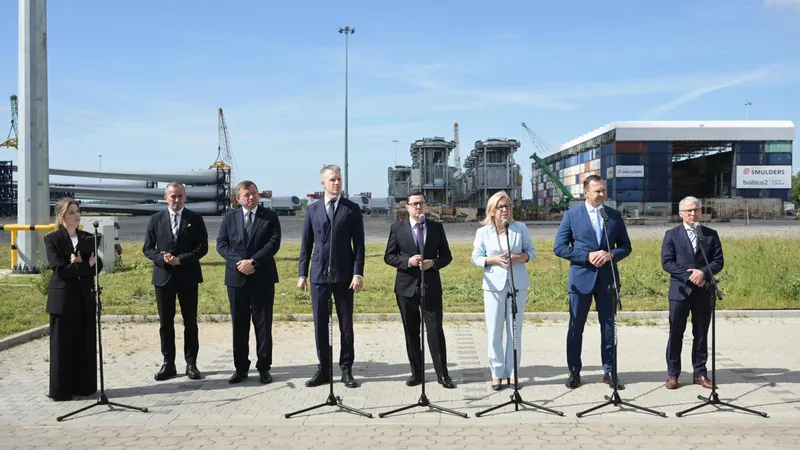
In brief
ORLEN Neptun and the Szczecin and Świnoujście Seaports Authority have signed a letter of intent on expanding the installation terminal for offshore wind farms in Świnoujście, launched in June 2025. Świnoujście Offshore Terminal receives transformer station components weighing nearly 3,000 tonnes, and the quay load capacity of up to 50 t/m² allows handling turbines with a capacity of about 15 MW and larger. The construction of the terminal involved 95 Polish entities, and over 20 local companies provide servicing. The next stage depends on the results of business analyses and securing financing.
After its first twelve months in operation, the Świnoujście Offshore Terminal has established itself as a strategic base for offshore wind development in this part of the Baltic Sea. It is the ORLEN Group's key logistics hub for its second-phase offshore wind projects – Baltic East and Baltic West – but it also handles external clients, including foreign partners. In its first year the terminal drew strong market interest, winning customers including Ocean Winds and Smulders.
The newly signed letter of intent is a first step towards an expansion intended to complement the terminal's existing logistics capacity and meet the anticipated clustering of projects running in parallel over the coming years. Both sides have declared their readiness for further talks on enlarging and modernising the port infrastructure. Moving to the next stage will, however, depend on the results of business analyses and the ability to secure financing.
One of the few facilities of its kind in the region
The Świnoujście Offshore Terminal combines the functions of an installation terminal and a marshalling port. It offers comprehensive handling and storage of offshore wind farm components, and its infrastructure can accommodate the latest jack-up and heavy-lift vessels as well as projects using turbines of around 15 MW and above. It can take offshore substation components weighing up to almost 3,000 tonnes, and a quay bearing capacity of up to 50 t/m² makes it one of the few facilities in the region able to serve the sector's most advanced projects.
A key advantage is its location, with access to rail, road, ferry and air transport, allowing it to support projects in German, Swedish and Danish waters as well.
Government and industry voices
Minister of Energy Miłosz Motyka said that developing the offshore wind sector is an investment in energy independence and security, and that the planned expansion is a concrete response to the needs of an industry that requires reliable infrastructure.
Minister of Climate and Environment Paulina Hennig-Kloska stressed that the growth of renewables strengthens Poland's energy sovereignty and provides an impulse for the economy, with the Świnoujście terminal becoming a space for developing the skills of Polish companies and engineers.
Arkadiusz Marchewka, Secretary of State at the Ministry of Infrastructure, noted that Polish ports now also underpin energy security, and that investments such as the ORLEN Neptun terminal reinforce it.
ORLEN Neptun President Janusz Bil said the expansion of the installation port answers anticipated demand in light of plans to build further wind farms in the Baltic. The investment is already reaching satisfactory utilisation in its first year, he noted, adding that the expansion would strengthen the domestic content in the delivery of Polish projects.
Regional impact and local content
The terminal is already a driver of growth for the West Pomeranian region and for Polish companies in the sector. Ninety-five Polish entities worked on its construction, and more than 20 local firms now provide services to the facility.
Jarosław Siergiej, President of the Szczecin and Świnoujście Seaports Authority, recalled that the key access infrastructure was built under an EU-funded project to expand the port's handling capacity. Its strategic location and a quay load-bearing capacity unique in Europe, he said, justify moving to a second stage – particularly given the strong growth potential of Baltic offshore wind over the next 15 years.
Source: Gazeta Morska · Compiled by: Michał Iwański
Related articles
 Energy and offshore Equinor takes over Bałtyk 2 and 3 O&M base in Łeba. Port to serve 1.44 GW of offshore wind for 30 years
 Navy and defence Port Gdański Eksploatacja secures NATO NCAGE code. Gdańsk port company lines up for defence tenders
 Shipbuilding industry Ex-Enterprise towed to Mobile under $418.5m contract. Test case for Nimitz-class disposal begins
 Energy and offshore Energa renames Gdańsk gas plant company as foundations for 6,000-tonne turbine and boiler are laid
 Equipment and technology WB Group takes Polish drones from Tokyo to SOFEX in Jordan in a single week
 Ports and logistics PGE books Gdańsk’s T5 terminal for the long haul: Baltica 2 first, then more offshore wind farms
Comments (0)
The discussion is moderated by the editors: a comment appears after review. Your e-mail address is not published.
Nobody has commented on this article yet.