









Sweden and Lithuania Set the Course for Zero-Emission Shipping
Two forward-looking initiatives—Sweden’s green hydrogen roadmap for Port of Umeå and Lithuania’s electrification of the inland waterway along the Neman River—are redefining what sustainable shipping looks like in the Baltic Sea Region. These projects, developed under the Blue Supply Chains (BSC) framework, offer scalable models for emission-free maritime logistics across Europe.
In brief
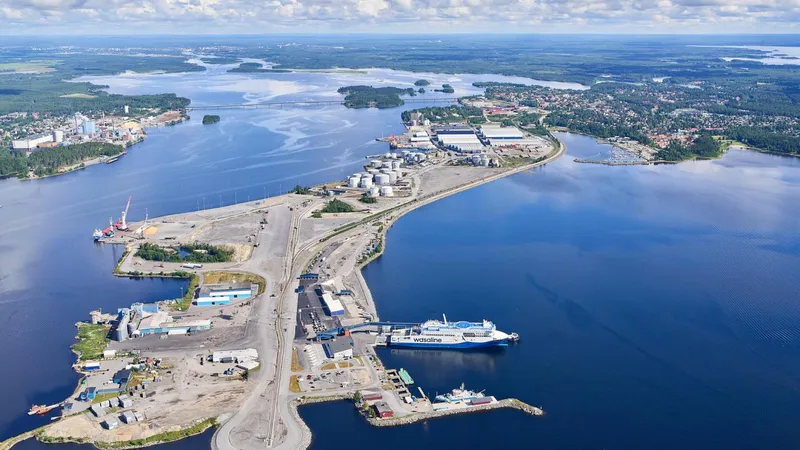
The Port of Umeå in Sweden and a Lithuanian project on the Nemunas River are implementing zero-emission shipping under the Blue Supply Chains project, co-financed by the Interreg BSR 2021 to 2027 programme. The Port of Umeå plans full climate neutrality by 2040 and, by 2030, the launch of a plant producing up to 110 thousand tonnes of e-methanol a year, to be bought by the shipowner Wasaline. The Lithuanian Inland Waterways Authority is electrifying the Kaunas to Klaipėda route, planning 6 electric pushers of 660 kW, 12 barges, 27 battery containers and 3 charging hubs, which is to replace up to 48 thousand truck journeys a year.
Case Sweden: Green Fuels Strategy Anchored in Umeå
The city of Umeå has unveiled an ambitious roadmap to achieve climate neutrality by 2040, making renewable fuels in port operations and transport a strategic priority. Developed by the IVL Swedish Environmental Research Institute together with Port of Umeå, Umeå Energy AB, Umeå Municipality, and INAB, the plan emphasizes locally produced green hydrogen and e-methanol as core solutions.
Umeå's strategic advantages include:
- Abundant renewable power (hydro, wind),
- Biogenic CO₂ from district heating for synthetic fuels,
- Strong rail and maritime infrastructure,
- Access to clean water for hydrogen electrolysis.
By 2030, the Umeå Eco Industrial Park is expected to produce up to 110,000 tonnes of e-methanol annually. Ferry operator Wasaline is among the first adopters, while companies like SCA are expected to support long-term decarbonization through fleet renewal.
Three future scenarios were evaluated, with the most likely positioning Umeå as a net exporter of renewable marine fuels, exceeding domestic demand.
Case Lithuania: Full-Scale Electrification of Inland Shipping
Meanwhile, Lithuania is transforming its inland shipping corridor with a comprehensive electrification strategy along the Neman River (Kaunas to Klaipėda), led by the Lithuanian Inland Waterways Authority (LIWA). The initiative, backed by national and EU funds, aims to remove over 48,000 truck trips annually, cutting congestion and CO₂ emissions.
Since 2019, more than €27 million has been invested in upgrading inland waterway E41, enabling year-round navigation and efficient freight operations. The new electric fleet includes:
- 6 azimuth-driven electric pushers (660 kW),
- 12 barges optimized for container transport,
- 27 swappable battery containers,
- 3 smart charging hubs: Port of Klaipėda, Jurbarkas, and Marvele Port (Kaunas).
Each barge will replace approximately 106 trucks per trip, saving up to 21 tonnes of CO₂. The government will cover 90% of the grid expansion and ensure stable long-term electricity prices for maritime operators.
Decarbonizing by Design: Tailoring Technology to Use Case
Both projects carefully evaluated propulsion technologies: battery-electric, e-methanol, hydrogen, and hybrid systems.
- In Sweden, e-methanol and hydrogen were prioritized for deep-sea and ferry applications, offering high energy density and long-term decarbonization potential. Hydrogen presents challenges (storage at 1,000 bar, material brittleness), but is seen as essential for future energy systems.
- In Lithuania, battery-electric solutions proved optimal for inland navigation, due to simpler infrastructure requirements and lower operational costs. Ship designs incorporate retractable wheelhouses (3.6 m) and CFD-modeled hulls, optimized for Neman River conditions.
Infrastructure Meets Policy
The success of both roadmaps hinges on coordinated infrastructure upgrades and regulatory support.
Sweden:
- Shore power systems (OPS) under development,
- Green fuel bunkering capacity,
- Carbon capture integration by 2029.
Lithuania:
- Port upgrades with 30-ton battery container cranes,
- High-capacity charging (up to 750 kW/ship),
- Secured long-term electricity contracts for fleet operators.
Upcoming EU policies, such as FuelEU Maritime and ETS for shipping, are expected to accelerate the deployment of clean marine fuels.
Timeline: What’s Next?
Sweden – Umeå:
- 2027: Rail link completion to Umeå Eco Industrial Park,
- 2029: Full carbon capture system operational,
- 2030: E-methanol production commences,
- 2040: Full port and municipal climate neutrality.
Lithuania – Neman Corridor:
- 2024–2025: Procurement and construction of electric pushers,
- 2026–2027: Charging hubs operational in Kaunas, Jurbarkas, Klaipėda,
- 2030: Complete electric inland fleet deployment.
From Baltic Innovation to Global Blueprint
Sweden and Lithuania’s complementary strategies show that zero-emission shipping is no longer a future vision—it’s underway. With integrated energy planning, localized solutions, and strong public-private governance, these initiatives serve as replicable models for ports and inland waterways across Europe and beyond.
Project link & documentation: here
About Blue Supply Chains
The BSC project supports port authorities and operators in decarbonizing their operations by developing electrification strategies, alternative fuel roadmaps, and green transport corridors. The initiative is co-funded by the Interreg Baltic Sea Region Programme 2021–2027, with Port of Hamburg Marketing Reg. Assoc. as lead partner. Other key partners include Port of Umeå, Umeå Energy AB, INAB, IVL, Lithuanian Inland Waterways Authority (LIWA), and the Baltic Ports Organization.
Source: Gazeta Morska · Compiled by: Kamil Kusier
Related articles
 Energy and offshore Equinor takes over Bałtyk 2 and 3 O&M base in Łeba. Port to serve 1.44 GW of offshore wind for 30 years
 Navy and defence Port Gdański Eksploatacja secures NATO NCAGE code. Gdańsk port company lines up for defence tenders
 Shipbuilding industry Ex-Enterprise towed to Mobile under $418.5m contract. Test case for Nimitz-class disposal begins
 Energy and offshore Energa renames Gdańsk gas plant company as foundations for 6,000-tonne turbine and boiler are laid
 Equipment and technology WB Group takes Polish drones from Tokyo to SOFEX in Jordan in a single week
 Ports and logistics PGE books Gdańsk’s T5 terminal for the long haul: Baltica 2 first, then more offshore wind farms
Comments (0)
The discussion is moderated by the editors: a comment appears after review. Your e-mail address is not published.
Nobody has commented on this article yet.