Port Haller: Poland’s new strategic gateway on the Baltic Sea
Law and Justice (PiS) has unveiled plans for Port Haller, a new deep-sea Ro-Ro port to be developed on Poland’s central Baltic coast in Choczewo. Designed as a high-capacity logistics and military mobility hub, the project aims to strengthen Poland’s maritime economy while reinforcing NATO’s eastern flank through secure, resilient port infrastructure.
business maritime economy investments politics pomerania west pomerania ports news14 january 2026 | 07:07 | Source: Gazeta Morska | Prepared by: Kamil Kusier | Print
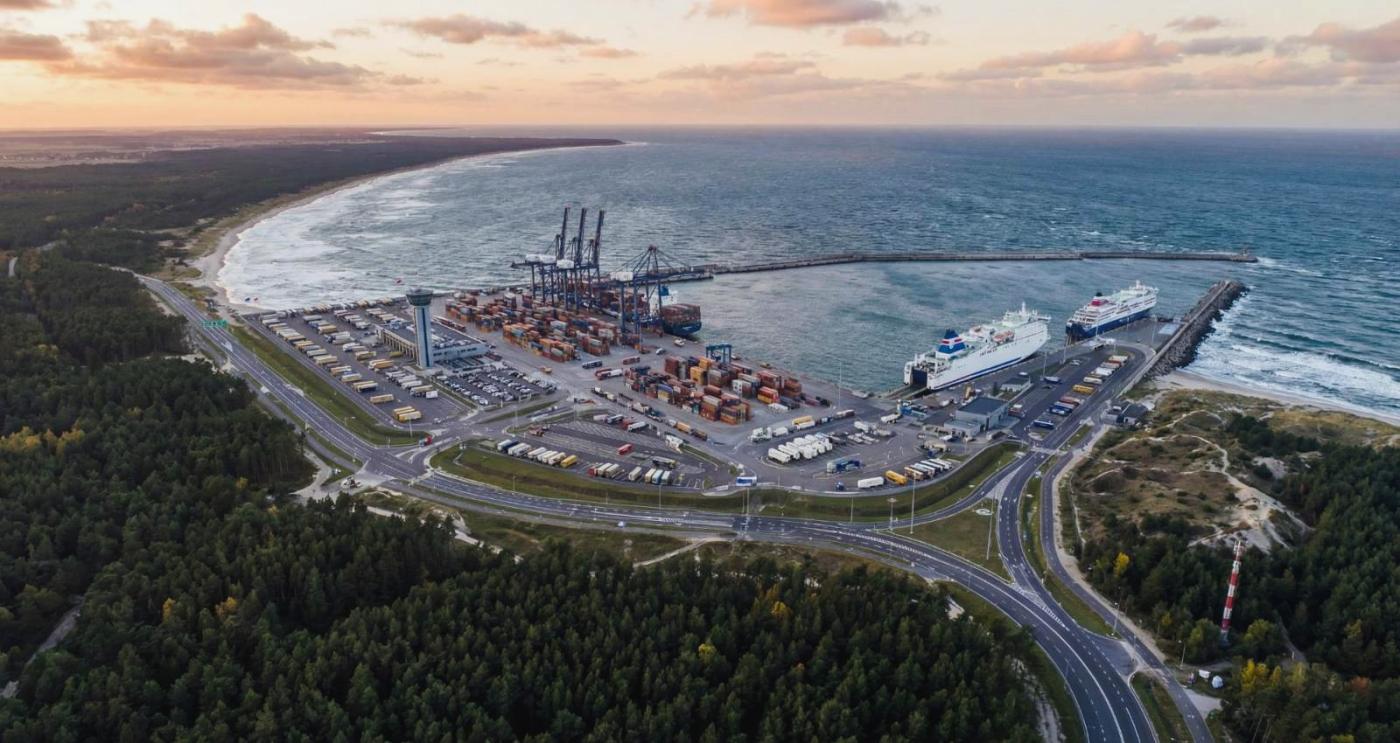
Wstępna koncepcja budowy Portu Haller w Gminie Choczewo / fot. Port Haller
A port integrated with nuclear power infrastructure
The Port Haller concept is closely linked to the construction of Poland’s first nuclear power plant at Lubiatowo–Kopalino. The project proposes leveraging the extensive road, rail, and maritime access infrastructure being built for the nuclear facility—investments exceeding PLN 4.7 billion.
Once the nuclear plant becomes operational, much of this infrastructure would otherwise be underutilised. Port Haller is intended to transform these sunk costs into long-term economic and strategic assets for the Polish maritime sector.
During the project presentation, PiS Chairman Jarosław Kaczyński emphasised the site’s logistical advantages:
- A port must be built here anyway in connection with the nuclear power plant, and at the same time this is a well-connected location where construction can be carried out quickly and efficiently. In short, this is another step toward strengthening Poland’s maritime economy, said Jarosław Kaczyński.
Ro-Ro capacity as a structural gap in the Polish port system
Port Haller is planned as Poland’s fourth fully fledged deep-sea port specialising in Ro-Ro operations, capable of handling unaccompanied trailers, wheeled cargo, heavy equipment, and military vehicles.
According to project proponents, Poland’s existing ports—Gdańsk, Gdynia, and the Szczecin–Świnoujście complex—are technologically advanced but face structural limitations. Space constraints restrict large-scale Ro-Ro terminal expansion in Gdańsk and Gdynia, while Szczecin–Świnoujście is located far from Poland’s main rail corridors, extending transit times and reducing competitiveness.
In addition, all existing major ports remain within the effective range of long-range artillery systems deployed in the Kaliningrad Oblast, posing a challenge in crisis or wartime scenarios.
Port Haller is intended to close this gap by offering scale, spatial flexibility, secure hinterland access, and full integration into national transport networks.
Emerging trade corridors and the Three Seas initiative
Key strategic details were presented by MP Kacper Płażyński, a member of the Sejm’s Maritime Economy Committee, who pointed to imminent changes in European freight flows.
- Why is Port Haller needed? Because within the next five years two new trade corridors will emerge: the Black Sea–Baltic corridor and the Adriatic–Baltic corridor, said Kacper Płażyński.
These corridors are expected to link Scandinavia with Turkey, the South Caucasus, Adriatic ports, and one of Europe’s largest inland multimodal logistics hubs in Verona. Port Haller would serve as the northern maritime gateway to this emerging logistics axis, strengthening Poland’s role within European trade and the Three Seas initiative.
- Since we are already allocating vast resources—rightly so—to build a nuclear power plant, we should fully utilise these investments, Kacper Płażyński added.
A critical asset for NATO’s eastern flank
Security considerations form a central pillar of the Port Haller concept. The port would be located within the protective coverage of the NATO missile defence site in Redzikowo and beyond the effective range of long-range artillery stationed in Kaliningrad.
Project authors argue that reliance on distant Western European ports—such as Rotterdam—is insufficient for rapid reinforcement of NATO’s eastern flank. A secure, proximate Ro-Ro hub on the Baltic Sea is seen as essential for efficient military mobility and logistical resilience.
Port Haller is designed to function as a primary entry point for allied equipment, vehicles, and forces, significantly reducing deployment times and enhancing deterrence posture.
Exceptional location parameters
The Choczewo site offers a rare combination of maritime and spatial advantages: 12.5 metres of natural water depth just 1.5 kilometres from shore, absence of dense urban development, and more than 300 hectares of land available for port expansion and industrial development.
Equally important, the area lies at a safe distance from Natura 2000 sites and protected landscapes, reducing environmental and permitting constraints compared to other Baltic locations.
Maritime heritage and strategic continuity
The port’s name honours General Józef Haller, symbolising Poland’s historic marriage to the sea and underscoring the continuity of Polish maritime ambition—from regaining access to the Baltic to building infrastructure capable of meeting 21st-century economic and security challenges.
see also
Buy us a coffee, and we’ll invest in great maritime journalism! Support Gazeta Morska and help us sail forward – click here!
Kamil Kusier
redaktor naczelny
comments
Add the first comment
see also
Mine countermeasure vessel Jaskółka begins sea acceptance trials
PEJ relocates headquarters to Pomerania. A strategic step in Poland’s nuclear power development
Radmor hosts delegation from the Republic of Turkey. Advancing maritime security cooperation
3D-printed catamaran: robotic manufacturing sets course for the future of small craft
Navantia and Fincantieri deepen cooperation on the european patrol corvette programme
Galeon Yachts and Meyer Shank Racing: merging luxury yachts with motorsport expertise
Unmanned systems and naval firepower modules. WB Group showcases integrated capabilities at Enforce Tac 2026
Swedish ports record lowest ship calls in 18 years. Implications for the maritime sector
February in Szczecin’s shiprepair sector. Ice, overhauls and North Sea expansion
Advanced ROV trials conducted at CTO to validate subsea technologies for offshore applications
ADVERTISEMENT
ADVERTISEMENT