









Strategic partnership: PLK and Port of Gdańsk join forces to expand rail access to deepwater terminals
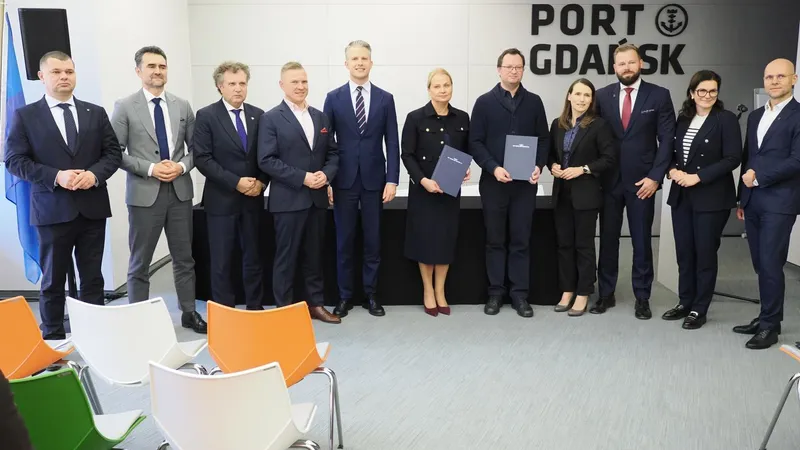
PKP Polskie Linie Kolejowe S.A. (PLK) and the Port of Gdańsk Authority have signed an agreement to develop preparatory documentation for the expansion of rail and road access to the deepwater terminals located on Stogi Island. The project is considered strategic for the port’s development and for the wider Polish economy.
In brief
PKP Polskie Linie Kolejowe S.A. and Zarząd Morskiego Portu Gdańsk S.A. signed an agreement on preparing documentation for expanding rail and road access to the deepwater terminals on Stogi island. The agreement covers a feasibility study in 2026 and 2027, design documentation from 2028 and completion of the investment by 2034. The Port of Gdańsk handled more than 355 thousand wagons in 2024, and all traffic from the deepwater area, which holds more than 80 percent of handling capacity, currently passes over a single bridge. Port of Gdańsk president Dorota Pyć pointed out that the current network is already a factor limiting development.
A key investment to strengthen national logistics
Rail remains the most efficient, safe and environmentally friendly mode of cargo transport. Increasing its share in port operations is one of PLK’s strategic priorities. The newly signed agreement aligns with these objectives, launching work on a comprehensive plan to enhance access to both existing and future terminals in the Northern Port.
Deputy minister of infrastructure Arkadiusz Marchewka emphasized during the signing ceremony that enhancing the capacity of rail lines serving Poland’s seaports is a prerequisite for maintaining their competitiveness in the coming decades.
In 2024 alone, the Port of Gdańsk handled over 355,000 rail wagons (data for ZMPG contractors only). Currently, all rail traffic from the deepwater area flows through a single bridge — now a major developmental bottleneck.
Port of Gdańsk: second bridge or tunnel is essential
Dorota Pyć, president of the Port of Gdańsk Authority, has repeatedly underlined the urgent need for a second access route — either a bridge or tunnel — to Stogi Island, home to over 80% of the port’s cargo throughput. Critical assets such as Naftoport, Gaspol, the Northern Port and Baltic Hub operate here, playing central roles in Poland’s energy security and logistics capacity.
- The current rail network has become a limiting factor for our growth. Ports cannot develop independently of the railway system. Intermodal connections are one of the pillars of our new strategy. Today’s agreement with PLK is not just a plan — it is a concrete, coordinated response to the challenges facing the Polish logistics sector, said president Dorota Pyć.
The planned investment will include the construction or modernization of port and access infrastructure, additional tracks, improved capacity at the Port Północny station and a new alternative entry and exit route from the island.
Gdańsk mayor Aleksandra Dulkiewicz welcomed the initiative, noting that the additional access route will relieve Stogi Island and support its sustainable transformation.
Three-stage development path
The cooperation between PLK and the Port of Gdańsk is structured into three stages:
- Feasibility study (2026–2027)
Comprehensive analyses of investment variants and technical assumptions. - Design documentation (from 2028)
Development of detailed design materials enabling the acquisition of administrative permits. - Infrastructure implementation (target: by 2034)
Modernisation and electrification of existing lines, construction of new rail sections and supporting access infrastructure.
Construction works will commence once financing is secured and all formal decisions are obtained.
PLK continues major upgrades to Tri-city port rail corridors
PLK has been intensively upgrading access routes to both Gdańsk and Gdynia ports. Between 2019 and 2024, more than PLN 3 billion from the Connecting Europe Facility (CEF) was invested to improve port rail access, enabling longer, heavier and more frequent trains to reach the quays.
The company is also carrying out a major modernisation of line 201 (Bydgoszcz–Tri-city), vital for the Port of Gdynia, and has launched a tender for the “Pszczółki – Pruszcz Gdański” section on the Tczew–Gdynia corridor. Constructing an additional track will significantly increase capacity on the main freight outlet from the Tri-city, including routes to the Port of Gdańsk. Completion is expected in 2030.
Source: Gazeta Morska · Compiled by: Kamil Kusier
Related articles
 Energy and offshore Equinor takes over Bałtyk 2 and 3 O&M base in Łeba. Port to serve 1.44 GW of offshore wind for 30 years
 Navy and defence Port Gdański Eksploatacja secures NATO NCAGE code. Gdańsk port company lines up for defence tenders
 Shipbuilding industry Ex-Enterprise towed to Mobile under $418.5m contract. Test case for Nimitz-class disposal begins
 Energy and offshore Energa renames Gdańsk gas plant company as foundations for 6,000-tonne turbine and boiler are laid
 Equipment and technology WB Group takes Polish drones from Tokyo to SOFEX in Jordan in a single week
 Ports and logistics PGE books Gdańsk’s T5 terminal for the long haul: Baltica 2 first, then more offshore wind farms
Comments (0)
The discussion is moderated by the editors: a comment appears after review. Your e-mail address is not published.
Nobody has commented on this article yet.