Slawkow terminal expansion: investment in logistics security for Poland and the EU
On 26 May 2025, a key investment agreement was signed in Slawkow between the Industrial Development Agency and Euroterminal Slawkow. The project marks a strategic leap in strengthening Poland’s role as a logistics hub in Central and Eastern Europe, while supporting the EU’s broader effort to secure supply chains and aid the reconstruction of Ukraine.
business logistics politics transport and forwarding news26 may 2025 | 23:58 | Source: Gazeta Morska | Prepared by: Kamil Kusier | Print
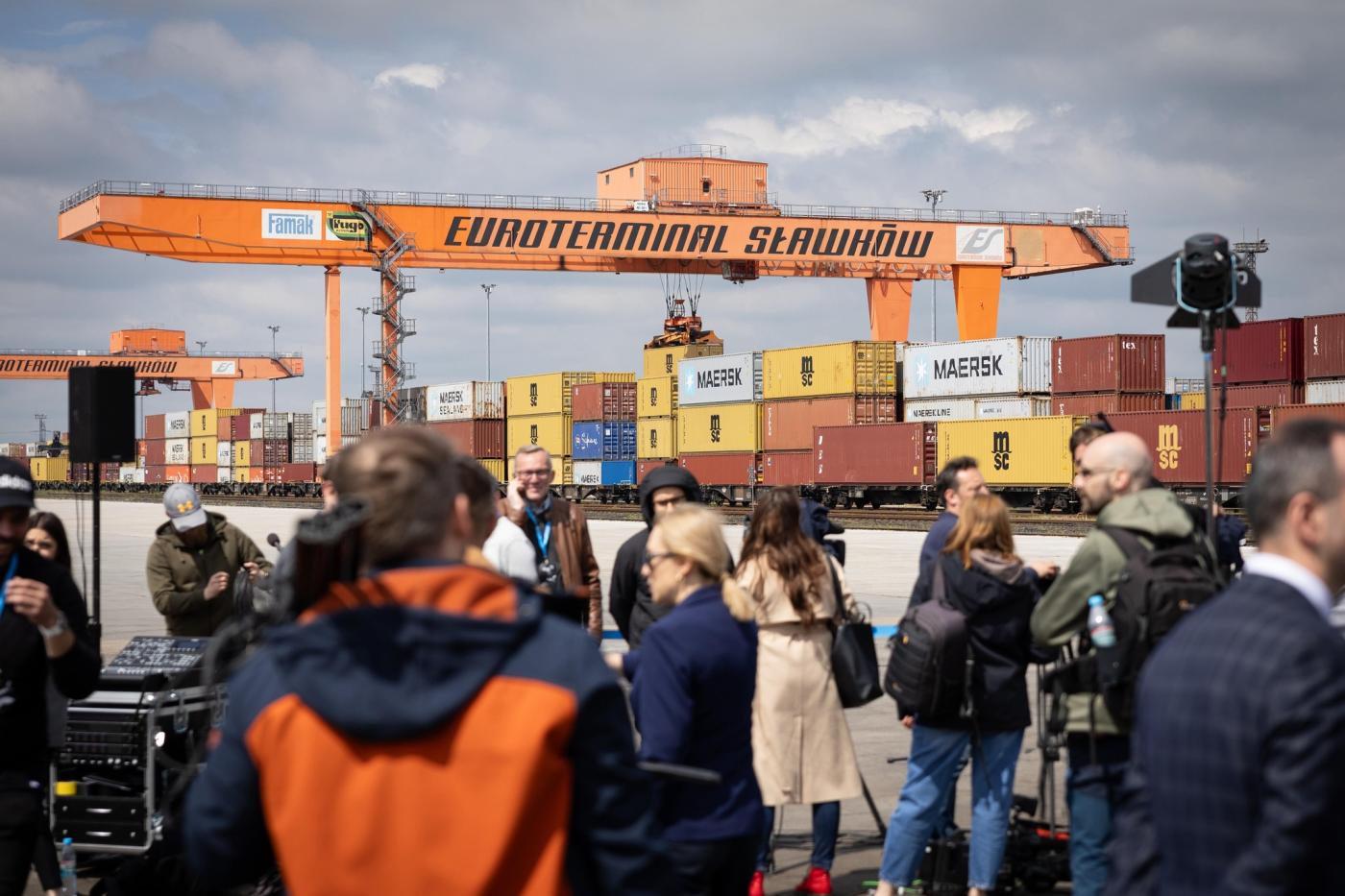
fot. Ministerstwo Infrastruktury
The first phase of the expansion involves the construction of a second intermodal terminal, equipped with seven new tracks and state-of-the-art transshipment equipment. This will significantly boost the terminal’s capacity and efficiency in handling intermodal containers, particularly for cargo coming from Ukraine and Asia.
With an investment value of PLN 180 million, the project is central to Poland’s strategy of reinforcing its position as a regional logistics leader and ensuring seamless cargo flows along critical trans-European corridors.
— Infrastructure is the lifeblood of the Polish economy, which is why the expansion of the Slawkow terminal is money best spent from the perspective of Polish logistics and transport. Our transport sector is modern and essential to cargo handling processes across Europe and beyond, said Dariusz Klimczak, Minister of Infrastructure.
— Slawkow is Poland’s window to the world, which is why its development should remain 100 percent under Polish control. Whoever controls Euroterminal Slawkow, controls the flow of goods between the European Union and Ukraine, he added.
Prime Minister Donald Tusk emphasized the terminal’s unique location at the intersection of major pan-European corridors, linking east with west and north with south—highlighting the growing significance of the north–south axis.
— This north–south route—connecting the Mediterranean with the Baltic—is today even more important for Slawkow than the east–west direction in terms of cargo volume. So we’re talking about Italy, the Adriatic nations, and on the other side the Baltic Hub—two maritime gateways to the world, with Slawkow as the land-based heart in between, said Prime Minister Tusk.
The expansion project will nearly double the terminal’s handling capacity, from the current 285,000 TEU annually to 530,000 TEU. Yet the initiative offers more than just infrastructure—it's a new growth engine for the region and the national economy.
Euroterminal Slawkow occupies a uniquely strategic location at the crossroads of the European rail network and the broad-gauge line originating in the Far East. It is just 57 km from Krakow-Balice airport and 44 km from Katowice-Pyrzowice airport, with easy access to two major motorways—A1 (8 km) and A4 (10 km).
Crucially, Slawkow is the western terminus of the LHS broad-gauge railway line—the only such infrastructure in the European Union—enabling uninterrupted freight movement from Ukraine without track gauge changes. This dramatically reduces both the time and cost of transport.
In a changing geopolitical landscape, Euroterminal Slawkow is evolving into a key asset—not only for Poland, but for the entire European logistics system.
Buy us a coffee, and we’ll invest in great maritime journalism! Support Gazeta Morska and help us sail forward – click here!
Kamil Kusier
redaktor naczelny
comments
Add the first comment
see also
Austal partners with Damen for local construction of LST 100 for Australian Army
The submarine contract of the decade? Canada weighs South Korea against Germany
Bechtel signs contract with Doraco for Poland’s first nuclear power plant
When two powers clash, Poland must be ready to act. Military security must be the priority
MON, Arka Gdynia and AMW sign letter of intent supporting "Green Industrial District - Kashubia" project
Mine countermeasure vessel Jaskółka begins sea acceptance trials
PEJ relocates headquarters to Pomerania. A strategic step in Poland’s nuclear power development
Radmor hosts delegation from the Republic of Turkey. Advancing maritime security cooperation
3D-printed catamaran: robotic manufacturing sets course for the future of small craft
Navantia and Fincantieri deepen cooperation on the european patrol corvette programme
ADVERTISEMENT
ADVERTISEMENT