Redefining non-nuclear deterrence: how South Korea built a credible conventional shield
In today’s security environment, deterrence is no longer synonymous with nuclear capability. South Korea has demonstrated that a state can build a credible, resilient, and strategically disruptive deterrence posture through advanced conventional systems alone. This achievement is particularly relevant for countries operating in contested regions — from the Korean Peninsula to Central and Eastern Europe.
security navy nato shipbuilding industry defense industry news20 november 2025 | 10:40 | Source: Gazeta Morska | Prepared by: Kamil Kusier | Print
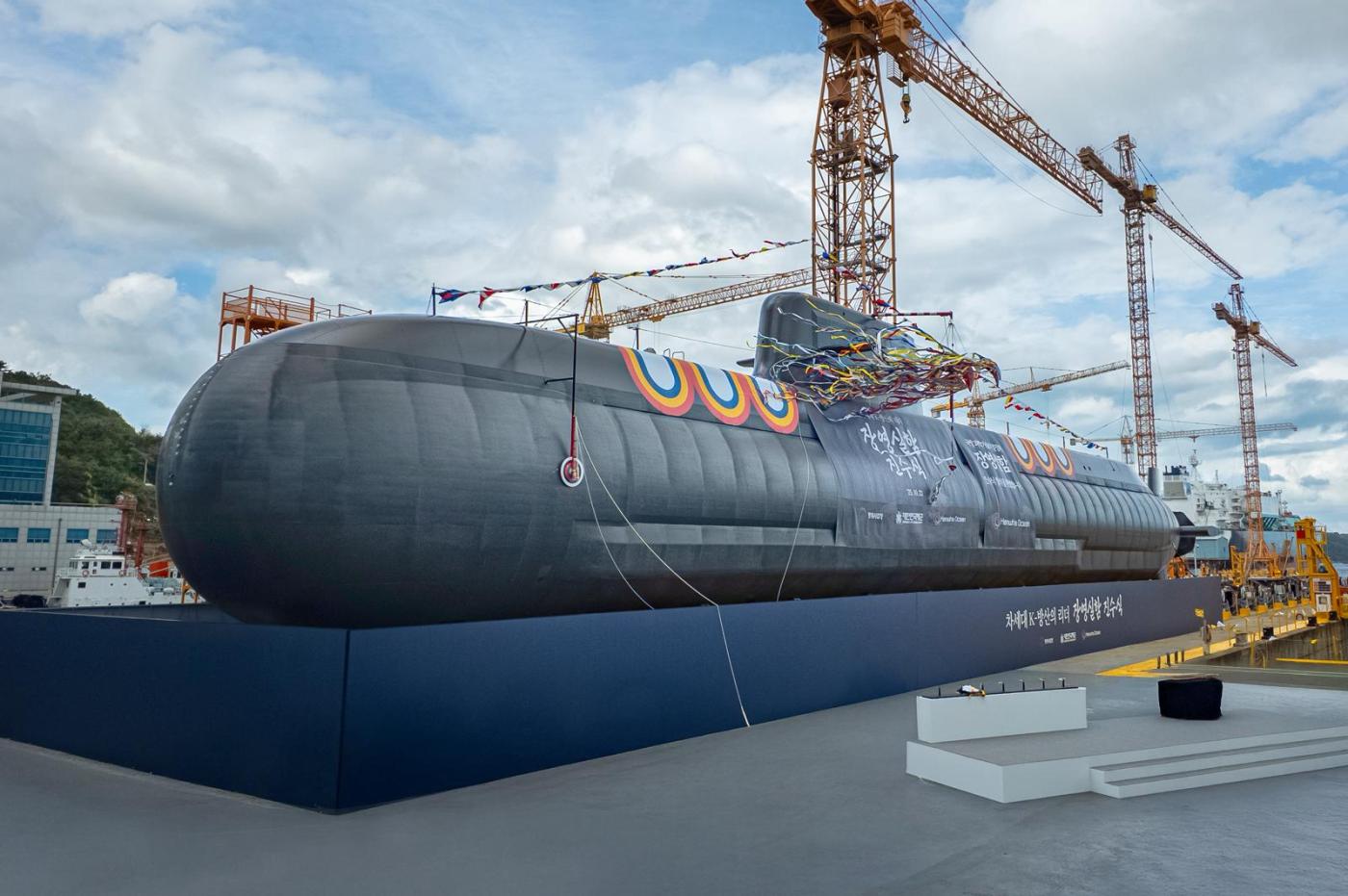
fot. Hanwha Ocean
At the core of Seoul’s approach is the Three-Axis System, a fully integrated architecture designed to detect, counter and respond to emerging threats across the entire escalation ladder. The concept, rooted in Thomas Schelling’s theory of credible retaliation, is built not on the quantity of weapons, but on the opponent’s belief that any attempt to neutralize South Korea’s response capabilities would fail.
The Three-Axis System consists of:
- Kill Chain — early detection and the ability to conduct precise pre-emptive strikes on critical targets before enemy launch preparations are completed.
- Korea Air and Missile Defense (KAMD) — a multilayered air and missile defense network built around M-SAM (Cheongung), L-SAM and advanced early-warning sensors.
- Korea Massive Punishment and Retaliation (KMPR) — a doctrine of overwhelming conventional counter-strikes targeting leadership nodes and strategic infrastructure if the adversary employs weapons of mass destruction.
This structure gives South Korea a credible second-strike capability without relying on nuclear forces. The country’s investment in long-range precision strike systems — including the Hyunmoo family of missiles and the latest Hyunmoo-5 — as well as integrated C2 networks and maritime platforms, has elevated its deterrence posture beyond traditional regional models.
For partners and NATO members such as Poland, the Korean experience offers a blueprint for building resilient, cross-domain defensive architecture. Advanced sensors, distributed strike assets, long-range land-based missiles and maritime second-strike platforms — including KSS-III submarines equipped with conventional ballistic missiles — represent capabilities that fundamentally enhance strategic depth.
It is also notable that South Korea is, for the first time, extending such offerings beyond its immediate region. Warsaw is not the only potential beneficiary; South Korea is preparing to take part in major international programmes such as Canada’s next-generation submarine project. This signals a broader strategic shift by Seoul toward a global defence industrial presence.
Poland’s current security posture — shaped by the war in Ukraine and increasing threats from long-range missiles, drones and hybrid maritime–air–land vectors — aligns closely with the Korean model.
- Poland’s national defence strategy places growing emphasis on developing second-strike capabilities. Integrating elements of the Three-Axis System into the Polish Navy would significantly strengthen NATO’s conventional deterrence posture in the Baltic Sea region, says Seong-Woo Park, Vice President of Hanwha Ocean and head of the ORKA submarine programme.
South Korea’s example proves that a state can build a powerful, survivable deterrence system without nuclear weapons. Distributed across land, sea and air, these capabilities complicate adversary planning long before a conflict begins.
- As Poland expands its portfolio of long-range precision strike and missile-defence systems, adopting key components of the Korean model is a natural progression. High-survivability submarines will play a central role in that evolution, Park adds.
Buy us a coffee, and we’ll invest in great maritime journalism! Support Gazeta Morska and help us sail forward – click here!
Kamil Kusier
redaktor naczelny
comments
Add the first comment
see also
Strait of Hormuz at a strategic crossroads: sinking of IRIS Dena and implications for maritime transport
The submarine contract of the decade? Canada weighs South Korea against Germany
When two powers clash, Poland must be ready to act. Military security must be the priority
Commodore Przemysław Karaś appointed deputy commander of the Maritime Operations Centre - Naval Component Command
Radmor hosts delegation from the Republic of Turkey. Advancing maritime security cooperation
French Navy expands global operations from the Pacific to the Red Sea
"Let everyone know we will prevail". Poland’s armed forces set strategic course for 2026-2039
“Army 500” and strategic transformation: Poland sets the course for long-term deterrence and allied readiness
Medical evacuation from offshore vessel in the Baltic. Rescue 511 helicopter and m/s Huragan deployed
Karol Nawrocki: “The strength of the republic lies in its armed forces”. Security requires national unity
ADVERTISEMENT
ADVERTISEMENT