









Shipbuilding industry is awesome. Marcin Ryngwelski on designing & installing sanitary cabins onboard
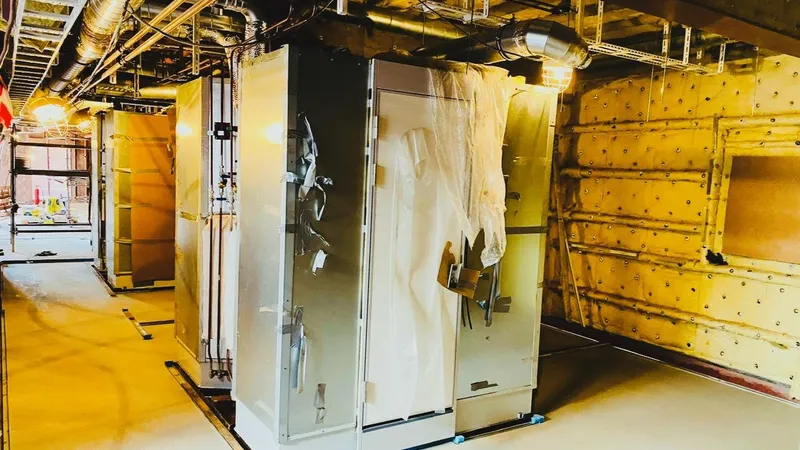
Sanitary cabins are among the most frequently used spaces on every vessel, yet their integration is one of the more sensitive stages of production. Their placement influences compartment layout, system routing and the build schedule. Marcin Ryngwelski, CEO of PGZ Naval Shipyard, explains how sanitary cabins are planned and installed, and why delays in their delivery can have structural and logistical consequences.
In brief
Marcin Ryngwelski, president of PGZ Stocznia Wojenna, explains that the layout of sanitary cabins is set at the technical design stage, and changing it during advanced construction is costly and technically difficult. Cabins or their bases must arrive while the hull and superstructure are still accessible through technological openings, otherwise installation requires removing doors or portholes. Large ferries with hundreds of cabins use a modular method, with ready-made cabins slid into prepared spaces. Sea acceptance trials (SAT) confirm the functionality of the cabins.
Function and configuration
A sanitary cabin is a self-contained unit assigned to a crew or passenger cabin, typically including a toilet and shower. Its size and level of outfitting depend on the vessel’s function and the owner’s specification.
- A passenger ship will have a different standard than a naval vessel. Requirements for number of crew, privacy, durability and ease of maintenance define the final configuration, says Ryngwelski.
Placement defined at the design stage
The arrangement of crew and passenger accommodations, including sanitary cabins, is determined during the technical design phase. This planning must meet regulatory requirements, including corridor width, escape routes and compartment division.
- The shipyard and its design office plan the layout according to capacity requirements provided by the client. The design must ensure compliance with class rules and naval standards. This is not something that can be corrected late in the process, Ryngwelski notes.
Delivery timing is critical
Cabins or their foundations must arrive while the hull or superstructure is still open and accessible.
- The hull must have technological openings that allow these units to be moved inside. If the cabin is delivered too late, and heavy doors or portholes are already installed, the shipyard faces unnecessary rework, explains Ryngwelski.
In cases where the supplier delays delivery, alternative transport paths may need to be created. This can require removal of elements already fitted, extending the schedule and increasing cost.
Assembly process
One common installation method includes:
- marking the position on the deck,
- attaching the cabin base to the deck structure,
- applying the leveling layer or using the factory-finished flooring,
- assembling the cabin walls and internal partitions,
- installing sanitary equipment,
- connecting water supply, drainage and electrical power,
- fitting the cabin door.
- Tolerance and alignment matter—cabin floors must drain correctly, walls must align with bulkheads, and pipe routing must not introduce stress into the system, Ryngwelski emphasizes.
Large passenger ship approach
On large ferries and passenger vessels, where cabin counts may exceed one thousand, the process is different. Fully outfitted cabin modules are produced off-site and installed as entire units.
- They are moved into the vessel in a single operation, once the structure reaches the correct stage. This is a highly coordinated logistics procedure.
First users
During sea acceptance trials, sanitary cabins are first used by:
- shipyard personnel,
- representatives of the owner or navy,
- classification society surveyors,
- regional naval inspectors (for military vessels).
SAT confirms not only the performance of ship systems but also the functionality and durability of outfitting components.
Sanitary cabins appear to be simple interior spaces, yet their integration is tightly linked to design decisions, supply-chain reliability and outfitting sequencing. They represent a precise interface between structural work, piping systems and accommodation standards.
Source: Gazeta Morska · Compiled by: Kamil Kusier
Related articles
 Shipbuilding industry Poland christens ro-pax ferry Bursztyn Unity in Szczecin on Independence Day. Ystad service starts 18 November
 Energy and offshore Orlen Neptun deploys V-LiDAR buoys at Baltic West ahead of Poland's 2027 offshore wind auction
 Energy and offshore Equinor takes over Bałtyk 2 and 3 O&M base in Łeba. Port to serve 1.44 GW of offshore wind for 30 years
 Navy and defence Port Gdański Eksploatacja secures NATO NCAGE code. Gdańsk port company lines up for defence tenders
 Shipbuilding industry Ex-Enterprise towed to Mobile under $418.5m contract. Test case for Nimitz-class disposal begins
 Energy and offshore Energa renames Gdańsk gas plant company as foundations for 6,000-tonne turbine and boiler are laid
Comments (0)
The discussion is moderated by the editors: a comment appears after review. Your e-mail address is not published.
Nobody has commented on this article yet.