Baltica 2: horizontal directional drilling underway in Choczewo
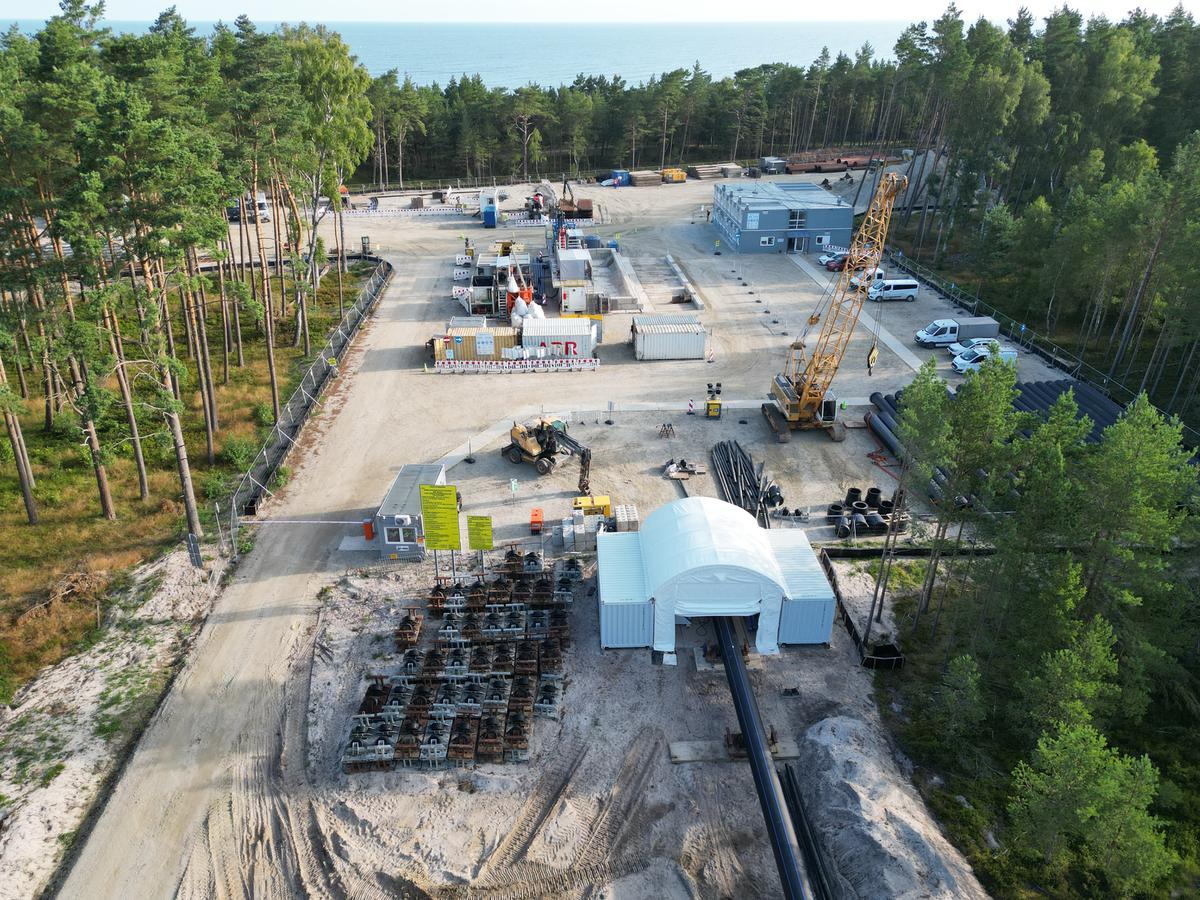
Work has begun on a key stage of the Baltica 2 offshore wind farm – the largest project of its kind in Poland, developed jointly by PGE and Ørsted. In the municipality of Choczewo, horizontal directional drilling (HDD) is being used to install export cable ducts beneath the shoreline, connecting offshore infrastructure with the onshore grid in a way that protects both the environment and the coastal landscape.
business power engineering maritime economy offshore pomerania news31 july 2025 | 17:16 | Source: Gazeta Morska | Prepared by: Kamil Kusier | Print
fot. Orsted
HDD enables trenchless landfall connection
HDD technology allows for highly precise drilling under the surface without the need for open trenching or disruption to dunes and beaches. Each of the four planned boreholes will be approximately 1,200 meters long, at depths of 20–30 meters below ground level. The work is being carried out by a consortium of Polish contractors: ROMGOS Gwiazdowscy and ZRB Janicki.
- This is a symbolic step for the entire project – connecting the offshore section with the onshore infrastructure, said Ulrik Lange, project director for Baltica 2 at Ørsted. - Using HDD, we can do this in a way that is safe for the environment and virtually invisible from the beach.
Bartosz Fedurek, president of PGE Baltica, added: - This is the least invasive way to install export cables. It does not require beach closures and allows us to carry out the work while preserving the landscape and natural surroundings.
Access maintained, local impact minimized
Public access to the beach remains open via marked pedestrian routes. The developers ask that all visitors follow signage and guidance from site personnel. Activities are coordinated closely with local authorities, and any necessary temporary changes to access or traffic will be communicated in advance.
To reduce noise-related inconvenience for residents and tourists, the project uses carefully selected equipment and construction zones located away from residential areas and the beachfront.
Environmental safeguards in place
Before the drilling began, comprehensive environmental studies were carried out both offshore and onshore. As a result, the cable route was designed to avoid ecologically sensitive areas, including habitats of the smooth snake (Coronella austriaca, a protected species in Poland), and the Lubiatowska Dune, one of the region’s most valuable natural features. The design also takes into account Natura 2000 protected areas.
Qualified environmental supervisors will oversee compliance with environmental regulations throughout construction.
Clean power for 2.5 million homes
Once drilling is completed – expected between late 2025 and early 2026 – installation of the export cables will begin. These will carry electricity generated by the offshore turbines to the national grid. With a planned capacity of 1.5 GW, Baltica 2 will provide enough clean, renewable power for around 2.5 million households, making it a cornerstone of Poland’s offshore energy transformation.
Buy us a coffee, and we’ll invest in great maritime journalism! Support Gazeta Morska and help us sail forward – click here!
Kamil Kusier
redaktor naczelny
gallery


comments
Add the first comment
see also
Navantia and Fincantieri deepen cooperation on the european patrol corvette programme
Galeon Yachts and Meyer Shank Racing: merging luxury yachts with motorsport expertise
Unmanned systems and naval firepower modules. WB Group showcases integrated capabilities at Enforce Tac 2026
Swedish ports record lowest ship calls in 18 years. Implications for the maritime sector
February in Szczecin’s shiprepair sector. Ice, overhauls and North Sea expansion
Advanced ROV trials conducted at CTO to validate subsea technologies for offshore applications
University of Gdańsk and PGZ Naval Shipyard join forces for innovation and security
Stadt Naval to deliver electric propulsion system for Polish rescue vessel Ratownik
Gdańsk port’s Basen Górniczy to gain modern port infrastructure
First month of Jantar Unity operations. Polsca ferry paves the way for Batory program units
ADVERTISEMENT
ADVERTISEMENT