









Royal Huisman presents TRIDENT 810: an 81-metre sailing superyacht ready to build
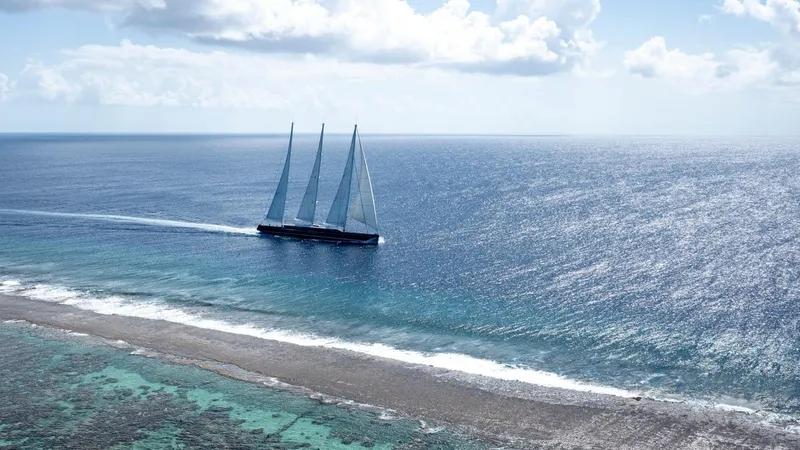
Following the debut of project AERA at the Monaco Yacht Show, Dutch shipyard Royal Huisman has unveiled its latest large sailing yacht concept — the TRIDENT 810, an 81-metre (266ft) aluminium flybridge schooner developed with Dykstra Naval Architects and Mark Whiteley Design. Fully engineered and ready to build, the project combines proven naval architecture with the ability for full customisation, setting a new benchmark for efficiency and versatility in the world of large sailing superyachts.
In brief
Royal Huisman has unveiled the build-ready TRIDENT 810 project, an 81-metre flybridge schooner sailing superyacht. Dykstra Naval Architects is responsible for the naval architecture and Mark Whiteley Design for the styling, while the aluminium hull and three-masted Panamax rig carry 2,580 square metres of sail. Use of Royal Huisman's existing engineering documentation shortens the build cycle to around three years. The interior by Mark Whiteley Design is modular, with cabin concepts for 12 guests.
Evolution, not reinvention
Rather than a complete reinvention, TRIDENT 810 represents a refinement of Royal Huisman’s existing large sailing yacht platform. By reusing an established engineering base, the yard can offer a significantly shorter delivery time of around three years while maintaining the custom standards associated with its brand.
This approach bridges the gap between proven series-built reliability and one-off bespoke creation, allowing owners to tailor the yacht’s configuration, layout and design to their individual vision.
Design and naval architecture
The yacht’s naval architecture is by Dykstra Naval Architects, with exterior and interior styling by Mark Whiteley Design. The hull features a plumb bow, long waterline and balanced proportions, optimised for performance and comfort during long-distance ocean cruising.
A three-masted Panamax rig provides a large sail area of approximately 2,580 sqm (27,770 sqft). An advanced sail management system allows all three mainsails to be hoisted simultaneously, reducing handling time and improving overall safety. Despite its size, the rig is designed for intuitive, low-effort operation, enabling experienced sailing crews — or even motor yacht owners transitioning to sail — to handle the vessel with confidence.
Systems and onboard technology
TRIDENT 810 benefits from in-house engineering by Royal Huisman, with a focus on redundancy, maintainability and energy efficiency. Key onboard systems feature fully redundant configurations and peak shaving technology to balance electrical loads, reduce fuel consumption and optimise generator performance.
These technical decisions translate into quieter operation, longer service intervals and reduced environmental impact — all crucial elements in long-range, bluewater cruising.
Construction and materials
The yacht’s all-aluminium hull and superstructure ensure a lightweight yet robust platform, enhancing performance under sail while allowing greater flexibility in custom interior layouts. Aluminium also provides superior corrosion resistance and easier long-term maintenance compared to steel, an advantage for global cruising.
The shipyard’s engineering philosophy prioritises easy technical access throughout the vessel, reducing downtime and simplifying service operations. Every system — from propulsion to hotel load management — is designed for long-term durability and simplified integration with Royal Huisman’s digital monitoring tools.
Range and operational profile
Designed as a true world cruiser, TRIDENT 810 offers the autonomy and capacity needed for global circumnavigation. Her efficient sailing configuration enables extensive voyages with minimal fuel use, aligning with the industry’s broader movement toward low-impact and wind-assisted propulsion.
This makes the yacht particularly appealing to experienced owners seeking a capable, environmentally conscious alternative to large displacement motor yachts.
Interior layout and customisation
Mark Whiteley Design has proposed several base layout configurations, all of which can be adapted to suit the owner’s operational preferences and lifestyle. The interior concept emphasises functionality, clarity of space and service flow, ensuring that crew operations remain discreet and efficient even during full guest occupancy.
Typical layouts include accommodation for up to 12 guests, a main deck salon with panoramic views, and an owner’s suite featuring private outdoor access. Finishes and materials can range from contemporary minimalist to traditional yacht craftsmanship, reflecting Royal Huisman’s flexibility in design execution.
A technical response to changing market demands
The TRIDENT 810 reflects broader shifts in the superyacht market: a move toward hybrid design thinking, energy-efficient operation, and accelerated delivery schedules without compromising quality. By leveraging existing engineering packages, Royal Huisman can offer a predictable build process, reducing risk while maintaining full custom scope.
For owners and brokers alike, the model demonstrates how established shipyards are adapting to a new balance between craftsmanship, sustainability and performance.
Technical maturity, not spectacular design
The TRIDENT 810 embodies Royal Huisman’s pragmatic vision of the future sailing superyacht: a vessel built upon proven technology, refined engineering, and a focus on long-range capability.
Ready for immediate build and open to full customisation, it offers a compelling example of how tradition and innovation can coexist in the large sailing yacht segment — not through radical reinvention, but through precise and deliberate evolution.
Source: Gazeta Morska · Compiled by: Kamil Kusier
Related articles
 Energy and offshore Equinor takes over Bałtyk 2 and 3 O&M base in Łeba. Port to serve 1.44 GW of offshore wind for 30 years
 Navy and defence Port Gdański Eksploatacja secures NATO NCAGE code. Gdańsk port company lines up for defence tenders
 Shipbuilding industry Ex-Enterprise towed to Mobile under $418.5m contract. Test case for Nimitz-class disposal begins
 Energy and offshore Energa renames Gdańsk gas plant company as foundations for 6,000-tonne turbine and boiler are laid
 Equipment and technology WB Group takes Polish drones from Tokyo to SOFEX in Jordan in a single week
 Ports and logistics PGE books Gdańsk’s T5 terminal for the long haul: Baltica 2 first, then more offshore wind farms
Comments (0)
The discussion is moderated by the editors: a comment appears after review. Your e-mail address is not published.
Nobody has commented on this article yet.