









Remontowa secures contract for new Hydrograf-class vessels for the Polish Navy
After more than four decades in service, ORP Heweliusz and ORP Arctowski will finally receive successors. Poland has signed a contract for two next-generation hydrographic vessels under the Hydrograf programme, strengthening maritime reconnaissance and NATO operational support capabilities in the Baltic Sea region.
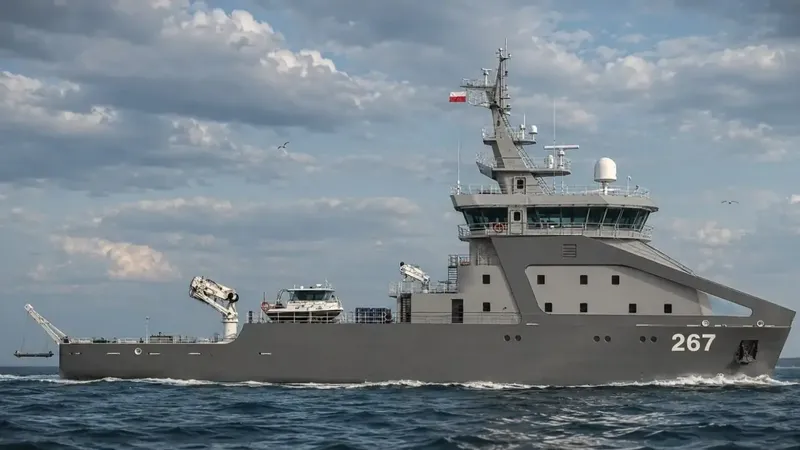
In brief
The Armament Agency and Remontowa Shipbuilding S.A. signed a contract in Gdańsk for the delivery of two hydrographic vessels under the Hydrograf programme, worth around PLN 1.5 billion, together with logistics and training packages. The new vessels are around 60 metres long and around 13 metres wide, with a range of around 5,000 nautical miles and a maximum speed of around 13 knots. The ships will replace ORP Heweliusz and ORP Arctowski, in service since the early 1980s. Deputy Prime Minister Władysław Kosiniak-Kamysz stressed that the contract is an investment in security and in more jobs.
Baltic security drives naval investments
The agreement between the Polish Armament Agency and Remontowa Shipbuilding was officially signed in Gdańsk. The contract covers the delivery of two hydrographic vessels together with logistics and support packages.
The HYDROGRAF programme is valued at approximately PLN 1.5 billion and represents another significant investment in Poland’s naval and maritime security capabilities.
The signing ceremony was attended by Deputy Prime Minister and Minister of National Defence Władysław Kosiniak-Kamysz, representatives of the Armament Agency and the management board of Remontowa Shipbuilding.
- This contract is an investment in security, but also in future jobs, said Deputy Prime Minister Władysław Kosiniak-Kamysz during the ceremony in Gdańsk.
The new vessels will replace the hydrographic support ships ORP Heweliusz and ORP Arctowski, both commissioned in the early 1980s and originally built at the former Stocznia Północna shipyard, today operating as Remontowa Shipbuilding.
From seabed mapping to critical infrastructure protection
The HYDROGRAF programme reflects the growing strategic importance of the Baltic Sea and the increasing demand for maritime domain awareness within NATO.
The future vessels will be designed for:
- hydrographic surveys,
- seabed mapping,
- acquisition and processing of geospatial data,
- navigational support for allied operations,
- underwater infrastructure monitoring.
The ships will feature advanced specialist equipment enabling data collection, processing and secure interoperability with NATO systems.
Beyond traditional hydrographic tasks, modern survey vessels are increasingly used for seabed reconnaissance, underwater object identification, mine countermeasure support and the protection of subsea critical infrastructure, including pipelines, power cables and telecommunications networks.
A new generation of naval hydrography
According to the currently available information, the vessels will measure approximately 60 metres in length with a beam of around 13 metres. Operational range is expected to reach approximately 5,000 nautical miles, while maximum speed will be around 13 knots.
Although the detailed equipment configuration has not yet been disclosed, the vessels are expected to incorporate state-of-the-art sonar systems, multibeam echo sounders and advanced hydrographic data-processing suites.
Remontowa expands its naval portfolio
The Hydrograf contract further strengthens the position of Remontowa Shipbuilding as one of Poland’s leading naval shipbuilders.
The Gdańsk-based yard is currently involved in several strategic naval programmes, including the Kormoran II mine countermeasure vessels and other specialist platforms for the Polish Navy.
For the domestic maritime industry, the programme represents not only a defence investment but also long-term support for highly specialised shipbuilding competencies and the national defence supply chain.
The project also highlights Poland’s growing role in NATO’s Baltic maritime security architecture at a time of heightened geopolitical tensions and increasing focus on the protection of subsea infrastructure.
Source: Gazeta Morska · Compiled by: Kamil Kusier
Related articles
 Energy and offshore Equinor takes over Bałtyk 2 and 3 O&M base in Łeba. Port to serve 1.44 GW of offshore wind for 30 years
 Navy and defence Port Gdański Eksploatacja secures NATO NCAGE code. Gdańsk port company lines up for defence tenders
 Shipbuilding industry Ex-Enterprise towed to Mobile under $418.5m contract. Test case for Nimitz-class disposal begins
 Energy and offshore Energa renames Gdańsk gas plant company as foundations for 6,000-tonne turbine and boiler are laid
 Equipment and technology WB Group takes Polish drones from Tokyo to SOFEX in Jordan in a single week
 Ports and logistics PGE books Gdańsk’s T5 terminal for the long haul: Baltica 2 first, then more offshore wind farms
Comments (0)
The discussion is moderated by the editors: a comment appears after review. Your e-mail address is not published.
Nobody has commented on this article yet.