









Remontowa lays keel for Torghatten Midt hybrid ferry B622
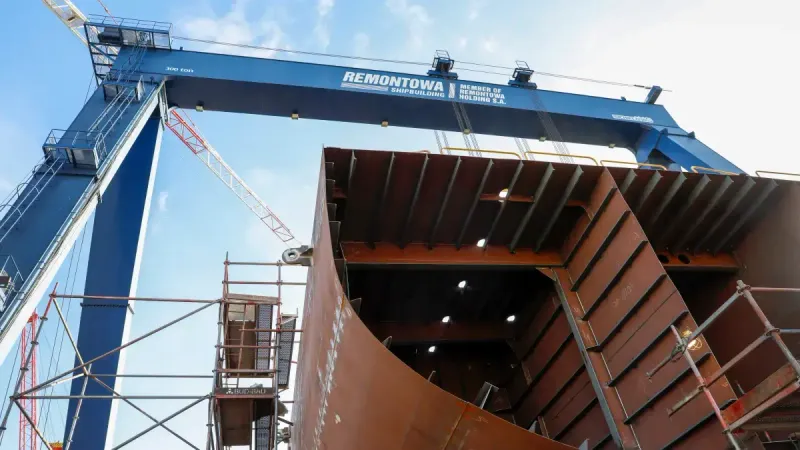
Remontowa Shipbuilding in Gdańsk held a keel-laying ceremony on Thursday, 15 October, for the hybrid passenger and car ferry B622 being built for Norwegian operator Torghatten Midt AS. The ceremony marks the start of hull construction for a vessel whose hull will eventually weigh around 1,000 tonnes. The 83.5-metre ferry will carry 249 passengers, 85 cars and six trucks at a time, with delivery planned for the second quarter of 2028.
In brief
Remontowa Shipbuilding laid the keel in Gdańsk on Thursday 15 October for the hybrid passenger and car ferry B622 for Norwegian owner Torghatten Midt AS. The 83.5 m ferry B622 will carry 249 passengers, 85 cars and 6 trucks, with delivery planned for the second quarter of 2028. A few years after delivery the batteries of ferry B622 are to be replaced with ones almost 15 times larger, enabling fully electric operation. Ferry B622 will be the tenth ferry built in Gdańsk for the Torghatten group.
From keel to a 1,000-tonne hull
In shipbuilding tradition, keel laying is the symbolic beginning of a ship's life. From this point the hull grows block by block on the slipway or in the dock, and the vessel formally exists as a structure under construction. For B622 it means moving from documentation and prefabrication to assembling a structure that will reach around 1,000 tonnes over the coming months.
Remontowa Shipbuilding signed the newbuilding contract on 16 January 2026. Nine months have passed from signing to keel laying, leaving roughly a year and a half until planned delivery.
Hybrid now, fully electric later
The ferry will have a diesel-electric hybrid propulsion system. Two azimuth thrusters with permanent magnet electric motors will be powered by four generator sets capable of running on 100 per cent biodiesel, supported by a small battery pack operating in peak-shaving mode to cover peak energy demand. As a result, no more than three generators need to run in normal operation, each at optimal load.
The most interesting part is the vessel's future. Within a few years of delivery, the air-cooled batteries are due to be replaced by water-cooled batteries almost 15 times larger, allowing the ferry to operate in fully electric mode. The design already accounts for this energy storage upgrade, so the change will not require rebuilding the ship.
Dønna and Herøy: a route where every kilowatt-hour counts
B622 is a double-ended ferry, identical at both ends, so it does not need to turn in port. It will serve the Norwegian fjords around the islands of Dønna and Herøy, an area known for its scenery and fishing villages. Given the sensitive operating area, the design focuses on minimising energy consumption and CO₂ emissions. The technical documentation was developed by The Norwegian Ship Design Company.
The tenth Gdańsk-built ferry for the Torghatten group
Remontowa Shipbuilding has worked with Torghatten group companies for 15 years, and B622 will be the tenth ferry built in Gdańsk for the operator. Between 2011 and 2013 the yard built eight ferries for Torghatten Nord, four of them LNG-powered. The ninth is the hybrid Bjarkøy (B620) for Torghatten Nord, which began sea trials in the summer of 2026.
The Gdańsk yard is one of Europe's most experienced builders of hybrid and battery-powered vessels. To date it has delivered seven such units, including electric ferries built between 2018 and 2021 for owners in Norway and the UK. Repeat orders from Norway, one of the world's most demanding markets for low-emission shipping, show continued confidence in Polish hulls and Polish expertise.
Source: Gazeta Morska · Compiled by: Kamil Kusier
Related articles
 Energy and offshore Equinor takes over Bałtyk 2 and 3 O&M base in Łeba. Port to serve 1.44 GW of offshore wind for 30 years
 Navy and defence Port Gdański Eksploatacja secures NATO NCAGE code. Gdańsk port company lines up for defence tenders
 Shipbuilding industry Ex-Enterprise towed to Mobile under $418.5m contract. Test case for Nimitz-class disposal begins
 Energy and offshore Energa renames Gdańsk gas plant company as foundations for 6,000-tonne turbine and boiler are laid
 Equipment and technology WB Group takes Polish drones from Tokyo to SOFEX in Jordan in a single week
 Ports and logistics PGE books Gdańsk’s T5 terminal for the long haul: Baltica 2 first, then more offshore wind farms
Comments (0)
The discussion is moderated by the editors: a comment appears after review. Your e-mail address is not published.
Nobody has commented on this article yet.