









Puck breakwater, new groynes and a permit for the nuclear MOLF: what Poland's maritime offices are building
The Maritime Office in Gdynia has completed piling works on the new protective breakwater at the fishing port of Puck, a project worth around PLN 50 million. It is one of more than a dozen jobs Poland's maritime administration is running this autumn between Świnoujście and the Gulf of Gdańsk. The offices in Gdynia and Szczecin are building groynes, widening beaches and preparing infrastructure for the country's first nuclear power plant and the new outer port in Świnoujście, while the Maritime Office in Słupsk, reinstated in August, is recruiting staff and setting up cooperation with the fisheries inspectorate.
In brief
Strabag has completed pile-driving works on the breakwater at the fishing port in Puck, a Maritime Office in Gdynia investment worth about 50 million PLN gross. The Puck breakwater will be 427.2 m long and will protect the Fishing Basin from waves and ice. The Regional Director for Environmental Protection in Gdańsk issued an environmental decision on 30 September for the MOLF in Lubiatowo, a jetty about 1112 m long. The Maritime Office in Szczecin is preparing about 50 new groynes between Niechorze and Rewal and between Pustkowo and Pobierowo for 39 million PLN.
For fishing operators in Puck Bay the work means safer berthing in the Fishing Basin. Coastal municipalities gain new storm protection, while port operators and energy investors move closer to the permits on which the largest construction projects on the coast depend.
Puck moves from piling to reinforced concrete
In the spring the contractor, Strabag, finished placing sand fill over a reclaimed area of almost 7,500 m² and began building the main hydraulic structures. The piling phase is now complete. Steel sheet pile walls have been installed, tubular piles driven and stabilising elements fitted, including steel tie rods.
Crews are now casting reinforced concrete capping beams, which top and tie together the breakwater structure. Work is under way on the western and eastern sides, from the bend in the breakwater axis to its connection with the shore. Filter layers are being laid in parallel on the root section and around the South Quay, clearing the way for further concrete work there.
The next stage is a rock armour layer between the bend and the breakwater head, after which concreting will move to the head itself. Despite weather interruptions, the work is on schedule.
The Maritime Office in Gdynia signed the contract with Strabag in September 2025, and the project is worth around PLN 50 million gross. The breakwater will be 427.2 metres long and will shield the Fishing Basin from waves and ice. The scope also includes the South Quay, an approach channel with navigation marking and a slipway for small vessels.
Gdynia and Rewa prepare the shoreline for winter storms
On 9 October the Maritime Office in Gdynia signed a contract for artificial beach nourishment between Oksywie and Babie Doły, covering kilometres 90.50 to 93.00 of the coast. The PLN 4.8 million gross job will be delivered on a design and build basis, with six months allowed for design and works. The result will be a wider beach at Babie Doły.
Repairs are also starting on the last section, around 400 metres long, of the coastal revetment along the Feliks Nowowiejski Seaside Boulevard in Gdynia, from the Small Pier to the beach at Redłowo. The revetment protects the promenade from waves and storms. The boulevard stays open to walkers, although the footpath will be narrowed in places.
After a summer break, work has resumed on flood protection at Rewa. The final stage has been under way since 1 September, with a granite footpath, the flood defence structure itself and rock armour on the shoreline. The Maritime Office in Gdynia plans to complete the project by the end of 2026.
Environmental decision for the MOLF at Lubiatowo
On 30 September the Regional Director for Environmental Protection in Gdańsk issued an environmental decision for the MOLF (Marine Off-Loading Facility) serving Poland's first nuclear power plant, together with a service road linking it to the plant site. The application was filed jointly by the Director of the Maritime Office in Gdynia, responsible for the MOLF structure, and Polskie Elektrownie Jądrowe, which will build the road.
The MOLF will be a fixed, open-structure reinforced concrete jetty on steel piles, around 1,112 metres long, with around 970 metres at sea. Cargo will be lifted off by crane on a lo-lo basis or driven off the ship on self-propelled platform trailers on a ro-ro basis. The scope also covers berths, a manoeuvring area, a turning basin and an approach channel, while the open structure is designed to let seabed sediment move freely between the supports.
The heaviest and largest plant components, including reactor vessels and steam generators, will arrive by sea. The Maritime Office in Gdynia has announced applications for a location decision and a water permit, followed by a building permit. A tender for the construction contractor is running in parallel with acceptance of the design documentation.
- We are drawing on our experience in delivering hydraulic engineering projects to prepare and carry out the construction of the MOLF with due care, taking into account safety and environmental requirements. We work closely with Polskie Elektrownie Jądrowe, coordinating our activities with the construction schedule of the power plant and other associated investments - said Anna Stelmaszyk-Świerczyńska, Director of the Maritime Office in Gdynia.
The facility is being planned on one of the best-studied stretches of the Polish coast. The Coastal Research Station at Lubiatowo, run by the Institute of Hydro-Engineering of the Polish Academy of Sciences, has studied waves, currents and sediment transport there since 1970 and has measured the shoreline position systematically since 1983. In 2025 the institute prepared an analysis of hydrodynamic conditions and sediment transport for the MOLF, used in the environmental impact report.
Protection plans for Puck Bay and seabirds
The Maritime Office in Gdynia has signed a contract to draft a protection plan for the Natura 2000 site Przybrzeżne Wody Bałtyku (PLB990002). The work covers seabird surveys, assessment of their numbers and distribution, identification of threats and specific conservation measures. The office has also begun drafting a protection plan for the marine part of the Zatoka Pucka i Półwysep Helski site (PLH220032), with comments and proposals open to the public.
On 9 September the Maritime Office in Szczecin announced a similar procedure for Natura 2000 sites designated in Polish maritime areas. Both offices also work with partners abroad. In September their representatives attended the KRING meeting of European coastal protection engineers in Rotterdam, and on 6 and 7 October Marcin Skrzypek of the Gdynia office's Coastal Protection Inspectorate took part in the launch of the HARCCA project on climate-resilient coasts in Lund, Sweden. The Maritime Office in Gdynia is an associated partner, and the Hel Peninsula is one of the study areas.
Groynes from Wicie to Pobierowo
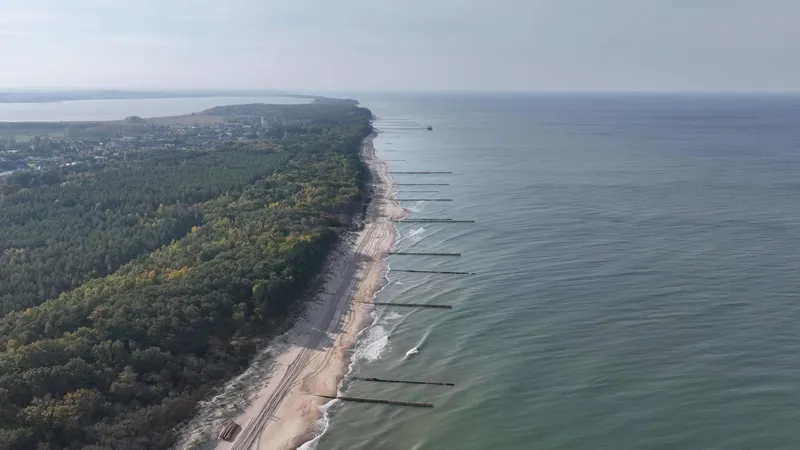
On the western coast, groynes are the main focus. Construction is under way at Wicie as part of a project to replace damaged groyne groups and build new ones between Wicie and Pleśna, co-financed by the EU's FEnIKS 2021-2027 programme under its climate adaptation measure. Under the environmental decision issued by the Regional Director for Environmental Protection in Szczecin on 18 June, an existing solid groyne on a stretch of around 540 metres at Wicie will be removed and replaced with timber pile palisade groynes with T-shaped cross heads. Although Wicie and Pleśna have fallen within the area of the Maritime Office in Słupsk since 1 August, the previously prepared project is being continued by the Maritime Office in Szczecin.
Larger programmes are being prepared in the municipalities of Rewal and Trzebiatów. Around 50 new groynes are planned between Niechorze and Rewal (2.2 km) and between Pustkowo and Pobierowo (2.6 km), in a PLN 39 million project with around PLN 31 million of EU funding. On the Rogowo-Mrzeżyno stretch, more than 6.5 km long, the office will rebuild damaged groynes and add new ones, an initial estimate of 30 to 45, at a cost of PLN 44 million, including around PLN 35 million from the EU.
The Maritime Office in Szczecin signed the funding agreements for both projects with the National Fund for Environmental Protection and Water Management (NFOŚiGW) on 17 September 2025. Construction will be preceded by design work backed by geodetic, geological and ferromagnetic surveys. Technical beach access ramps will be built at Pobierowo and on the Rogowo-Mrzeżyno stretch, so that the office's crews can inspect and maintain the new structures.
Świnoujście and Darłowo, from unexploded ordnance to a new quay
Second World War ordnance weighing almost 3,500 kg in total was found on the construction site of the breakwater for the new outer port in Świnoujście. Neutralisation was scheduled for 5 to 8 October, carried out by the mine clearance divers of the 12th Minesweeper Squadron of the 8th Coastal Defence Flotilla. Safety zones and navigation restrictions were set in the Pomeranian Bay for the duration, with a strict ban on entering the water planned for beaches from Ahlbeck in Germany to Międzyzdroje.
In May the Maritime Office in Szczecin launched tenders for two projects intended to improve traffic safety and the capacity of the transport system. The first will widen a section of the approach channel to the port of Świnoujście to 500 metres, the second will create a passing place for ships in the Police Canal.
On 17 August in Darłowo, the office marked the completion of its breakwater reconstruction and new structures improving wave conditions inside the harbour basin, funded by Poland's National Recovery Plan. At the same time the town completed its own project upgrading the port's hydraulic structures for offshore wind operations and maintenance, and the event was held at the newly built Transshipment Quay. Darłowo now falls within the area of the Maritime Office in Słupsk.
The Maritime Office in Szczecin celebrated its 80th anniversary on 25 September. The ceremony, attended by Deputy Infrastructure Minister Arkadiusz Marchewka, took place in the new buoy hall of the Navigational Marking Base, and long-serving staff received state, ministerial and company awards.
Słupsk builds its team and sits down with the fisheries inspectorate
The Maritime Office in Słupsk has been operating since 1 August and supervises the coast from Łeba to Dźwirzyno. It took over the area east of Ustka from the Maritime Office in Gdynia and the stretch west of Ustka from the Maritime Office in Szczecin, together with VTS Ławica Słupska and the harbour master's offices in Ustka, Łeba, Darłowo, Kołobrzeg and Dźwirzyno. In Słupsk it operates from two sites, its main office on Niemcewicza Street and a technical branch on Sienkiewicza Street.
At the end of September Director Anna Sędzińska put the headcount at around 240, with a target team of 290, leaving around 50 posts to fill. At the same time the office was clearing residues of an oil-based substance from local beaches, with samples sent for testing.
On 16 October Anna Sędzińska met Marek Zimakowski, Chief Inspector of Sea Fisheries, and Wioleta Lisowska, Director General of the Chief Inspectorate of Sea Fisheries. Talks covered supervision of fishing ports and landing sites, sea fisheries control, port infrastructure development, and recreational and amateur fishing. Both institutions are based in Słupsk, and the meeting was their first formal step towards coordinating work on the central coast.
Source: Gazeta Morska · Compiled by: Kamil Kusier
Related articles
 Energy and offshore Equinor takes over Bałtyk 2 and 3 O&M base in Łeba. Port to serve 1.44 GW of offshore wind for 30 years
 Navy and defence Port Gdański Eksploatacja secures NATO NCAGE code. Gdańsk port company lines up for defence tenders
 Shipbuilding industry Ex-Enterprise towed to Mobile under $418.5m contract. Test case for Nimitz-class disposal begins
 Energy and offshore Energa renames Gdańsk gas plant company as foundations for 6,000-tonne turbine and boiler are laid
 Equipment and technology WB Group takes Polish drones from Tokyo to SOFEX in Jordan in a single week
 Ports and logistics PGE books Gdańsk’s T5 terminal for the long haul: Baltica 2 first, then more offshore wind farms
Comments (0)
The discussion is moderated by the editors: a comment appears after review. Your e-mail address is not published.
Nobody has commented on this article yet.