









Pricing out accessibility? Water tram to Hel reflects broader shift in Baltic coastal mobility
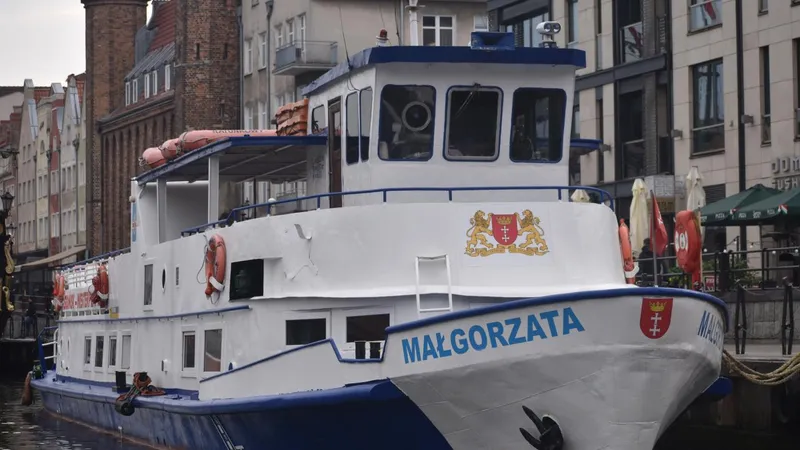
For years, seasonal water tram connections between Gdańsk, Sopot, Gdynia and Hel have occupied a unique space between public transport and leisure product. In 2026, that balance appears to have shifted decisively toward the latter.
In brief
Water tram tickets on the Gdańsk to Hel route in the 2026 season cost around 120 zlotys one way and up to 170 zlotys return, which for a family of four means spending more than 600 zlotys. A train journey from Gdańsk to Hel costs the same family around 70 zlotys one way, with a change required in Gdynia. Some Żegluga Gdańska sailings are marked with the letter R, meaning reserve sailings that may not run if too few passengers turn up. Operators explain the prices by the costs of fuel, vessel maintenance and crew work.
With ticket prices reaching approximately 120 PLN one way from Gdańsk and up to 170 PLN for a return journey, the water tram is increasingly positioned as a premium coastal experience rather than an accessible mobility solution. For a family of four, the cost of a round trip now exceeds 600 PLN - effectively redefining the service from spontaneous day-trip option to a planned discretionary expense.
From hybrid mobility to tourism-driven pricing
The water tram across the Gulf of Gdańsk has long been framed as a hybrid offering - part of the region’s transport ecosystem, yet strongly tied to tourism demand. Today, the economic logic is clearer: this is a commercially operated service, sensitive to fuel costs, vessel maintenance, and seasonal demand fluctuations.
Operators point to rising operational expenditures as the primary driver of fare increases. These include not only fuel and crew costs, but also compliance, port fees, and fleet upkeep - factors that have intensified across the European maritime sector in recent years.
However, from a user perspective, the shift is more structural than cyclical. The absence of broad discount frameworks - such as family-oriented schemes or integration with national programs like large family cards - underscores the limited role of public subsidy in this segment.
Demand uncertainty and operational flexibility
An additional layer shaping the passenger experience is operational conditionality. Selected sailings are marked with an "R" designation, indicating a reserve (conditional) service. In practice, this means that a given departure may be cancelled if demand does not reach a minimum threshold.
From an operator’s standpoint, this is a rational tool for cost control in a highly seasonal market. Running underfilled vessels on fuel-intensive coastal routes is economically inefficient, particularly in a volatile pricing environment.
From a passenger perspective, however, it introduces uncertainty that is atypical for transport services. The combination of relatively high ticket prices and the possibility of last-minute cancellation reinforces the perception of the water tram as a tourism-driven, demand-dependent product rather than a reliable mobility option.
Competitive alternatives remain constrained
In theory, the Hel Peninsula is accessible via multiple transport modes. In practice, each comes with trade-offs. Road access along the Hel Peninsula is notoriously congested during peak summer periods, with travel times often exceeding several hours. Rail connections offer lower fares but limited comfort and high occupancy in peak season. Active mobility options, such as cycling, are viable only for a niche segment.
Within this context, the water tram retains a strong value proposition in terms of travel time reliability and user experience—when the service operates as scheduled. This conditional reliability is an increasingly important variable in how passengers assess value.
Accessibility vs. experience: a policy question
The current trajectory raises a broader question for maritime and regional policy stakeholders: should seasonal coastal shipping services be treated purely as commercial tourism products, or as part of a wider, publicly relevant transport framework?
In several European regions, comparable short-distance maritime connections benefit from public co-financing, enabling lower fares and broader accessibility. In Northern Poland, such mechanisms remain limited or absent in this segment.
Given the strategic importance of coastal tourism and the socio-economic role of the Baltic shoreline, there is a growing case for re-evaluating this model - particularly in the context of inclusive access and predictable service availability.
Beyond pricing: positioning coastal shipping
The case of the Gdańsk–Hel water tram illustrates a wider trend in short-sea and nearshore passenger services: the gradual repositioning from transport utility to curated experience. While this can enhance profitability and brand value, it may also narrow the user base.
For industry stakeholders, the key challenge lies in balancing operational viability with accessibility and reliability. Without intervention - whether through policy, partnerships, or pricing innovation - services risk becoming increasingly exclusive and operationally conditional, limiting their role in the broader maritime mobility ecosystem.
As the Baltic region continues to develop its coastal infrastructure and tourism offering, the question is no longer whether demand exists, but who will ultimately be able to access it and under what conditions.
In that sense, the future of short-distance maritime transport may depend as much on pricing strategy and demand management as on fleet or route development.
Source: Gazeta Morska · Compiled by: Kamil Kusier
Related articles
 Energy and offshore Equinor takes over Bałtyk 2 and 3 O&M base in Łeba. Port to serve 1.44 GW of offshore wind for 30 years
 Navy and defence Port Gdański Eksploatacja secures NATO NCAGE code. Gdańsk port company lines up for defence tenders
 Shipbuilding industry Ex-Enterprise towed to Mobile under $418.5m contract. Test case for Nimitz-class disposal begins
 Energy and offshore Energa renames Gdańsk gas plant company as foundations for 6,000-tonne turbine and boiler are laid
 Equipment and technology WB Group takes Polish drones from Tokyo to SOFEX in Jordan in a single week
 Ports and logistics PGE books Gdańsk’s T5 terminal for the long haul: Baltica 2 first, then more offshore wind farms
Comments (0)
The discussion is moderated by the editors: a comment appears after review. Your e-mail address is not published.
Nobody has commented on this article yet.