









Port of Gdynia strengthens its role in European logistics with Finnlines’ Biscay Line
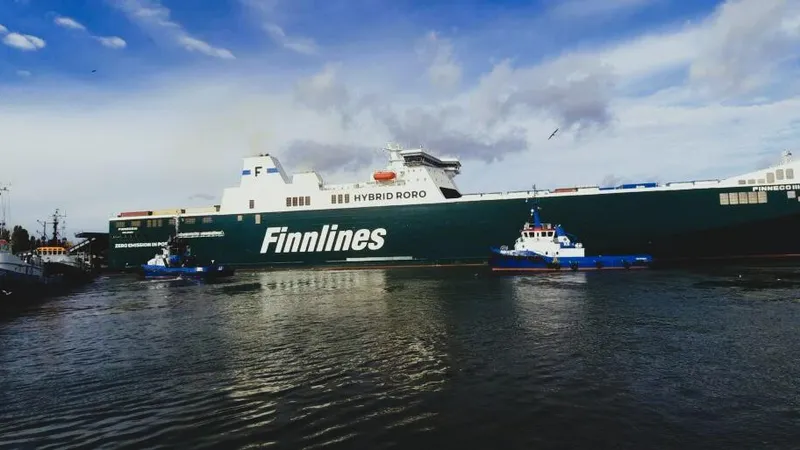
The Port of Gdynia continues to reinforce its position as a key logistics hub in Northern Europe. Finnlines marked six months of operation of its new Biscay Line during an industry event held on 12 December in Gdynia. Launched in June 2025, the weekly ro-ro service directly connects Gdynia with Belgium, the United Kingdom, Spain and Finland.
In brief
Finnlines summed up in Gdynia on 12 December six months of operating its Biscay line, launched in June 2025. The weekly ro-ro service links the Port of Gdynia with Belgium, the United Kingdom, Spain and Finland and is operated by three hybrid vessels, Finneco I, Finneco II and Finneco III, each carrying 420 trailers or 2,500 vehicles. Hybrid technologies, lithium-ion batteries and solar panels cut CO₂ emissions by up to 90%.
The new connection significantly enhances the port’s transport offering, increasing capacity along the North–West corridor and improving the handling of ro-ro, breakbulk, containerised and project cargo. Through seamless integration with the Grimaldi Group’s global network, Polish shippers also gain access to services linking Europe with the Far East, the Middle East, the Mediterranean, West Africa, South America and the US East Coast.
The Biscay Line is operated by three next-generation hybrid ro-ro vessels – Finneco I, Finneco II and Finneco III – each capable of carrying up to 420 trailers or 2,500 vehicles. The vessels are designed to handle a wide range of cargo, including oversized and special units transported on 80’ mafi trailers with integrated rail tracks.
Advanced hybrid technologies, lithium-ion batteries, solar panels and optimised hull design allow CO₂ emissions to be reduced by up to 90%. Combined with zero-emission port operations, the service significantly lowers emissions per cargo unit, setting new sustainability benchmarks in European short-sea shipping.
Finnlines’ Biscay Line strengthens trade links between Northern and Western Europe, offering customers a reliable, cost-effective and environmentally responsible alternative to long-haul road transport. At the same time, it further consolidates Gdynia’s role as a strategic ro-ro gateway in the Baltic and European logistics landscape.
Source: Gazeta Morska · Compiled by: Kamil Kusier
Related articles
 Shipbuilding industry Ex-Enterprise towed to Mobile under $418.5m contract. Test case for Nimitz-class disposal begins
 Maritime economy Poland’s constitutional crisis is also a maritime story
 Safety and rescue Polish SAR’s new rescue vessel Mistral launched at Kewatec in Finland
 Investments Port of Gdańsk opens T5 offshore installation terminal, bringing Baltica 2 logistics home from Bornholm
 Maritime economy Bursztyn Unity to raise the Polish flag, but crew terms remain an open question
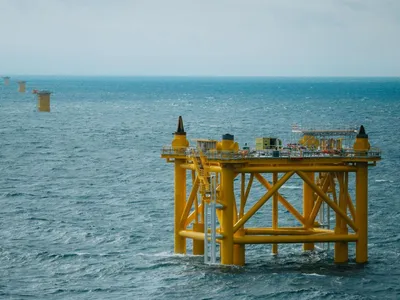 Energy and offshore Bałtyk 2 and 3 offshore wind: all 100 foundations installed, export cables laid
Comments (0)
The discussion is moderated by the editors: a comment appears after review. Your e-mail address is not published.
Nobody has commented on this article yet.