









Port of Gdynia Joins Finnlines' Bay of Biscay Line - A New Ro-Ro Gateway Linking the Baltic with Western Europe
At the end of June, OT Port Gdynia became part of the Bay of Biscay Line, a new regular ro-ro service operated by Finnlines, marking a significant step in expanding the Port of Gdynia’s role in European logistics and intermodal transport networks.
In brief
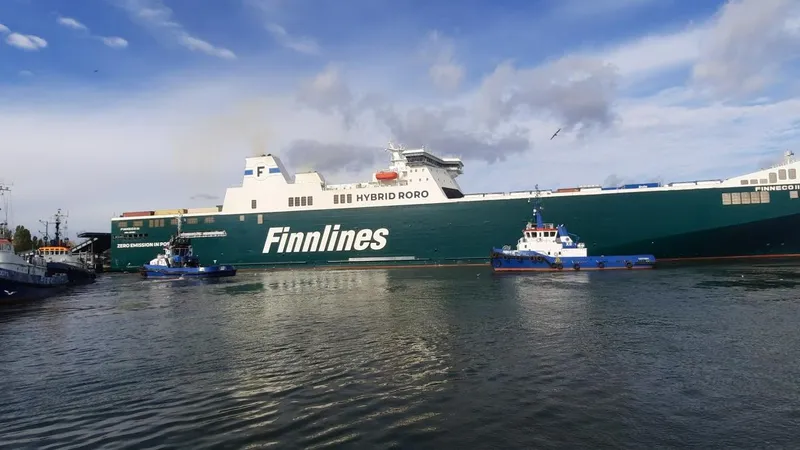
The first ship of the new Biscay Line of the shipowner Finnlines called at the OT Port Gdynia terminal at the end of June. The Biscay Line is a weekly ro-ro service from Helsinki via Kotka, Gdynia, Antwerp, Sheerness and Zeebrugge to Bilbao, with ships departing Gdynia westbound on Fridays and eastbound on Sunday mornings. The service is operated by three Finneco class vessels with 5,800 lane metres, accommodating up to 400 trailers. The Finneco ships feature hybrid propulsion, exhaust gas cleaning systems, solar panels and shore power supply.
The new line connects key ports across Finland, Poland, Belgium, the United Kingdom, and Spain, forming a full loop with weekly westbound and eastbound calls. The westbound route runs from Helsinki and Kotka (Finland) via Gdynia, Antwerp (Belgium), Sheerness near London (UK), and Zeebrugge (Belgium) to Bilbao (Spain). The eastbound leg mirrors this, returning from Bilbao to Helsinki.
OT Port Gdynia now hosts weekly port calls: departures to the west take place on Friday PM, while eastbound arrivals occur on Sunday AM. The service is operated by three next-generation Finneco-class ro-ro vessels, each offering 5,800 lane metres of cargo space—enough to accommodate approximately 400 trailers per sailing.
These vessels are engineered to carry a wide spectrum of wheeled cargo, including semi-trailers, trucks, industrial machinery, and out-of-gauge loads, the latter facilitated by mafi-type trailers designed for heavy and non-standard units. OT Port Gdynia is fully equipped to handle such cargoes, with the necessary terminal infrastructure and operational expertise already in place.
Importantly, the Finneco vessels meet the highest environmental standards. These are hybrid ro-ro ships, featuring electric propulsion assistance, advanced exhaust gas cleaning systems, solar panels, and shore power compatibility. As a result, they significantly reduce CO₂, NOₓ, and SOₓ emissions, aligning with broader EU decarbonisation goals and the maritime industry's drive toward cleaner transport corridors.
The launch of the Bay of Biscay Line is more than just a new service call—it positions Port of Gdynia as a strategic player in a modern, sustainable logistics chain spanning Northern and Southern Europe. It’s a move that reflects both operational growth and the port’s commitment to innovation in maritime transport.
Source: Gazeta Morska · Compiled by: Kamil Kusier
Related articles
 Energy and offshore Equinor takes over Bałtyk 2 and 3 O&M base in Łeba. Port to serve 1.44 GW of offshore wind for 30 years
 Navy and defence Port Gdański Eksploatacja secures NATO NCAGE code. Gdańsk port company lines up for defence tenders
 Shipbuilding industry Ex-Enterprise towed to Mobile under $418.5m contract. Test case for Nimitz-class disposal begins
 Energy and offshore Energa renames Gdańsk gas plant company as foundations for 6,000-tonne turbine and boiler are laid
 Equipment and technology WB Group takes Polish drones from Tokyo to SOFEX in Jordan in a single week
 Ports and logistics PGE books Gdańsk’s T5 terminal for the long haul: Baltica 2 first, then more offshore wind farms
Comments (0)
The discussion is moderated by the editors: a comment appears after review. Your e-mail address is not published.
Nobody has commented on this article yet.