









Port of Gdańsk signs design contract for integrated border control centre
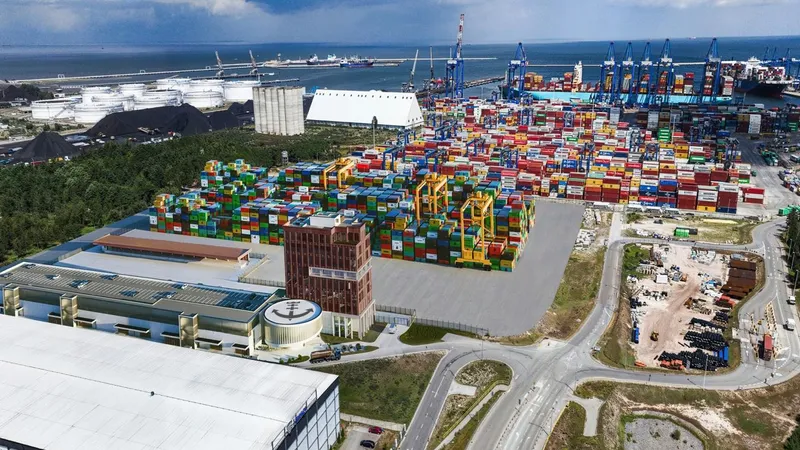
An Integrated Border Control Point (ZPKG) will be built on a plot of more than 2 hectares at Kontenerowa Street in the Port of Gdańsk, directly adjacent to the Baltic Hub container terminal. On 6 August, the port authority signed a contract with the design office Transprojekt Gdański, selected in a tender that drew six bidders. The contract covers design documentation, the necessary permits and administrative decisions, and multidisciplinary designer's supervision over the investment, with completion set for 14 September 2028.
In brief
The Port of Gdańsk Authority signed a contract on 6 August with Transprojekt Gdański for documentation of an Integrated Border Control Point on Kontenerowa Street, next to the Baltic Hub terminal. The contract, due by 14 September 2028, covers design, permits and author's supervision, and Transprojekt Gdański was chosen from six bidders. The facility on a plot of over 2 hectares will comprise a 9-storey office building and a 3-storey inspection hall, with rooftop parking for 230 cars and 235 staff per shift. Documentation costs PLN 3.5 million net and construction PLN 163 million net, with works starting in the first quarter of 2029.
This is the next stage in preparing the investment, following the agreement signed on 28 May 2025 between the Pomeranian Voivode and the Port of Gdańsk Authority on the development of design and cost documentation.
Inspection services under one roof
Border control services currently operate from different parts of Gdańsk, working in a dispersed one- and two-shift model. The ZPKG will consolidate their activity in a single facility housing, among others, the National Revenue Administration, the Border Veterinary Inspectorate, the Border Sanitary and Epidemiological Station, the Voivodeship Plant Health and Seed Inspection Service and the Voivodeship Inspectorate of Commercial Quality of Agri-Food Products. A single shift will employ 235 people. The ZPKG will carry out border controls of consignments entering the EU mainly through the Baltic Hub container terminal.
- A port means imports, exports and transit, and all of these areas are hugely important for both the region and the state as a whole. Imports generate customs revenue for the state budget, while the efficiency of clearances translates directly into the attractiveness of the Port of Gdańsk, growth in cargo volumes and higher income from port charges. It is also crucial for us to provide proper working conditions for the services and the administration, both the consolidated voivodeship administration and the central one. Although the Port of Gdańsk is formally the investor, as the owner of the land and the party responsible for obtaining the necessary decisions, the investment is financed from the state budget. The facility will be used by state services - explains Emil Rojek, First Deputy Pomeranian Voivode.
- The Integrated Border Control Point is an investment that brings inspection services together in one place and speeds up controls, which will translate directly into the efficiency and security of operations at the Port of Gdańsk. It is a project important not only for the port but for the whole economy, strengthening our logistics security and competitiveness. We are consistently delivering investments that build the resilience of the Port of Gdańsk and its position as a modern, sustainable hub in international maritime trade - says Dorota Pyć, president of the Port of Gdańsk Authority.
Office tower, control hall and rooftop parking
The construction site is already prepared. Under the architectural concept by the FOGO Architekci studio, the ZPKG will consist of a nine-storey office building and a three-storey border control hall. A canopy with a staff room for security checks is planned opposite the hall. The roof of the hall will hold a car park for 230 employee vehicles, accessed via an external covered spiral ramp between the buildings and connected to the office building by a link on the hall's third storey.
The site will be fenced, with four entrances from the internal port road. A direct connection to the Baltic Hub terminal will also be built - tractor units carrying containers directed for inspection will pass through two gates. Security checks will take place under the ramp, while full physical inspections will be carried out in the hall. The design also provides for renewable energy installations with the option of feeding surpluses into the grid.
Costs and timeline
Stage one, covering the documentation, is priced at PLN 3.5 million net, while stage two, covering construction and fitting out the facility, is estimated at PLN 163 million net. Construction is expected to begin in the first quarter of 2029.
Source: Gazeta Morska · Compiled by: Michał Iwański
Related articles
 Energy and offshore Equinor takes over Bałtyk 2 and 3 O&M base in Łeba. Port to serve 1.44 GW of offshore wind for 30 years
 Navy and defence Port Gdański Eksploatacja secures NATO NCAGE code. Gdańsk port company lines up for defence tenders
 Shipbuilding industry Ex-Enterprise towed to Mobile under $418.5m contract. Test case for Nimitz-class disposal begins
 Energy and offshore Energa renames Gdańsk gas plant company as foundations for 6,000-tonne turbine and boiler are laid
 Equipment and technology WB Group takes Polish drones from Tokyo to SOFEX in Jordan in a single week
 Ports and logistics PGE books Gdańsk’s T5 terminal for the long haul: Baltica 2 first, then more offshore wind farms
Comments (0)
The discussion is moderated by the editors: a comment appears after review. Your e-mail address is not published.
Nobody has commented on this article yet.