Port of Gdańsk strengthens its leading position - a robust first half of 2025
The Port of Gdańsk closed the first half of 2025 with strong operational and financial results, reinforcing its position as a key logistics hub in the Baltic Sea region. Cargo throughput exceeded 38.3 million tonnes, marking a 0.4% increase year-on-year. Financial performance was equally solid: net sales profitability reached 56%, while net profit rose by 40%, amounting to PLN 179.6 million.
business maritime economy pomerania ports tricity news24 july 2025 | 17:00 | Source: Gazeta Morska | Prepared by: Kamil Kusier | Print
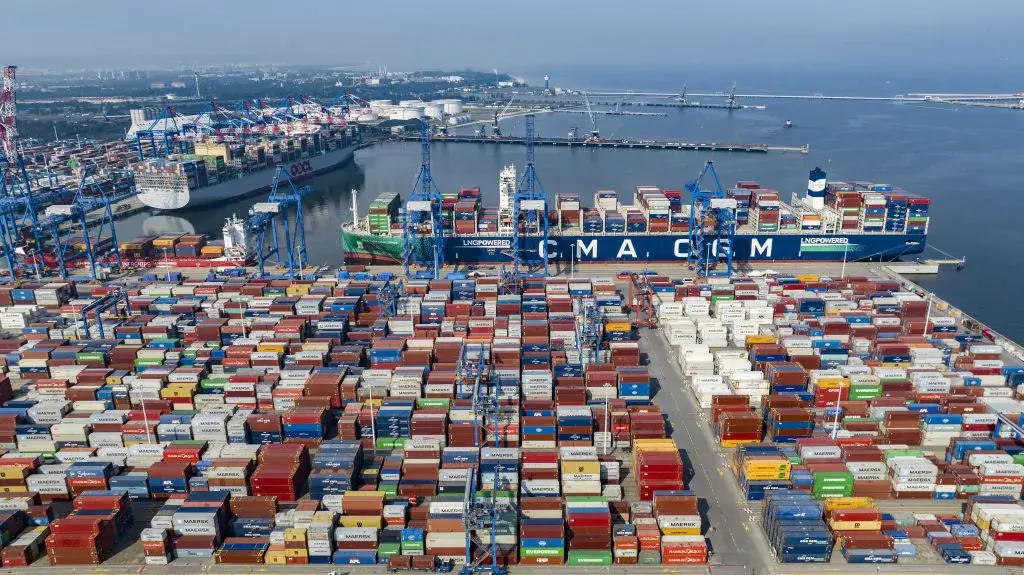
fot. Port Gdańsk
Liquid fuels remain dominant, container segment drives growth
Liquid fuels continued to dominate the cargo structure, accounting for 50% of total throughput. Although volumes fell slightly (down 4.7% year-on-year to 19.2 million tonnes) due to reduced domestic energy demand and lower strategic reserve activity, the segment remained stable. The majority of this traffic was handled by Naftoport.
The second-largest cargo category was general cargo, with volumes reaching 13 million tonnes, an increase of 12%. Within this segment, containerised cargo grew by 14% to 11.6 million tonnes. This boost is largely attributed to the launch of new maritime services by Mediterranean Shipping Company (MSC). With the introduction of its Britannia and Albatros services, Gdańsk has become a regular stop on MSC's Asia–Europe routes, connecting Poland directly to ports in China, South Korea, and Vietnam.
Baltic Hub expansion unlocks new container capacity
The container segment remains the port’s primary growth driver. The expansion of the Baltic Hub Container Terminal (BHCT) — the largest container terminal on the Baltic Sea — played a key role. The launch of the T3 terminal increased BHCT’s capacity by 1.5 million TEUs, from 3 to 4.5 million TEUs, reinforcing Gdańsk’s strategic position as a hub for Central and Eastern Europe.
Ore volumes surge, while coal and grain decline
The bulk cargo segment recorded mixed results. The "other bulk goods" category increased by 25%, reaching 1.9 million tonnes, with a particularly sharp rise in ore throughput, which jumped by 206%, the highest growth rate across all cargo types.
Conversely, coal volumes dropped by 12.4% to 2.9 million tonnes, reflecting lower national demand. Grain shipments were also down — falling 26% year-on-year to just over 1.1 million tonnes, in line with earlier forecasts.
Long-term resilience built on investment and global connectivity
– The Port of Gdańsk is steadily and pragmatically building its leadership in the Baltic Sea region, said Dorota Pyć, CEO of the Port of Gdańsk Authority. – The dynamic expansion of the container segment, stable performance in liquid fuels, and a rebound in bulk cargo show that we are responding flexibly to evolving economic, social, and geopolitical conditions.
The positive first-half results, supported by a diversified cargo structure and expanding infrastructure, confirm Gdańsk’s growing relevance in global maritime logistics. The port’s strong financial base and improved connectivity position it for continued growth in the second half of 2025 and beyond.
see also
Buy us a coffee, and we’ll invest in great maritime journalism! Support Gazeta Morska and help us sail forward – click here!
Kamil Kusier
redaktor naczelny
comments
Add the first comment
see also
Navantia and Fincantieri deepen cooperation on the european patrol corvette programme
Galeon Yachts and Meyer Shank Racing: merging luxury yachts with motorsport expertise
Unmanned systems and naval firepower modules. WB Group showcases integrated capabilities at Enforce Tac 2026
Swedish ports record lowest ship calls in 18 years. Implications for the maritime sector
February in Szczecin’s shiprepair sector. Ice, overhauls and North Sea expansion
Advanced ROV trials conducted at CTO to validate subsea technologies for offshore applications
University of Gdańsk and PGZ Naval Shipyard join forces for innovation and security
Stadt Naval to deliver electric propulsion system for Polish rescue vessel Ratownik
Gdańsk port’s Basen Górniczy to gain modern port infrastructure
First month of Jantar Unity operations. Polsca ferry paves the way for Batory program units
ADVERTISEMENT
ADVERTISEMENT