









Port Gdańsk climbs the European port ranking with strong growth in 2025
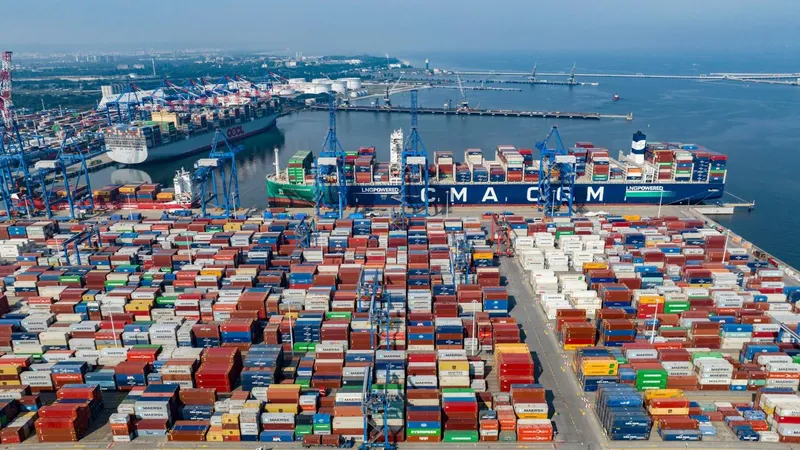
Port Gdańsk closed 2025 with 80.4 million tons of cargo handled, strengthening its position among the largest ports in Europe. The port moved up three positions in the European ranking, reaching eighth place in Europe and sixth place within the European Union. This performance places Gdańsk ahead of ports in Valencia, Amsterdam, and Constanța, which recorded slower growth.
In brief
The Port of Gdańsk ended 2025 with cargo handling of 80.4 million tonnes and moved up three places, ranking eighth in Europe and sixth in the European Union. Growth was driven by containers, almost 2.8 million TEU with an increase of 23 percent, and general cargo, 27.2 million tonnes with an increase of 16.6 percent, while liquid fuels reached 39.6 million tonnes. Dorota Pyć, President of the Management Board of the Port of Gdańsk Authority, announced continued investment in port and access infrastructure. The Port of Gdańsk overtook the ports of Valencia, Amsterdam and Constanța in the ranking.
Growth by segment
The growth of Port Gdańsk in 2025 was driven by strong performance across key cargo segments:
- liquid fuels: 39.6 million tons (+0.4%)
- general cargo: 27.2 million tons (+16.6%)
- containers: nearly 2.8 million TEU (+23%)
- As the largest seaport in Poland, we are building our security and sustainable development on solid foundations – says Dorota Pyć, president of the board of ZMPG. – The result achieved in 2025 is very pleasing, considering that the European port market develops unevenly. Some ports are experiencing declines in cargo throughput, yet ports with stable infrastructure and high operational flexibility are able to realize potential and build resilience even in these challenging times. Therefore, the management board of Port Gdańsk will continue investment plans, pragmatically allocating earned resources to port and access infrastructure.
Position in Europe
Among the largest EU ports, Gdańsk now ranks sixth, behind:
- Rotterdam – 428.4 million tons
- Antwerp–Bruges – 266.35 million tons (down 4.03%)
- Hamburg – 114.61 million tons (up over 2%)
- Algeciras and HAROPA
In the European context, Gdańsk outperformed Valencia, Amsterdam, and Constanța. The Romanian port in Constanța recorded the largest decline in the ranking, moving from 10th to 13th position. The top five European ports also included the Russian ports Novorossiysk (168 million tons, +1.94%) and Ust-Luga (130.5 million tons, -3.33%).
Uneven growth across European ports
The 2025 data show a clear variation in growth dynamics among European ports. Some, including Gdańsk and Hamburg, increased throughput despite a challenging market environment, while others, such as Antwerp–Bruges, Ust-Luga, and Algeciras, experienced declines.
- Ports with stable infrastructure and high operational flexibility are able to realize potential and build resilience - emphasizes Dorota Pyć.
The year 2025 was a milestone for Port Gdańsk:
- a three-position jump in the European ranking
- growth in key cargo segments
- maintained competitiveness within the EU and European context
Port Gdańsk continues to invest in port infrastructure and access networks, ensuring continued growth and strengthening its position among Europe’s leading seaports.
Source: Gazeta Morska · Compiled by: Oskar Wojciechowski
Related articles
 Energy and offshore Equinor takes over Bałtyk 2 and 3 O&M base in Łeba. Port to serve 1.44 GW of offshore wind for 30 years
 Navy and defence Port Gdański Eksploatacja secures NATO NCAGE code. Gdańsk port company lines up for defence tenders
 Shipbuilding industry Ex-Enterprise towed to Mobile under $418.5m contract. Test case for Nimitz-class disposal begins
 Energy and offshore Energa renames Gdańsk gas plant company as foundations for 6,000-tonne turbine and boiler are laid
 Equipment and technology WB Group takes Polish drones from Tokyo to SOFEX in Jordan in a single week
 Ports and logistics PGE books Gdańsk’s T5 terminal for the long haul: Baltica 2 first, then more offshore wind farms
Comments (0)
The discussion is moderated by the editors: a comment appears after review. Your e-mail address is not published.
Nobody has commented on this article yet.