









Polish naval defence exports — challenges and opportunities
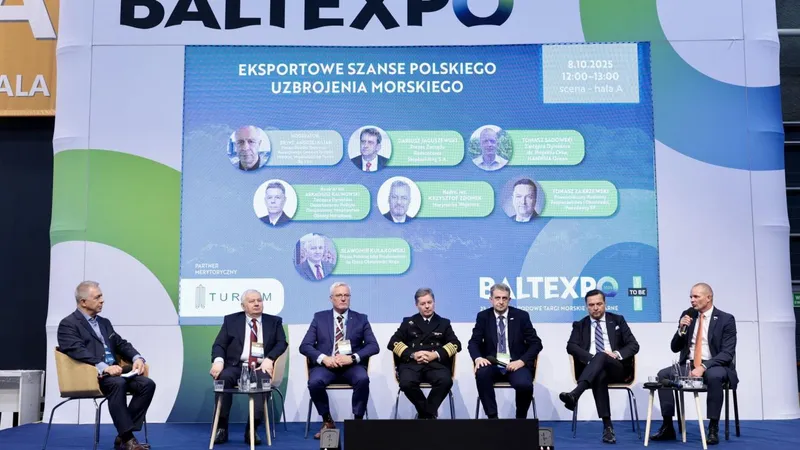
Growing strategic threats in Europe are driving dynamic development in defence systems, including naval armaments. A recent expert debate in Gdańsk brought together industry leaders, defence policy makers, and independent analysts to discuss whether Poland possesses naval defence products with export potential, and what conditions should be met for Polish companies to compete successfully abroad.
In brief
Experts at a debate on export opportunities for Polish naval armaments during the BALTEXPO 2025 fair concluded that Poland has a technological base but lacks a state strategy and development funding. Rear Admiral (lower half) in the reserve Krzysztof Zdonek pointed to the participation of warships in NATO operations and exercises as a natural way of presenting Polish solutions. Dariusz Jaguszewski, president of Remontowa Shipbuilding, recalled that the design and construction of a warship sometimes takes 5 to 6 years and requires stable programmes. Sławomir Kułakowski of the Polish Chamber of National Defence Manufacturers called for diplomatic support.
The panel agreed that Poland has promising capabilities in naval technology, but that turning this potential into real export success will require systemic support — from the government, armed forces, and industry alike.
Demonstrating capabilities through operations
Rear Admiral (Ret.) Krzysztof Zdonek, representing the Polish Navy, stressed that while the Navy’s mission is not to promote the industry, operational participation offers a unique opportunity to showcase capabilities.
- Participation of Polish ships in NATO operations and exercises offers an excellent opportunity. Commanders exchange experiences on the effectiveness of weapon systems, and without overt promotion, Polish products can be demonstrated through their capabilities and performance, he noted.
R&D and competitiveness as key drivers
A common theme was the need for stronger investment in research and development. Deputy Director of the Department of Defence Policy at the Ministry of National Defence, Commander Dr. inż. Arkadiusz Kalinowski, emphasized:
- Low R&D investment is a serious limitation for the future of the industry. Without investment in development, we confine ourselves to the domestic market. To succeed, we must have high-quality, competitive products in terms of performance and price. Active marketing beyond Poland is essential, and manufacturing capabilities must be strengthened.
Long-term programmes as a foundation
From the industry side, Dariusz Jaguszewski, President of Remontowa Shipbuilding S.A., pointed out that shipbuilding programmes must be long-term and consistent.
- Building a vessel takes five to six years, and the shipyard needs a stable order book, competencies, and infrastructure. Programmes must meet high standards set by the Ministry of National Defence and NATO. If we want to sell further, we must work together — through the Ministry, Navy, embassies, and other state structures — to offer ships effectively to other navies, he said.
The role of government and diplomacy
Sławomir Kułakowski of the Polish Chamber of Defence Producers argued that without strong governmental and diplomatic support, Polish defence products face serious limitations in export markets.
- Our customers are states, and therefore politicians — funded by taxpayers — should actively promote Polish defence products abroad, he said.
Building export competence
Independent defence expert Tomasz Zakrzewski stressed the importance of dialogue and knowledge-sharing.
- Business is built by people, not by companies. We need dialogue — especially with the Ministry of Defence — to share knowledge on building export capabilities. Polish officers should be aware of what is produced domestically and promote it, just like NATO officers from other countries do. Production in cooperation with other states should be a standard we adopt, he argued.
Strategic investment for technological edge
Tomasz Sadowski, Deputy Director for the Orka Project at Hanwha Ocean, highlighted the need to focus on breakthrough technologies.
- We should bet on a strong technological driver — a "good horse" — that will shorten access to key technologies. This can serve as a springboard for our industry and make it competitive on the global stage, he said.
Conclusion: moving from potential to reality
The debate in Gdańsk made clear that Poland’s naval defence export potential depends on more than just technical capabilities. It requires a strategic approach that integrates long-term programme stability, consistent R&D investment, active marketing abroad, strong manufacturing capacity, and coordinated support from government and diplomacy. Without these, Poland risks limiting its competitive position to the domestic market.
If implemented, these measures could transform Poland’s naval industry from a promising national sector into a respected player on the global stage.
Source: Gazeta Morska · Compiled by: Kamil Kusier
Related articles
 Energy and offshore Equinor takes over Bałtyk 2 and 3 O&M base in Łeba. Port to serve 1.44 GW of offshore wind for 30 years
 Navy and defence Port Gdański Eksploatacja secures NATO NCAGE code. Gdańsk port company lines up for defence tenders
 Shipbuilding industry Ex-Enterprise towed to Mobile under $418.5m contract. Test case for Nimitz-class disposal begins
 Energy and offshore Energa renames Gdańsk gas plant company as foundations for 6,000-tonne turbine and boiler are laid
 Equipment and technology WB Group takes Polish drones from Tokyo to SOFEX in Jordan in a single week
 Ports and logistics PGE books Gdańsk’s T5 terminal for the long haul: Baltica 2 first, then more offshore wind farms
Comments (0)
The discussion is moderated by the editors: a comment appears after review. Your e-mail address is not published.
Nobody has commented on this article yet.