









Polish drones, Norwegian missiles: WB Group and Kongsberg team up on Baltic unmanned systems
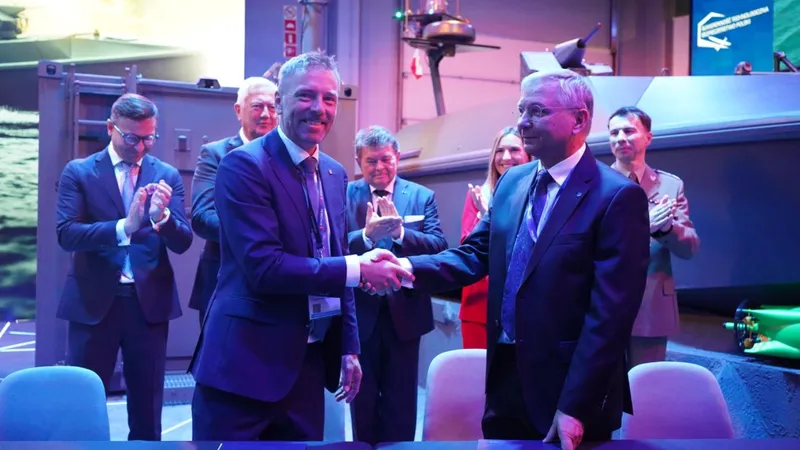
WB Electronics, the lead company of Poland's WB Group, and Norway's Kongsberg signed a cooperation agreement on unmanned maritime systems on 8 September, the opening day of the 34th MSPO defence exhibition in Kielce. The agreement covers joint development, integration and production of unmanned maritime platforms carrying multi-sensor reconnaissance suites, with provision for fitting them with effectors to engage surface vessels. For Poland's defence industry it is the first partnership of this scope between the country's leading drone manufacturer and the supplier whose Naval Strike Missile already arms the Polish Navy's coastal missile squadron and has been selected for the Miecznik frigates.
In brief
WB Electronics and Norway's Kongsberg signed on 8 September in Kielce an agreement on joint development, integration and production of unmanned maritime platforms with multi-sensor reconnaissance systems. The agreement was signed by WB Electronics CEO Piotr Wojciechowski and Kongsberg vice president Ronny Langset Opsjøen on the first day of the International Defence Industry Exhibition. The platforms are also to receive effectors for engaging naval vessels, and the companies gave no schedule or platform types. Kongsberg produces NSM missiles, which the Polish Coastal Missile Division has operated since 2013 and which were selected for the Miecznik programme frigates.
Piotr Wojciechowski, chief executive of WB Electronics, signed for the Polish side. Kongsberg was represented by Ronny Langset Opsjøen, executive vice president for new business development. The signing took place in the presence of Magdalena Sobkowiak-Czarnecka, undersecretary of state at the Polish Ministry of National Defence, and Brigadier General Romuald Maksymiuk, director of the ministry's armaments policy department.
- By combining Polish and Norwegian competencies, technologies and production capabilities, we can jointly create top-class solutions capable of operating in the Baltic Sea and beyond, Piotr Wojciechowski said.
Piotr Wojciechowski stressed that security requires real cooperation between states, armed forces and industry, and that pooling Polish and Norwegian production capacity should yield systems usable well beyond the Baltic.
A platform built to watch and to strike
The partnership draws on both companies' experience in manned and unmanned maritime and aerial systems, air defence, weapons, communications, command and control and advanced electronics. The first area of joint work is unmanned maritime platforms equipped with multi-sensor reconnaissance systems, integrating imagery and electronic intelligence with other sensors adapted to the maritime environment.
The Norwegian side describes the deal as a strategic partnership and a natural step towards lasting operational cooperation between Poland and Norway.
- By combining our competencies in maritime, unmanned and command systems, we are creating solutions that genuinely increase security in the Baltic and beyond, Ronny Langset Opsjøen said.
The agreement also provides from the outset for arming the platforms with effectors capable of engaging surface vessels, so that they can carry out strike as well as reconnaissance and surveillance tasks. Particular emphasis is to be placed on integrating sensors, command systems and effectors within a single architecture. The companies gave no timeline, named no specific platforms and identified no launch customer; the statement refers in general terms to multi-role maritime systems for military users, able to operate in the demanding Baltic environment and on other seas.
FlyEye and Warmate meet NSM and HUGIN
WB Group is Poland's largest privately owned defence company, known for the FlyEye reconnaissance drone, the Warmate loitering munition, the FONET communications system and the TOPAZ fire control system. Kongsberg produces the Naval Strike Missile, fielded by Poland's coastal missile squadron since 2013 and chosen as the anti-ship weapon for the Miecznik frigates, while its subsidiary Kongsberg Discovery is one of the leading makers of HUGIN autonomous underwater vehicles, used by NATO navies for mine reconnaissance and seabed survey. That points to a natural division of labour, Polish sensors, communications and command with Norwegian platforms and effectors, though the statement does not spell one out.
The agreement fits a clear pattern at this year's MSPO. On the same day the Polish Naval Academy formally joined the defence ministry's Autonomous Systems Centre, bringing its unmanned underwater vehicle expertise into the programme. With its subsea cables, pipelines and shallow, hydrologically difficult waters, the Baltic is becoming the main proving ground for maritime unmanned systems on both the military and the industrial side.
Source: Gazeta Morska · Compiled by: Kamil Kusier
Related articles
 Energy and offshore Equinor takes over Bałtyk 2 and 3 O&M base in Łeba. Port to serve 1.44 GW of offshore wind for 30 years
 Navy and defence Port Gdański Eksploatacja secures NATO NCAGE code. Gdańsk port company lines up for defence tenders
 Shipbuilding industry Ex-Enterprise towed to Mobile under $418.5m contract. Test case for Nimitz-class disposal begins
 Energy and offshore Energa renames Gdańsk gas plant company as foundations for 6,000-tonne turbine and boiler are laid
 Equipment and technology WB Group takes Polish drones from Tokyo to SOFEX in Jordan in a single week
 Ports and logistics PGE books Gdańsk’s T5 terminal for the long haul: Baltica 2 first, then more offshore wind farms
Comments (0)
The discussion is moderated by the editors: a comment appears after review. Your e-mail address is not published.
Nobody has commented on this article yet.