









Poland turns north: Baltic Sea as a strategic hub for energy and security
Long perceived mainly as a Central European country, Poland is increasingly pivoting toward the Baltic Sea. This strategic reorientation – noted in international analyses – is driven by the country’s energy transition and the consequences of Russia’s invasion of Ukraine.
In brief
Poland is shifting the centre of gravity of its politics and economy towards the Baltic Sea, driven by the energy transition and the consequences of Russia's aggression against Ukraine. The LNG terminal in Świnoujście has increased its capacity to 8.3 billion cubic metres per year, and a second terminal with a capacity of 6.1 billion cubic metres is being built in Gdańsk, with opening in 2028. Offshore wind farm capacity in the Baltic is to reach 18 GW by 2040, and the cost of the programme exceeds 140 billion dollars over 15 years. The Port of Gdańsk is the fifth largest commercial port in the European Union.
Baltic energy at the core
The energy sector is at the forefront of this shift. Poland has committed to phasing out coal by 2049, and in June 2025, for the first time, renewable sources generated more electricity than coal (Forum Energii data).
Gas infrastructure is expanding as well. The Świnoujście LNG terminal has increased its capacity to 8.3 bcm per year, while a second terminal is under development in Gdańsk, scheduled to open in 2028 with a planned capacity of 6.1 bcm.
In the 2030s, Poland’s first nuclear power plant is set to be built on the Baltic coast, with cold seawater ensuring efficient and safe reactor cooling.
Offshore wind is becoming a pillar of Poland’s energy mix, currently accounting for 14.7%, compared to just 0.3% two decades ago. Government projections estimate 18 GW of capacity in the Baltic by 2040, requiring an investment of over USD 140 billion within 15 years.
- The Baltic course is not a matter of choice. It is practically the only way we can import energy. The sea becomes our window to the world, says Zuzanna Nowak from the foreign policy think tank Opportunity.
Ports and logistics – Baltic as a gateway
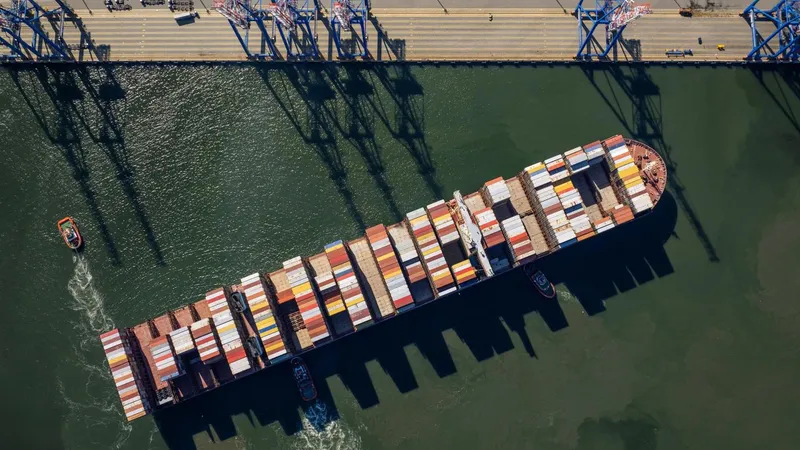
Geopolitical tensions and sanctions on Russia have reinforced the role of Poland’s ports. Over the past decade, cargo volumes have nearly doubled. Today, Gdańsk is the fifth-busiest seaport in the European Union, while Gdynia has emerged as a critical NATO logistics hub, handling shipments of military equipment for Ukraine and U.S. bases in Europe.
New alliances, new priorities
At the same time, Poland’s ties with Central European neighbors are weakening, with the Visegrád Group losing relevance amid pro-Russian policies in Budapest and Bratislava. Instead, Poland is deepening cooperation with Baltic and Nordic countries, including newly admitted NATO members Sweden and Finland. The Rail Baltica project, linking Poland with Lithuania, Latvia, and Estonia, is a flagship symbol of this northern integration.
A northern course set to stay
Regardless of political outcomes in the 2027 parliamentary elections, Poland’s trajectory seems clear: energy, maritime logistics, and regional security firmly anchor the country to the Baltic Sea. The northern course is set.
Source: Gazeta Morska / PAP · Compiled by: Oskar Wojciechowski
Related articles
 Energy and offshore Equinor takes over Bałtyk 2 and 3 O&M base in Łeba. Port to serve 1.44 GW of offshore wind for 30 years
 Navy and defence Port Gdański Eksploatacja secures NATO NCAGE code. Gdańsk port company lines up for defence tenders
 Shipbuilding industry Ex-Enterprise towed to Mobile under $418.5m contract. Test case for Nimitz-class disposal begins
 Energy and offshore Energa renames Gdańsk gas plant company as foundations for 6,000-tonne turbine and boiler are laid
 Equipment and technology WB Group takes Polish drones from Tokyo to SOFEX in Jordan in a single week
 Ports and logistics PGE books Gdańsk’s T5 terminal for the long haul: Baltica 2 first, then more offshore wind farms
Comments (0)
The discussion is moderated by the editors: a comment appears after review. Your e-mail address is not published.
Nobody has commented on this article yet.