









Poland's own exhaust for Ratownik: EcoExhaust to cool the ship's fumes from 400 to 60 degrees
PGZ Stocznia Wojenna has signed a contract with EcoExhaust for the design, production and delivery of complete exhaust gas treatment and cooling systems for the rescue ship Ratownik now under construction. Behind that short announcement sits one of the toughest engineering challenges on board a modern naval vessel - and another sign that Poland's domestic defence supply chain is maturing faster than many assumed.
In brief
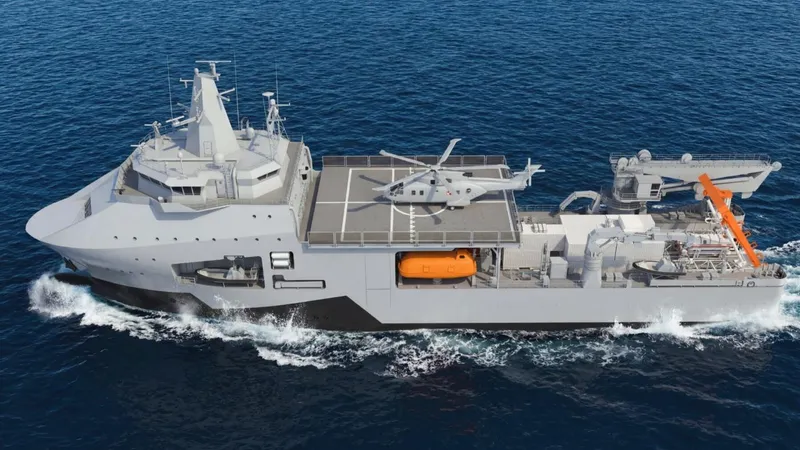
PGZ Stocznia Wojenna has ordered from the Polish company EcoExhaust complete exhaust gas cleaning and cooling systems for the rescue ship Ratownik, lowering the exhaust temperature from over 400°C to no more than 60°C. EcoExhaust will deliver four seawater-cooled systems, one for each main engine, and a dry exhaust system for the emergency generator. Ratownik, being built in Gdynia from 2025 to 2029 for over one billion zlotys, is about 96 metres long, displaces 6,500 tonnes and will replace ORP Piast and ORP Lech.
The thermometer as a battlefield
It sounds mundane - an exhaust system. In reality it is one of those subsystems where physics meets tactics. The fumes leaving the main engine exceed 400°C. Before they go over the side they must be cooled to no more than 60°C - and not at a single operating point, but across the engine's entire load range and even at a steep list, when the geometry of the whole system starts behaving differently.
Why does it matter so much? Because a hot exhaust leaves two kinds of telltale signature. First, the thermal signature - the ship's visibility in infrared to seeker heads and observation systems. Second, the noise carried through the exhaust ducting, which translates into the vessel's own underwater acoustic signature. On a ship meant, among other things, to discreetly support submarine operations, every decibel and every degree Celsius has operational value.
What the delivery actually covers
The scope of the contract goes well beyond a single part. EcoExhaust will deliver four exhaust systems with seawater fume cooling - one for each main engine - plus a separate dry exhaust system for the emergency generator. The whole package is to be built as a compact, lightweight structure made of corrosion-resistant materials, which in constant contact with seawater is a requirement rather than a nicety.
That gives a sense of the scale of the task: the Polish supplier is responsible not for a single component but for a complete, integrated system operating in one of the most demanding environments imaginable.
"Where Polish competence exists, we reach for a domestic supplier"
The contract fits the declared strategy of building Ratownik around domestic industry.
- We are building Ratownik on the assumption that wherever Polish engineering competence exists at the required level, we reach for a domestic supplier - says Marcin Ryngwelski, president of the management board of PGZ Stocznia Wojenna.
In his view, EcoExhaust has proven that Polish technology companies can deliver specialised tasks in defence projects without compromising on quality.
From an industry perspective this is a meaningful signal. Defence programmes of this scale tend to be dominated by foreign integrators and tier-one suppliers. Moving a specialised, "difficult" subsystem to a domestic company is not only a matter of złoty staying in the Polish economy, but also of building competences that will pay off on future vessels.
Ratownik - a ship that opens a bigger game
The contract itself is worth reading in a wider context. Ratownik is a multi-role rescue ship being built at PGZ Stocznia Wojenna in Gdynia under a deal signed in December 2024 between the Armament Agency and a consortium of PGZ S.A., PGZ Stocznia Wojenna and the OBR Centre of Maritime Technology. The programme is worth over a billion złoty and is scheduled to run from 2025 to 2029.
The vessel has impressive figures - roughly 96 metres long, 19 metres wide and 6,500 tonnes of displacement - making it one of the largest ships in the Polish fleet. Ratownik will replace two ageing rescue ships, ORP Piast and ORP Lech, in service for more than half a century. Its tasks will include rescuing submarine crews, conducting deep-sea operations and protecting critical underwater infrastructure in the Baltic - a subject whose importance, after a string of incidents involving subsea cables, no longer needs explaining.
The keel was laid in February 2026, preceded by steel cutting in the autumn of 2025. PGZ representatives make no secret of the fact that the unit is more than a single ship: without effective rescue capability and saturation diving, operating the future submarines of the Orka programme would be difficult. Ratownik is therefore something of an antechamber to a far larger fleet expansion.
The supply chain as a maturity test
The EcoExhaust contract is another piece of the puzzle that PGZ Stocznia Wojenna is steadily assembling around Ratownik from domestic subcontractors. Each such deal is also a test - whether Polish firms can meet military requirements for quality, timing and reliability in conditions where the margin for error is minimal.
If the scenario plays out, the benefit will reach far beyond a single ship. The competences built on Ratownik could pay dividends on the frigates of the Miecznik programme, on vessels for foreign partners - PGZ has announced the construction of a sister rescue ship for another Baltic state - and, in the longer run, across the wave of orders awaiting Poland's naval yards over the coming decade.
Source: Gazeta Morska · Compiled by: Kamil Kusier
Related articles
 Energy and offshore Equinor takes over Bałtyk 2 and 3 O&M base in Łeba. Port to serve 1.44 GW of offshore wind for 30 years
 Navy and defence Port Gdański Eksploatacja secures NATO NCAGE code. Gdańsk port company lines up for defence tenders
 Shipbuilding industry Ex-Enterprise towed to Mobile under $418.5m contract. Test case for Nimitz-class disposal begins
 Energy and offshore Energa renames Gdańsk gas plant company as foundations for 6,000-tonne turbine and boiler are laid
 Equipment and technology WB Group takes Polish drones from Tokyo to SOFEX in Jordan in a single week
 Ports and logistics PGE books Gdańsk’s T5 terminal for the long haul: Baltica 2 first, then more offshore wind farms
Comments (0)
The discussion is moderated by the editors: a comment appears after review. Your e-mail address is not published.
Nobody has commented on this article yet.