









Poland's first nuclear plant moves closer to its construction contract, and Pomerania faces a decade of work
Polskie Elektrownie Jądrowe and the American Westinghouse-Bechtel consortium have agreed the main commercial terms of the EPC contract for Poland's first nuclear power plant. The agreement covers the principal commercial and legal issues but does not close the negotiations. Both sides say they intend to finish the process by the end of the year.
In brief
Polskie Elektrownie Jądrowe and the Westinghouse-Bechtel consortium have agreed the main commercial terms of the EPC contract to build Poland's first nuclear power plant in the Choczewo municipality. Polskie Elektrownie Jądrowe and Westinghouse-Bechtel plan to conclude negotiations by the end of the year, and the contract value has not been disclosed. The Choczewo plant is to have three AP1000 reactors with a combined capacity of 3750 MWe, with first power due in 2036. Oversized components for the plant are to reach the construction site by sea.
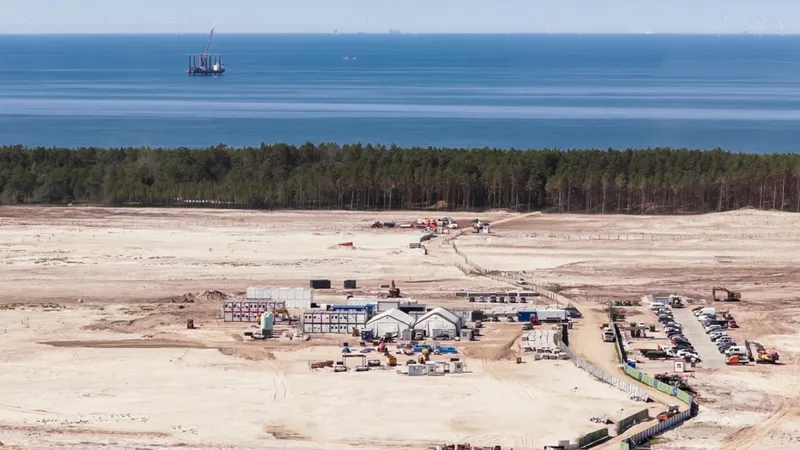
For the maritime economy the news matters more than it appears. The plant is being built in the municipality of Choczewo, on a stretch of coast where offshore wind farms are under construction at the same time, and where the heavy components for such an investment arrive by sea.
What has been agreed
An EPC contract covers engineering, procurement and construction, meaning the delivery of the plant as a whole. Agreeing the main commercial terms means the parties have settled the principal rules of their cooperation and can move on to the remaining provisions and the annexes.
In nuclear projects it is the EPC contract, more than the reactor technology, that decides whether a project succeeds. It determines who carries the risk of delay, who pays for design changes and how cost overruns are settled. European experience, from Olkiluoto in Finland to Flamanville in France and Hinkley Point C in the United Kingdom, has shown that these provisions, rather than the schedule on paper, determine what a plant finally costs.
The contract value, the contractor's remuneration model and the financing structure have not been disclosed.
Work is already under way on site
The second stage of preparatory works and detailed geological surveys are in progress at the Choczewo site. In August the investor handed the construction site over to Bechtel, formally opening the delivery phase.
Polish companies already hold contracts for work on site: Budimex, Doraco, Unihouse, MSA Security and Barg M.B. Gdańsk, with further subcontracts expected. Several of them are Pomeranian firms, including Doraco of Gdańsk, whose record includes port projects.
Two separate permits
In March the investor applied to the National Atomic Energy Agency for a construction licence, the nuclear regulator's decision without which no nuclear construction work may begin.
In parallel, documentation is being prepared for a building permit under construction law, for which the company intends to apply next year. These are two separate procedures, and both must be completed before work on the nuclear island itself can start.
The plant is to comprise three Westinghouse AP1000 reactors with a combined capacity of 3,750 MWe. The first power is to reach the Polish grid in 2036.
Why this is a maritime story
Building a nuclear plant on the coast means several years of cargo flows that cannot move by rail or on national roads. Vessels, generators, primary circuit components and oversized structures arrive by ship and have to be unloaded either next to the site or at a port able to handle abnormal loads, then moved by specialised transport along local roads.
The same applies to bulk materials. Concreting the foundations of a nuclear island is an operation measured in hundreds of thousands of cubic metres, with batching plants, storage areas and haul roads behind it.
Offshore wind construction is already under way along the same stretch of coast, and an operations and maintenance base for the BC-Wind farm is being built at Władysławowo. For the next decade Pomerania will therefore serve two major energy investments at once, competing for the same roads, the same ports and the same people.
Workforce is the common denominator
Certified welders, structural fitters, heavy equipment operators, industrial electricians and construction engineers are needed simultaneously at the nuclear site, in offshore wind and in shipyards running naval programmes. Each of those sectors has its own recruitment plans and its own calendar.
That is the real bottleneck for the region, regardless of how the EPC contract is eventually drafted. The power plant, the wind farm and the shipyard need the same people at the same time, and the coast does not have them in surplus.
What to watch next
Three things will determine how much of this project stays in the region. First, the final shape of the EPC contract and the division of risk between investor and consortium. Second, local content measured as a share of contract value rather than as a count of signed agreements. Third, the logistics arrangements for abnormal loads, which will decide whether a Polish port features in the supply chain or only a foreign transhipment terminal.
Source: Gazeta Morska · Compiled by: Kamil Kusier
Related articles
 Energy and offshore Equinor takes over Bałtyk 2 and 3 O&M base in Łeba. Port to serve 1.44 GW of offshore wind for 30 years
 Navy and defence Port Gdański Eksploatacja secures NATO NCAGE code. Gdańsk port company lines up for defence tenders
 Shipbuilding industry Ex-Enterprise towed to Mobile under $418.5m contract. Test case for Nimitz-class disposal begins
 Energy and offshore Energa renames Gdańsk gas plant company as foundations for 6,000-tonne turbine and boiler are laid
 Equipment and technology WB Group takes Polish drones from Tokyo to SOFEX in Jordan in a single week
 Ports and logistics PGE books Gdańsk’s T5 terminal for the long haul: Baltica 2 first, then more offshore wind farms
Comments (0)
The discussion is moderated by the editors: a comment appears after review. Your e-mail address is not published.
Nobody has commented on this article yet.