









Poland launches research vessel project. Maritime University of Szczecin to build next-generation training ship
Poland is taking a decisive step toward strengthening its position in maritime research and offshore industries. The Maritime University of Szczecin has officially launched a major investment project to design and build a state-of-the-art training and research vessel, with a total budget of PLN 625 million (approximately €145 million).
In brief
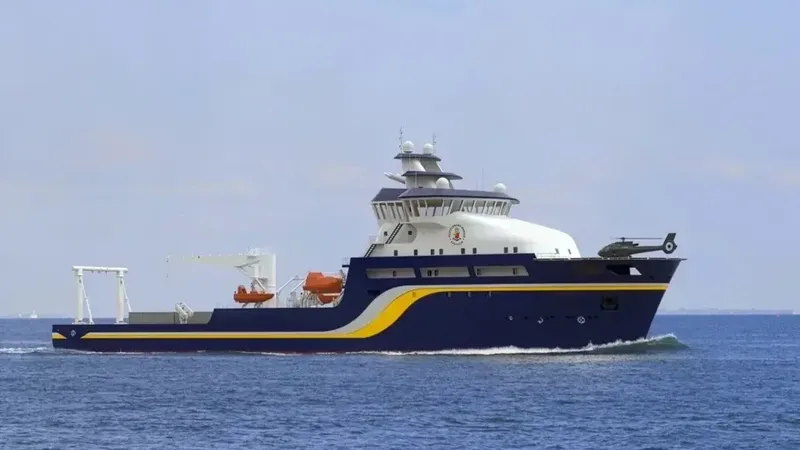
The Maritime University of Szczecin is starting construction of a training and research vessel worth PLN 625 million under the government programme Building Ships for Maritime Universities in 2025 to 2029. Arkadiusz Marchewka, Secretary of State at the Ministry of Infrastructure, handed the decision on the first funding tranche to Rector Wojciech Ślączka. The vessel will be about 93 metres long and 18 metres wide, with laboratories, eco-friendly propulsion systems and underwater robots, and will be able to operate in polar regions. The Maritime University of Szczecin will hold a tender for the builder, and the ship's name will be chosen in an open competition.
The first tranche of funding was formally approved and handed over by Deputy Minister of Infrastructure Arkadiusz Marchewka to the Rector of the university, Wojciech Ślączka, marking the operational start of the project under the national multiannual programme “Construction of vessels for maritime universities 2025–2029”.
A next-generation research vessel with global reach
The planned vessel is positioned to become one of the most advanced research and training platforms in Europe. According to Rector Wojciech Ślączka:
- We want the new ship to be a multifunctional unit. Primarily educational, but also scientific, serving the entire academic community in Poland and Europe, and supporting the most advanced research at sea.
With an overall length of approximately 93 metres and a beam of around 18 metres, the vessel will be capable of global operations, including missions in polar regions. This capability places the project in line with leading European oceanographic fleets and significantly expands Poland’s operational reach beyond the Baltic Sea.
Advanced technologies and offshore capabilities
The newbuild will integrate modern research infrastructure and training facilities, combining academic and industrial applications on a single platform. Planned onboard systems include:
- specialised scientific laboratories
- satellite-based navigation and positioning systems
- environmentally friendly propulsion solutions
- remotely operated vehicles (ROVs) for subsea operations
Deputy Minister Arkadiusz Marchewka подчеркнул strategic importance of the investment:
- This new unit will support the development of science and enable the acquisition of competencies for work at sea. It will be a modern vessel equipped with technologies for conducting research, including underwater robots. Thanks to it, we will open a new chapter in the history of maritime science in Poland.
Strategic impact on maritime economy and offshore sector
The project reflects broader structural changes within the maritime economy, particularly in the Baltic Sea region. The presence of Marshal of the West Pomeranian Region Olgierd Geblewicz highlighted the regional dimension of the investment:
- The maritime economy is evolving and will continue to do so, but it remains one of the pillars of our region. Our maritime identity has a strong future, and this vessel will be proof of that.
Beyond its academic role, the vessel is expected to support key sectors such as:
- offshore wind energy development
- marine environmental monitoring
- hydrography and seabed mapping
- maritime technology and innovation
Project timeline and next steps
Following the funding decision, the project now enters the procurement and design phase. The Maritime University of Szczecin will launch tender procedures to select a shipyard and technology partners responsible for delivering the vessel.
The ship’s name will be selected through an open public competition, while construction is scheduled within the 2025–2029 programme framework.
Once completed, the vessel is expected to become a flagship asset for Polish maritime education and research, enhancing international cooperation and positioning Poland as a more active player in global ocean science and offshore development.
The launch of this project signals a clear shift: Poland is no longer only a participant in maritime industries, but increasingly an innovator shaping their future.
Source: Gazeta Morska · Compiled by: Kamil Kusier
Related articles
 Energy and offshore Equinor takes over Bałtyk 2 and 3 O&M base in Łeba. Port to serve 1.44 GW of offshore wind for 30 years
 Navy and defence Port Gdański Eksploatacja secures NATO NCAGE code. Gdańsk port company lines up for defence tenders
 Shipbuilding industry Ex-Enterprise towed to Mobile under $418.5m contract. Test case for Nimitz-class disposal begins
 Energy and offshore Energa renames Gdańsk gas plant company as foundations for 6,000-tonne turbine and boiler are laid
 Equipment and technology WB Group takes Polish drones from Tokyo to SOFEX in Jordan in a single week
 Ports and logistics PGE books Gdańsk’s T5 terminal for the long haul: Baltica 2 first, then more offshore wind farms
Comments (0)
The discussion is moderated by the editors: a comment appears after review. Your e-mail address is not published.
Nobody has commented on this article yet.