









POL32 from Gdańsk Makes Waves in the Netherlands. Polish Students Excel at The Ultimate Solar Boat Challenge
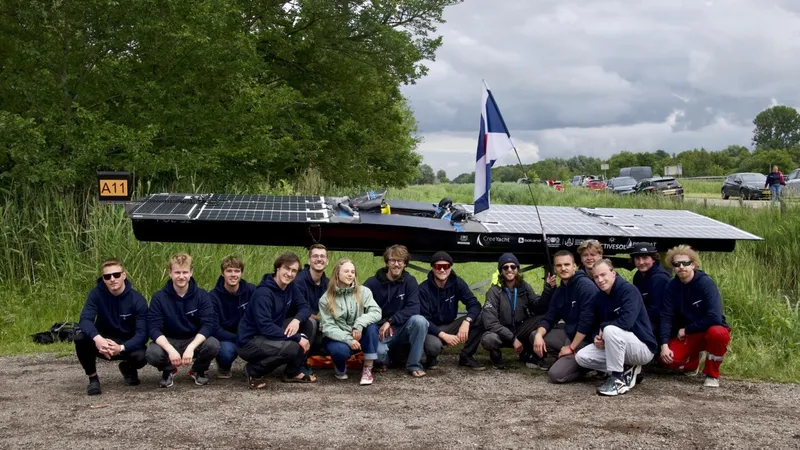
A student team from Gdańsk University of Technology (GUT) has successfully represented Poland in the international Ultimate Solar Boat Challenge 2025, held on Dutch inland waters. The team from the Student Marine Technology Association KORAB, operating within the Faculty of Mechanical Engineering and Ship Technology, was the only non-Dutch entry to complete all stages of the demanding multi-day solar-powered race — finishing an impressive sixth overall.
In brief
The team of the KORAB Naval Architecture Students' Association at Gdańsk University of Technology took sixth place in The Ultimate Solar Boat Challenge 2025 in the Netherlands. The KORAB crew was the only team from outside the host country among the ten competing teams and completed all stages of the race without recharging its batteries from the grid. The POL32 hydrofoil was built over more than six months at the Faculty of Mechanical Engineering and Ship Technology of Gdańsk University of Technology, with BLDC motors, MPPT systems and extensive telemetry. The KORAB team has begun designing a new solar boat with an autonomous flight control system.
The competition format required solar boats to cover over 160 km in three days without recharging batteries from the grid — relying solely on solar energy. Efficiency, endurance, and intelligent energy management were critical success factors.
- From start to finish, we operated only on power harvested from the sun. Each tactical decision we made was grounded in real-time telemetry data, not assumptions, said Julian Serkieza, team member and systems specialist.
POL32 – From Experimental Platform to Proven Hydrofoil
The POL32 solar boat has undergone years of iterative development. Once an experimental build, it now stands as a robust and race-ready platform. In the run-up to the event, the team conducted over six months of rigorous R&D at GUT labs, focusing on:
- Advanced BLDC motor testing, including torque characteristics, energy draw, and performance under dynamic loads;
- Optimization of the high-speed gear unit, particularly cooling efficiency, lubrication behavior, and thermal/vibration resilience;
- Development of robust diagnostic and operational procedures tailored to competitive solar racing environments.
These efforts culminated in a reliable propulsion system, which operated consistently and safely throughout the race — a testament to careful engineering and validation.
Smart Systems, Smarter Tactics
KORAB’s success was also attributed to their custom-designed energy management and propulsion control architecture. Highlights include:
- High-efficiency MPPT systems, optimized for mid-range solar panel performance;
- A bespoke motor setup capable of effective operation under low voltage and fluctuating loads;
- A live telemetry suite enabling real-time monitoring of key parameters such as battery voltage, module temperatures, charge state, and energy consumption.
The team used these insights to optimize speed and route decisions on the fly, avoiding critical power drops and strategically pacing the boat through challenging stages.
Although POL32 is a fully-fledged hydrofoil, this edition of the race was completed with a shortened propulsion strut to prioritize reliability and gather performance data for future hydrofoil operations.
Looking Ahead: A New Generation Solar Hydrofoil
Building on lessons from this year’s competition and previous editions, the KORAB team is already developing a new vessel — this time engineered from scratch for sustained hydrofoiling. Planned innovations include:
- Autonomous flight control systems;
- A redesigned solar deck incorporating custom-built photovoltaic modules;
- Predictive telemetry tools for strategic energy planning and race optimization.
All systems are being tested in parallel as the team prepares for future events, including competitions in Hungary and other European venues.
One limiting factor remains: access to advanced manufacturing tools. The team is currently seeking partners and funding to gain access to multi-axis CNC machining — essential for refining hydrofoil wing profiles and next-gen propulsion components.
Guided by Experience – Two Decades of Solar Boat Expertise
The team benefits from the mentorship of Dr. Eng. Wojciech Leśniewski, who brings over 20 years of hands-on experience in solar boat design and international racing.
- These projects expose students to real-world interdisciplinary engineering challenges — from composites and electric drives to electronics, telemetry, and advanced manufacturing. It’s a unique training ground, and the innovations they deliver are often comparable to teams with much larger budgets, notes Dr. Leśniewski.
Beyond the Budget – Engineering Ingenuity That Inspires
Despite operating on a modest budget compared to their competitors, the KORAB team received considerable attention in the Netherlands. Fellow teams praised the effectiveness and simplicity of their systems — a strong reminder that creativity, persistence, and systems thinking can successfully challenge larger and better-funded projects.
The success of POL32 would not have been possible without the backing of the Faculty of Mechanical Engineering and Ship Technology and the GUT Student Council, whose support enabled the realization of this ambitious racing campaign.
Team POL32 – Gdańsk University of Technology at The Ultimate Solar Boat Challenge 2025:
Mateusz Bartuś, Maksym Domkowski, Piotr Demski, Dawid Dubiel, Gerard Gallas, Łukasz Gede-Niewiadomski, Konrad Kohut, Aleksander Longa, Tymoteusz Maleńczyk, Miłosz Tokarczyk, Piotr Pruszko, Joanna Rakieć, Julian Serkieza, Michał Struk, Wojciech Wierzbicki.
Source: Gazeta Morska · Compiled by: Kamil Kusier
Related articles
 Education Gdynia Maritime School teams up with UCMMiT for a seafarer health day on 6 November
 Education Energa's Kropelka Energii blood drive marks 100th edition with over 4,100 litres donated since 2012
 Education From Newton's prism to a microplate reader. A Science Evening in Charzykowy on light and matter
 Energy and offshore Offshore wind enters the classroom in Świnoujście. ORLEN Neptun to teach logistics and navigation students
 Education Drones at the Naval Academy, Dar Młodzieży in Gdynia, a sports hall at UG. Coastal universities open the year
 Sailing and water sports Poland argues over where Dar Młodzieży should retire, while its successor still does not exist
Comments (0)
The discussion is moderated by the editors: a comment appears after review. Your e-mail address is not published.
Nobody has commented on this article yet.