









PGZ Naval Shipyard and AMW collaborate to train future shipbuilders
PGZ Naval Shipyard is making strategic investments in workforce development through a close partnership with the Naval Academy (AMW). As part of the mechanical engineering and shipbuilding program, a specialized track—technological support for ship production—has been created to align with industry demands. This initiative equips students with essential competencies, blending theoretical knowledge with hands-on training under the mentorship of experienced shipyard professionals.
In brief
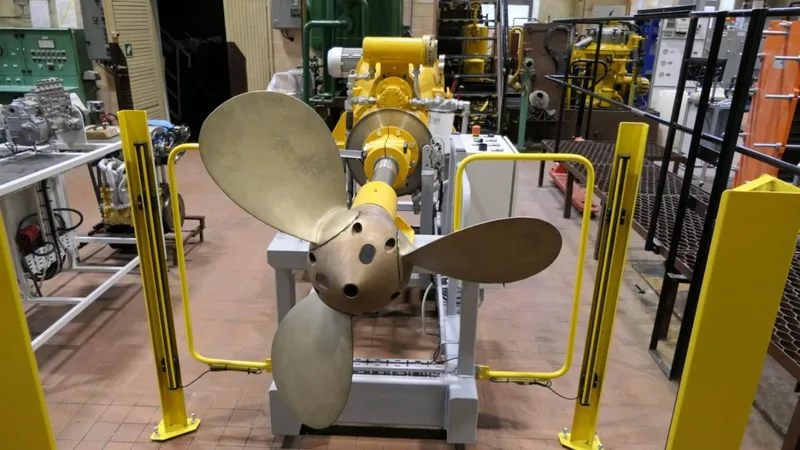
PGZ Stocznia Wojenna and the Polish Naval Academy run a specialisation in Technological Support of Ship Production within the Mechanical Engineering and Machine Construction degree programme, tailored to the needs of the shipbuilding industry. Classes are taught, among others, by PGZ Stocznia Wojenna president Marcin Ryngwelski and Jamal Hamoud, deputy technical director for production development. The Polish Naval Academy has the only Ship Power Plant Operation Laboratory in Poland, equipped with Sulzer 6AL20/24 and MTU 2000 series engines and UNITEST simulators. Students benefit from paid summer internships and the PGZ Stocznia Wojenna scholarship programme.
Bridging academia and industry for future success
The collaboration between AMW and PGZ Naval Shipyard addresses the increasing need for skilled specialists in the shipbuilding sector. Marcin Ryngwelski, president of PGZ Naval Shipyard, highlights:
- Revitalizing technical and vocational education is a priority for us. Strengthening cooperation with universities, particularly the Institute of Shipbuilding at Gdańsk University of Technology and the Institute of Ship Design and Operation at the Naval Academy, is essential for training warship designers. We need to challenge outdated perceptions of shipyard work—it is no longer about heavy manual labor but about highly skilled professionals operating advanced technological equipment.
PGZ Naval Shipyard plays an active role in education. Jamal Hamoud, deputy technical director for production development and a lecturer at AMW, explains:
- We have defined the graduate profile, specifying the knowledge, skills, and competencies they should acquire. This specialization is practically tailor-made for us.
The faculty also includes president Marcin Ryngwelski, who teaches ship theory and design, Radosław Cackowski, head of the design office, and Wojciech Szyszkowski, head of the quality control department. Their involvement ensures that students gain both strong theoretical foundations and valuable industry insights.
Advanced educational facilities for practical learning
AMW offers Poland's only ship power plant operation laboratory, where students train using real ship equipment. Jamal Hamoud describes its significance:
- Students here can start a combustion engine and conduct full-scale laboratory tests—such as engine indication, energy parameter assessment, and exhaust gas analysis. The engine runs alongside auxiliary systems like pumps, centrifuges, compressors, and more.
The laboratory features:
- Sulzer 6AL20/24 and MTU Series 2000 engines—common in naval applications,
- GTD-350 and TG-16 turbine engines,
- Auxiliary devices such as pumps, fuel centrifuges, a steam boiler, bilge water separator, and ship refrigeration systems,
- UNITEST ship engine room simulators replicating various propulsion systems.
This hands-on experience prepares students for real-world maritime machinery operation, diagnostics, and maintenance.
Personalized training and career opportunities
Small class sizes and direct engagement with industry professionals enhance the learning process. Additionally, students benefit from paid summer internships and the PGZ Naval Shipyard Scholarship Program, which supports top-performing individuals in further skill development.
Jamal Hamoud emphasizes:
- We need specialists in direct production, but we also seek to attract designers, technologists, and production supervisors. These roles are increasingly crucial.
Shaping the future of shipbuilding
The partnership between PGZ Naval Shipyard and AMW exemplifies successful integration of academia and industry. Students receive practical training while the shipyard gains access to highly qualified professionals. Moreover, AMW’s academic staff supports the shipyard in critical projects, contributing expertise in areas such as finite element analysis (FEA), engine diagnostics, and material strength assessment.
The impact of this collaboration is already evident—graduates of the technological support for ship production specialization are seamlessly entering the shipbuilding industry, driving the development of modern naval vessels. This forward-thinking approach is instrumental in advancing Poland’s shipbuilding sector and enhancing the navy’s technological capabilities.
Source: Gazeta Morska · Compiled by: Kamil Kusier
Related articles
 Shipbuilding industry Poland christens ro-pax ferry Bursztyn Unity in Szczecin on Independence Day. Ystad service starts 18 November
 Energy and offshore Orlen Neptun deploys V-LiDAR buoys at Baltic West ahead of Poland's 2027 offshore wind auction
 Energy and offshore Equinor takes over Bałtyk 2 and 3 O&M base in Łeba. Port to serve 1.44 GW of offshore wind for 30 years
 Navy and defence Port Gdański Eksploatacja secures NATO NCAGE code. Gdańsk port company lines up for defence tenders
 Shipbuilding industry Ex-Enterprise towed to Mobile under $418.5m contract. Test case for Nimitz-class disposal begins
 Energy and offshore Energa renames Gdańsk gas plant company as foundations for 6,000-tonne turbine and boiler are laid
Comments (0)
The discussion is moderated by the editors: a comment appears after review. Your e-mail address is not published.
Nobody has commented on this article yet.