









PERN expands fuel storage and loading infrastructure in Dębogórze
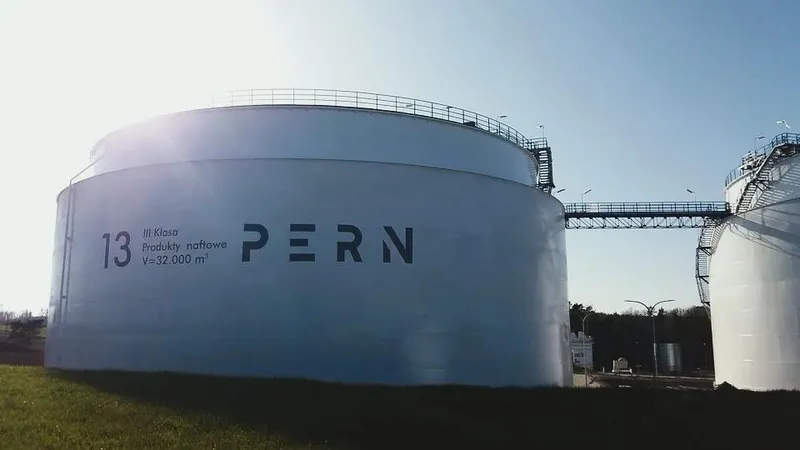
PERN has expanded the railway loading facility at its Dębogórze fuel depot (Pomerania) by adding two new loading stations, bringing the total to eight. This upgrade has increased the terminal’s daily throughput capacity by 4,000 cubic meters.
In brief
The throughput of the PERN fuel depot in Dębogórze has increased by 4 thousand cubic metres per day after two new rail loading positions were commissioned, giving the rail loading facility eight tank car filling points. Three tanks with a capacity of 50 thousand cubic metres each are under construction in Dębogórze, with completion planned for autumn this year. PERN CEO Daniel Świętochowski said the investments strengthen Poland's energy independence. The capacity of the Dębogórze fuel depot currently stands at 360 thousand cubic metres.
At the same time, construction is underway on three new fuel storage tanks, each with a capacity of 50,000 cubic meters. The company announced that the project is progressing ahead of schedule thanks to favorable weather conditions, with completion planned for autumn 2025. The new infrastructure will be dedicated both to storing strategic reserves and to ensuring greater flexibility in fuel distribution.
The Dębogórze depot is strategically located to receive petroleum products delivered by sea to Poland via the Baltic. Its current storage capacity stands at 360,000 cubic meters. Once the expansion is finalized, the facility will further strengthen its role as a regional energy hub.
- Our investments respond to the challenges of a changing fuel market and the need to strengthen Poland’s resilience to any disruption of energy supplies, said PERN President Daniel Świętochowski. - In the face of an unstable geopolitical environment, we are expanding our infrastructure to reinforce the country’s energy independence and secure reliable deliveries for our clients.
The company highlighted that the war in Ukraine and EU sanctions banning Russian fuel imports have completely reshaped Poland’s diesel supply chain. Before 2023, more than 30% of the country’s diesel imports originated from Russia. Following the sanctions, the main suppliers in Q1 2025 were Germany, Lithuania, and the United States, with additional volumes sourced from Finland, the Netherlands, and Sweden.
The Dębogórze upgrade is closely linked to the ongoing expansion of the Liquid Fuels Handling Terminal in the Port of Gdynia, which will enable the port to accommodate tankers of more than 100,000 tonnes. The railway loading project was implemented under a design-and-build contract by KB Pomorze, following an agreement signed with the Port of Gdynia Authority in 2023.
With its growing capacity to handle both maritime and rail transport, the Dębogórze terminal is consolidating its position as a key fuel logistics hub for Poland and the wider Baltic region.
Headquartered in Płock, PERN plays a strategic role in Poland’s energy security. The company operates a network of more than 2,500 km of crude oil and product pipelines, 19 fuel depots with a combined capacity of around 2.7 million cubic meters, and four crude oil storage bases with a total capacity exceeding 4.1 million cubic meters. PERN also delivers crude to the Orlen refineries in Płock and Gdańsk, as well as to the Schwedt and Leuna refineries in Germany.
Source: Gazeta Morska · Compiled by: Kamil Kusier
Related articles
 Energy and offshore Equinor takes over Bałtyk 2 and 3 O&M base in Łeba. Port to serve 1.44 GW of offshore wind for 30 years
 Navy and defence Port Gdański Eksploatacja secures NATO NCAGE code. Gdańsk port company lines up for defence tenders
 Shipbuilding industry Ex-Enterprise towed to Mobile under $418.5m contract. Test case for Nimitz-class disposal begins
 Energy and offshore Energa renames Gdańsk gas plant company as foundations for 6,000-tonne turbine and boiler are laid
 Equipment and technology WB Group takes Polish drones from Tokyo to SOFEX in Jordan in a single week
 Ports and logistics PGE books Gdańsk’s T5 terminal for the long haul: Baltica 2 first, then more offshore wind farms
Comments (0)
The discussion is moderated by the editors: a comment appears after review. Your e-mail address is not published.
Nobody has commented on this article yet.