Pentagon deploys USS Gerald R. Ford to the Caribbean in anti-narcotics operation
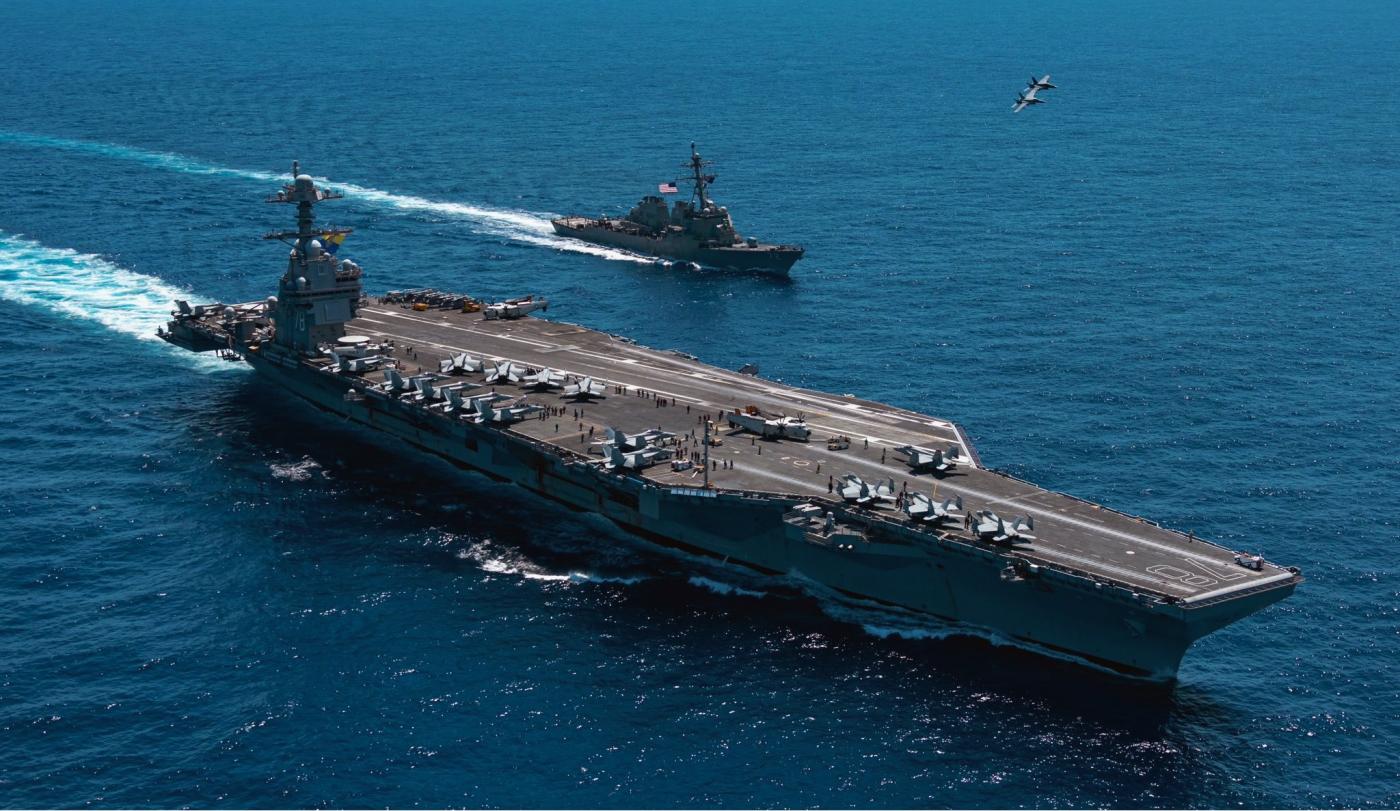
The United States has announced the deployment of the aircraft carrier USS Gerald R. Ford (CVN-78) and its carrier strike group to the Caribbean region. The mission, directed by the Pentagon, marks a new phase in the U.S. strategy against transnational crime and targets so-called narco-terrorist organizations operating across the maritime routes of the Western Hemisphere.
security navy worldwide nato news25 october 2025 | 10:02 | Source: Gazeta Morska | Prepared by: Kamil Kusier | Print
fot. U.S. Navy
According to the Department of Defense, the operation aims to strengthen U.S. naval presence in the Southern Command area and enhance maritime domain awareness, interdiction, and deterrence capabilities against smuggling and organized crime networks.
Pentagon: deterrence and forward presence
Pentagon spokesman Sean Parnell emphasized that the deployment is both a deterrent and preventive measure.
– The reinforced presence of our forces in the Southern Command’s area of responsibility will enhance the United States’ ability to detect, monitor, and disrupt illicit activities that threaten our national security, our prosperity, and the stability of the Western Hemisphere.
U.S. Secretary of the Army Pete Hegseth delivered a sharper message, framing the operation as part of a broader counterterrorism doctrine:
– If you are a narco-terrorist smuggling drugs in our maritime zone, we will treat you as we treated al-Qaeda. Day or night, we will identify your network, locate your people, find you, and take you down.
These statements reflect a clear strategic shift within the Pentagon—from reactive patrol missions to proactive, force-based operations targeting non-state maritime threats.
A carrier in a law enforcement role
Deploying the USS Gerald R. Ford, the U.S. Navy’s most advanced and powerful warship, in a counter-narcotics mission is unprecedented. Traditionally, such operations have been led by smaller patrol vessels and the U.S. Coast Guard.
This time, the operation includes a full carrier strike group (CSG), composed of Arleigh Burke-class destroyers, a replenishment ship, and a robust air component: F/A-18 Super Hornets, E-2D Hawkeye early warning aircraft, and MH-60 Seahawk helicopters.
From a military standpoint, this is a demonstration of global power projection; operationally, it marks the expansion of the Navy’s role into hybrid missions—combining military readiness with intelligence, surveillance, and law enforcement coordination.
Operational framework and maritime tasks
The Caribbean operation is expected to involve a wide range of maritime and aerial activities. These include persistent patrols across known smuggling corridors, maritime interdiction operations, and the interception of so-called go-fast boats—high-speed vessels commonly used by cartels to transport narcotics from South America.
Destroyers will conduct sea blockades and coordinate with carrier-based aviation assets responsible for reconnaissance and maritime surveillance. Portions of the air wing will support joint missions with U.S. agencies such as the DEA and allied maritime forces in the region.
In effect, the USS Gerald R. Ford will function as a mobile maritime command and control hub, integrating satellite intelligence, airborne reconnaissance, and signals intelligence (SIGINT) into a single operational framework.
Legal and political dimensions
Legal experts note that treating cartels as parties in a “non-international armed conflict” sets a significant precedent. The U.S. interpretation allows the use of military force under the framework of armed conflict law against organized crime networks.
Critics, however, warn that such an approach blurs the line between law enforcement and warfare, and could raise sovereignty concerns among regional states. Venezuela and Colombia have already voiced opposition to the increased U.S. military presence near their territorial waters, calling it an act of provocation and a step toward militarization of regional security.
Strategic significance for maritime security
For naval and maritime observers, the operation represents an evolution in the application of sea power. Modern navies are increasingly operating in hybrid environments—where conventional defense, crisis response, and transnational law enforcement overlap.
Deploying the USS Gerald R. Ford to the Caribbean demonstrates that the sea is becoming a primary theater in the fight against transnational threats. The mission highlights the Navy’s growing role not only as a warfighting force but also as a key actor in maintaining global security and stability.
For U.S. allies—including NATO partners such as Poland—this operation could serve as a case study in integrating naval, intelligence, and civilian capabilities for maritime domain security.
Editorial comment – Daily Mare
The Pentagon’s decision is more than a military maneuver; it is a strategic message. It signifies a redefinition of naval power in the 21st century—where aircraft carriers serve not only as symbols of deterrence but also as platforms for global law enforcement and intelligence coordination.
The Caribbean mission suggests that future maritime operations will increasingly combine hard power with strategic presence, cyber capabilities, and interagency cooperation.
In an era when security, trade, and criminal networks converge on the world’s oceans, the USS Gerald R. Ford stands as a symbol of a new maritime paradigm—hybrid, agile, and globally responsive.
Buy us a coffee, and we’ll invest in great maritime journalism! Support Gazeta Morska and help us sail forward – click here!
Kamil Kusier
redaktor naczelny
comments
Bardzo fajny artykuł :)
16:04
see also
Strait of Hormuz at a strategic crossroads: sinking of IRIS Dena and implications for maritime transport
The submarine contract of the decade? Canada weighs South Korea against Germany
When two powers clash, Poland must be ready to act. Military security must be the priority
Commodore Przemysław Karaś appointed deputy commander of the Maritime Operations Centre - Naval Component Command
Radmor hosts delegation from the Republic of Turkey. Advancing maritime security cooperation
French Navy expands global operations from the Pacific to the Red Sea
"Let everyone know we will prevail". Poland’s armed forces set strategic course for 2026-2039
“Army 500” and strategic transformation: Poland sets the course for long-term deterrence and allied readiness
Medical evacuation from offshore vessel in the Baltic. Rescue 511 helicopter and m/s Huragan deployed
Karol Nawrocki: “The strength of the republic lies in its armed forces”. Security requires national unity
ADVERTISEMENT
ADVERTISEMENT