









ORLEN secures up to a quarter of its annual crude oil demand from Norway
ORLEN has signed a three-year agreement with Equinor for crude oil supplies from the Johan Sverdrup field on the Norwegian Continental Shelf. Deliveries are due to begin in September, with annual volumes potentially exceeding 9 million tonnes – equivalent to up to one quarter of the ORLEN Group’s annual crude oil demand. The crude will be supplied to refineries in Poland, the Czech Republic and Lithuania, strengthening the security and resilience of oil supplies across Central Europe.
In brief
ORLEN Group has signed a three-year agreement with Equinor for the purchase of crude oil from the Johan Sverdrup field on the Norwegian Continental Shelf. The annual volume may range from nearly 5 million tonnes to more than 9 million tonnes, corresponding to as much as 25 percent of ORLEN Group's annual demand. The crude will be shipped by sea to refineries in Poland, the Czech Republic and Lithuania, and the first deliveries will start in September. ORLEN CEO Ireneusz Fąfara said the agreement strengthens the company's access to stable sources of crude from Norway.
The new agreement will further increase the role of Norwegian crude in ORLEN’s supply portfolio. The contract provides for annual deliveries ranging from nearly 5 million tonnes to more than 9 million tonnes, allowing the group to adjust volumes depending on market conditions and the operational requirements of its refineries.
At the maximum contracted volume, Norwegian crude could cover as much as 25% of ORLEN Group’s annual crude oil requirements.
The agreement also provides flexibility in terms of the crude grades supplied. While Johan Sverdrup crude will form the basis of deliveries, the contract allows for supplies of other crude grades produced on the Norwegian Continental Shelf.
Norway strengthens its role in ORLEN’s supply chain
The agreement is part of ORLEN’s broader strategy of diversifying crude oil supply sources and strengthening the resilience of its energy supply chain.
Norway has become an increasingly important source of energy for Europe, with the Norwegian Continental Shelf playing a key role in supplying both crude oil and natural gas to European markets.
For ORLEN, securing long-term volumes from a stable producer provides greater predictability in crude procurement while reducing exposure to disruptions affecting individual supply routes.
- Safe energy future starts with decisions made well in advance. That is why we are strengthening the ORLEN Group’s access to stable sources of crude oil from Norway, which can cover up to one quarter of our annual demand. Equinor is a reliable partner with whom we are building relationships based on shared responsibility for the energy security of the region. This agreement is a concrete response to instability in global markets and proof that resilience in the energy sector is built through long-term cooperation with partners that provide predictable supplies and the highest operating standards, said Ireneusz Fąfara, President of the Management Board of ORLEN.
Johan Sverdrup at the centre of the deal
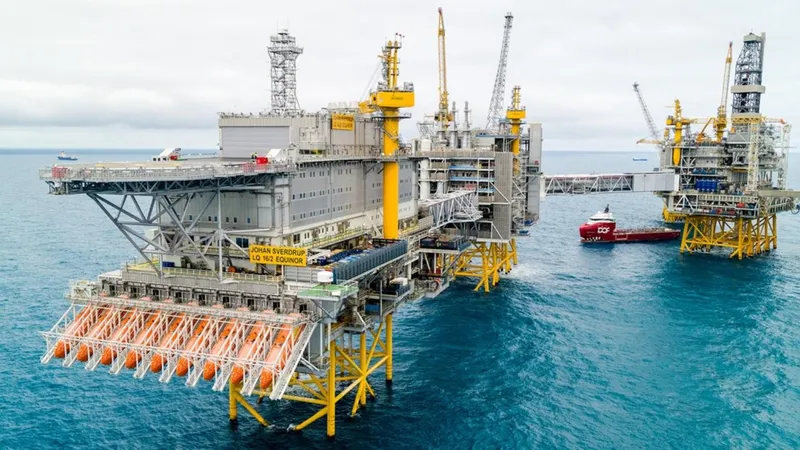
The main crude grade covered by the agreement will come from the Johan Sverdrup field, one of the largest oil fields on the Norwegian Continental Shelf and one of the largest offshore oil developments in the world.
The field accounts for approximately one third of Norway’s total oil production. It is also notable for the relatively low carbon intensity of its production, with the offshore facilities powered by electricity supplied from shore, largely generated from renewable sources.
The agreement nevertheless gives ORLEN the option to receive other crude grades produced from fields on the Norwegian Continental Shelf. This additional flexibility allows the company to adapt its supply structure to the requirements of its refining system.
For a group operating refineries in three countries, the ability to optimise both volumes and crude grades can be particularly important as market conditions, refinery economics and demand change.
- This agreement demonstrates the important role that energy supplies from the Norwegian Continental Shelf play in strengthening Europe’s energy security. We are pleased that, through this agreement to supply crude oil to ORLEN’s refineries in Poland, Lithuania and the Czech Republic, we are further strengthening our cooperation with the company, said Irene Rummelhoff, Executive Vice President Marketing, Midstream and Processing at Equinor.
A flexible contract for changing market conditions
One of the key features of the agreement is the flexibility of the annual volumes.
ORLEN may receive close to 5 million tonnes of crude per year at the lower end of the contracted range, while the maximum volume can exceed 9 million tonnes. This allows the group to align deliveries with changing market conditions and the operational needs of its refineries.
At the upper end of the range, the contract represents a significant share of ORLEN’s total crude requirements.
Such flexibility can also be important in managing refinery margins, inventory levels, fuel demand and changes in global crude markets. It allows the group to adjust its procurement strategy without relying on a fixed annual volume throughout the entire three-year period.
Maritime logistics remain a key part of the supply chain
The new agreement also highlights the continued importance of maritime logistics to Europe’s energy security.
Crude oil produced on the Norwegian Continental Shelf is transported by sea before entering the infrastructure serving individual markets and refineries. Ports, terminals, storage facilities and pipeline networks therefore form an important part of the supply chain connecting Norwegian offshore production with Central European refining capacity.
For the maritime sector, the agreement illustrates the strategic importance of the North Sea as an energy production and transportation hub for Europe.
The Norwegian Continental Shelf is supported by an extensive offshore infrastructure developed over decades of oil and gas production. Its role is now evolving alongside changes in the European energy market, but oil and gas production from the region remains an important component of European energy security.
Long-term partnership between ORLEN and Equinor
The new crude oil agreement builds on an existing relationship between ORLEN and Equinor.
The companies already cooperate in areas including upstream activities on the Norwegian Continental Shelf and projects involving lower-emission technologies. The new agreement adds another important element to that relationship by connecting Norwegian oil production directly with ORLEN’s refining system in Poland, the Czech Republic and Lithuania.
For both companies, the agreement also provides a framework for closer cooperation at a time when European energy companies are placing greater emphasis on supply-chain resilience, diversification and long-term access to strategic energy resources.
The first deliveries under the three-year agreement are scheduled to begin in September.
With annual volumes potentially exceeding 9 million tonnes, Norwegian crude could account for up to one quarter of ORLEN Group’s annual crude oil demand, further strengthening Norway’s position as one of the key sources of crude oil for the Central European market.
Source: Gazeta Morska · Compiled by: Kamil Kusier
Related articles
 Energy and offshore Equinor takes over Bałtyk 2 and 3 O&M base in Łeba. Port to serve 1.44 GW of offshore wind for 30 years
 Navy and defence Port Gdański Eksploatacja secures NATO NCAGE code. Gdańsk port company lines up for defence tenders
 Shipbuilding industry Ex-Enterprise towed to Mobile under $418.5m contract. Test case for Nimitz-class disposal begins
 Energy and offshore Energa renames Gdańsk gas plant company as foundations for 6,000-tonne turbine and boiler are laid
 Equipment and technology WB Group takes Polish drones from Tokyo to SOFEX in Jordan in a single week
 Ports and logistics PGE books Gdańsk’s T5 terminal for the long haul: Baltica 2 first, then more offshore wind farms
Comments (0)
The discussion is moderated by the editors: a comment appears after review. Your e-mail address is not published.
Nobody has commented on this article yet.