









ORLEN Petrobaltic invests in offshore innovation: autonomous vessel DriX H-8 begins its mission in the Baltic Sea
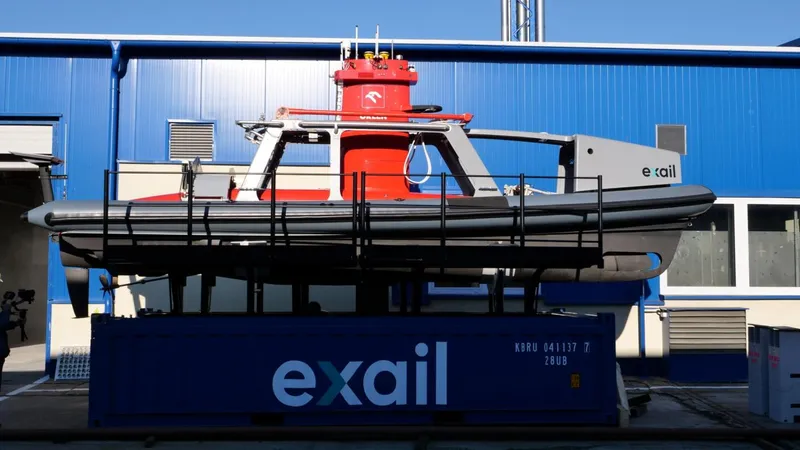
ORLEN Petrobaltic has expanded its offshore fleet with the addition of the DriX H-8, a state-of-the-art unmanned surface vessel (USV) designed to operate in the demanding conditions of the Baltic Sea. The new autonomous unit will support seabed research in hard-to-reach areas, monitor offshore platforms and wind turbines, and enhance the overall safety of ORLEN Group’s marine infrastructure. This is the first civilian deployment of this technology in Poland.
In brief
ORLEN Petrobaltic has added the DriX H-8 uncrewed surface vehicle to its fleet, the first such unit in the Polish civilian sector. The DriX H-8 was manufactured by the French company Exail and delivered by the Szczecin-based company Thesta, and the vehicle is equipped with an MBES multibeam echosounder and an SBP sub-bottom profiler for seabed mapping and monitoring of drilling platforms and wind turbines. The Maritime Office in Gdynia has approved operational tests in a designated area of the Baltic Sea. Wiesław Prugar, ORLEN management board member for Upstream, called the purchase a new stage in the use of autonomous maritime systems.
- The scale of ORLEN Group’s investment in the Baltic Sea is unprecedented. We are building the first offshore wind farm, developing exploration activities, and providing advanced offshore services. Investing in top-tier technology that boosts operational efficiency is a natural step forward. The DriX H-8 represents a new stage in the use of autonomous technologies in the Baltic, aligning with the global trend of digitalisation and automation in the offshore sector, said Wiesław Prugar, Member of the ORLEN Management Board for Upstream.
Advanced technology for offshore operations
Built by the French company Exail and delivered by Thesta Sp. z o.o. from Szczecin, the DriX H-8 is one of the most technologically advanced USVs currently available on the market. The unit is equipped with high-precision sensors, including a multibeam echosounder (MBES) and a sub-bottom profiler (SBP), enabling detailed hydrographic and geophysical data acquisition.
The system will be used for the monitoring of offshore structures and high-resolution seabed mapping. Thanks to the quality and scope of collected data, DriX H-8 will also support compliance with the EU Methane Regulation, which obliges oil and gas operators to detect and respond promptly to potential methane leaks.
- This is the second DriX unit delivered by Thesta to the Polish market, but the first one intended for non-military applications. We are proud to open a new chapter in the implementation of innovative offshore technologies in cooperation with ORLEN Petrobaltic, said Michał Bytomski, CEO of Thesta.
Efficiency, safety, and sustainability
Designed for autonomous operation, DriX H-8 offers exceptional endurance and data accuracy while reducing the need for crewed missions. Its deployment increases safety, cuts operational costs, and shortens project timelines compared to traditional manned vessels.
With its low environmental footprint and energy-efficient propulsion, DriX H-8 provides a greener alternative for offshore operations. The vessel’s deployment has been approved by the Maritime Office in Gdynia, allowing ORLEN Petrobaltic to conduct operational tests within a designated area of the Baltic Sea.
Strengthening Poland’s offshore capabilities
ORLEN Petrobaltic S.A. is the only Polish company engaged in oil and gas exploration and production within Poland’s exclusive economic zone of the Baltic Sea. The company plays a key role in ORLEN Group’s energy security and upstream development strategy.
The introduction of the DriX H-8 autonomous vessel marks a significant step towards the digitalisation of offshore processes, operational efficiency, and the reduction of the company’s carbon footprint. It also supports ORLEN Group’s long-term objectives in offshore wind development and the creation of a sustainable energy supply chain across the Baltic region.
Source: Gazeta Morska · Compiled by: Kamil Kusier
Related articles
 Energy and offshore Equinor takes over Bałtyk 2 and 3 O&M base in Łeba. Port to serve 1.44 GW of offshore wind for 30 years
 Navy and defence Port Gdański Eksploatacja secures NATO NCAGE code. Gdańsk port company lines up for defence tenders
 Shipbuilding industry Ex-Enterprise towed to Mobile under $418.5m contract. Test case for Nimitz-class disposal begins
 Energy and offshore Energa renames Gdańsk gas plant company as foundations for 6,000-tonne turbine and boiler are laid
 Equipment and technology WB Group takes Polish drones from Tokyo to SOFEX in Jordan in a single week
 Ports and logistics PGE books Gdańsk’s T5 terminal for the long haul: Baltica 2 first, then more offshore wind farms
Comments (0)
The discussion is moderated by the editors: a comment appears after review. Your e-mail address is not published.
Nobody has commented on this article yet.