









ORLEN opens first hydrogen refuelling station in Northern Poland
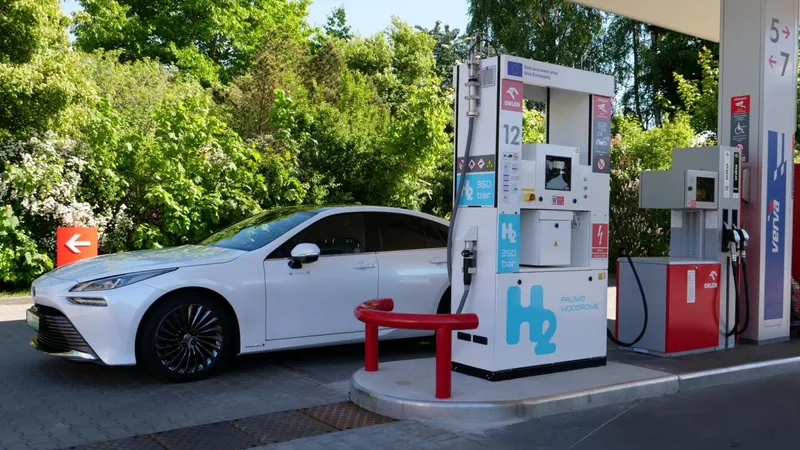
ORLEN has launched its seventh public hydrogen refuelling station in Poland and the first one in the northern part of the country. Located in Gdynia, close to key transport corridors linking the S6 and S7 expressways, the facility is expected to support the development of low-emission transport, including public transit and heavy-duty logistics.
In brief
ORLEN opened Poland's seventh publicly accessible hydrogen refuelling station, and the first in the north of the country, at 239 Wielkopolska Street in Gdynia. The station operates around the clock, has two refuelling points, at 350 bar and 700 bar pressure, and its daily capacity is 630 kilograms of hydrogen. Refuelling a passenger car takes about five minutes, and a bus about fifteen minutes. The investment was built as part of the PureH2 project co-financed by the European Union, and pilot runs of a hydrogen bus are planned in Gdynia during the summer holidays.
Strategic location for hydrogen mobility
The new station, situated at Wielkopolska Street 239 in Gdynia, is designed to serve passenger cars, buses and heavy goods vehicles. The facility operates 24/7 and offers hydrogen refuelling at both 350 bar and 700 bar pressure levels.
With a daily capacity of 630 kilograms of hydrogen, the station can refuel a passenger vehicle in approximately five minutes and a hydrogen-powered bus in around fifteen minutes.
Supporting decarbonisation of transport
According to ORLEN, hydrogen is expected to play a growing role in the future energy mix and transport sector, particularly in applications where battery-electric solutions may face operational limitations.
- Hydrogen will play an increasingly important role in the modern economy, which is why we are consistently developing both its production and the infrastructure necessary for its use. We see particular potential in public and heavy transport, where hydrogen can effectively support decarbonisation efforts and improve air quality. Our goal is to build a reliable supply system for transport. The launch of the Gdynia station expands our nationwide network, offering drivers access to low-emission fuel at our seventh location and the first in northern Poland, strategically positioned near the S6 and S7 transport corridors, said Grzegorz Jóźwiak, Executive Director for Biofuels and Hydrogen at ORLEN.
Fuel supply and safety standards
Hydrogen supplied to the Gdynia station is transported from ORLEN hydrogen hubs located in Włocławek and Trzebinia using specialised hydrogen trailers with capacities ranging from 500 to 900 kilograms.
The station was developed under the EU co-financed “PureH2” project and incorporates advanced safety systems, including hydrogen detection sensors and breakaway couplings. Dedicated storage areas have also been secured in line with industry standards.
Part of a wider hydrogen network
The Gdynia investment forms part of ORLEN’s broader strategy to develop hydrogen infrastructure across Poland and along the Trans-European Transport Network (TEN-T). The company already operates public hydrogen stations in Poznań, Katowice, Wałbrzych, Włocławek, Piła and Płock, while a mobile hydrogen station has been serving Kraków’s municipal bus fleet since 2022.
Looking ahead, ORLEN plans to expand its hydrogen network with new refuelling stations in Warsaw, Kraków, Bielsko-Biała and Gorzów Wielkopolski. By 2035, the Group aims to reach approximately 0.9 GW of electrolyser capacity, enabling annual production of more than 130,000 tonnes of renewable hydrogen, supported by waste-to-hydrogen projects.
Source: Gazeta Morska · Compiled by: Kamil Kusier
Related articles
 Energy and offshore Equinor takes over Bałtyk 2 and 3 O&M base in Łeba. Port to serve 1.44 GW of offshore wind for 30 years
 Navy and defence Port Gdański Eksploatacja secures NATO NCAGE code. Gdańsk port company lines up for defence tenders
 Shipbuilding industry Ex-Enterprise towed to Mobile under $418.5m contract. Test case for Nimitz-class disposal begins
 Energy and offshore Energa renames Gdańsk gas plant company as foundations for 6,000-tonne turbine and boiler are laid
 Equipment and technology WB Group takes Polish drones from Tokyo to SOFEX in Jordan in a single week
 Ports and logistics PGE books Gdańsk’s T5 terminal for the long haul: Baltica 2 first, then more offshore wind farms
Comments (0)
The discussion is moderated by the editors: a comment appears after review. Your e-mail address is not published.
Nobody has commented on this article yet.