









Orlen and Northland Power have begun construction of the first wind farm in the Polish Baltic Sea
After months of preparations, 11 vessels set out to sea to begin constructing the foundations of the first wind farm in Polish Baltic waters. As part of the ongoing work, 2 out of 78 monopiles—100-meter structures that will support 15 MW wind turbines—have already been installed. These are among the most advanced solutions on the market, with some components manufactured at the Vestas factory in Szczecin. The Baltic Power farm, with a total capacity of 1.2 GW, is set to begin production in 2026 and will generate clean and stable energy, capable of powering over 1.5 million households. Offshore wind energy is a key element of ORLEN Group's new strategy, which aims to develop over 4 GW of installed capacity in the Baltic Sea in collaboration with partners.
In brief
Orlen and Northland Power have installed 2 of the 78 monopiles of the Baltic Power farm, starting construction of the first offshore wind farm in Polish Baltic waters. The monopiles are up to 100 metres long, weigh up to 1,700 tonnes and have a diameter of more than 9 metres, with 11 vessels involved in the works over an area of around 130 square kilometres. The 1.2 GW Baltic Power farm will start up in 2026 and generate around 4,000 GWh annually, cutting CO2 emissions by around 2.8 million tonnes per year. Orlen CEO Ireneusz Fąfara announced that 2025 will be a breakthrough year for the project.
Baltic Power: Poland’s first offshore wind farm moves forward
Baltic Power is the first and most advanced offshore wind energy investment in Polish Baltic waters. As part of its new strategy, Orlen Group has committed to developing three additional offshore projects, for which it already holds concessions. Together with large-scale energy storage, onshore renewables, gas power plants, and small modular reactors, this technology will be a cornerstone of Poland’s energy transition.
A milestone in Poland’s offshore wind industry
— Our new strategy is about concrete actions, and Baltic Power is a prime example. After months of intensive work, we are proud to announce that the first foundations of the Baltic Power wind farm have been installed. The year 2025 will be a turning point for this project, with hundreds of our employees carrying out the largest offshore installation operations in Polish history. By 2026, energy from the Baltic Sea will be flowing to consumers—clean, stable, and secure electricity that will power the Polish economy. This project is also about Polish companies growing alongside us. It’s the energy of tomorrow, starting today — said Ireneusz Fąfara, CEO of Orlen.
Orlen Group's project aims to maximize the involvement of local suppliers throughout the wind farm's 30-year lifespan. Key components such as turbine nacelles, cables, offshore substation structures, and foundation elements are being produced in factories located in Szczecin, Bydgoszcz, Trójmiasto, Żary, and Niemodlin. Baltic Power is also working with Polish companies in geological research, design services, and logistics.
— Installing the first foundations of the Baltic Power wind farm is a significant moment for Poland’s offshore wind sector. We are proud to collaborate with Orlen Group on this pioneering project. As partners in developing Poland’s first offshore wind farm, we are excited to contribute our global expertise. This achievement not only reflects our shared progress but also strengthens our commitment to Poland’s energy future. Safety remains our top priority at every stage, ensuring the highest standards across all aspects of the project. Today’s milestone is a testament to the strong partnership between Northland and Orlen Group, further reinforcing our joint commitment — said Christine Healy, President and CEO of Northland Power Inc.
A massive offshore construction site
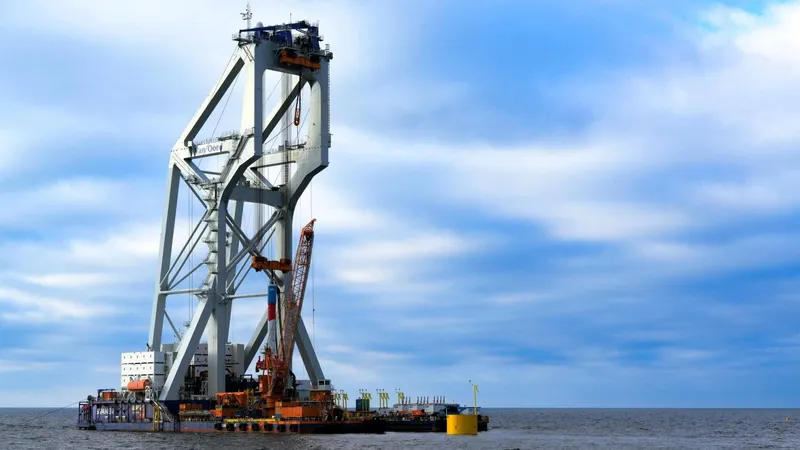
The Baltic Power offshore construction zone covers approximately 130 km²—comparable to the size of Gdynia. The site will feature 78 monopiles, each up to 100 meters long, weighing up to 1,700 tons, and exceeding 9 meters in diameter. These steel structures are installed by a floating crane, which drives them into the seabed at depths of around 40 meters.
Alongside the crane, more than a dozen vessels are actively involved in the project, including support ships, tugboats, personnel and equipment transport vessels, environmental monitoring units, and security patrols. The entire construction process and marine traffic around the site are monitored 24/7 by the Baltic Power Marine Coordination Center.
The next stages of the offshore construction will involve installing transition pieces connecting the foundations to the turbines, followed by the turbines themselves, offshore substations, inter-array cables linking the turbines, and export cables transmitting the generated energy to shore. Installation work will continue through 2026.
Powering Poland’s energy transition
Upon its planned completion in 2026, Baltic Power will be Poland’s first operational offshore wind farm. It is expected to generate approximately 4,000 GWh of zero-emission electricity annually, reducing CO₂ emissions by around 2.8 million tons per year compared to conventional energy sources.
Source: Orlen / Gazeta Morska · Compiled by: Kamil Kusier
Related articles
 Energy and offshore Orlen Neptun deploys V-LiDAR buoys at Baltic West ahead of Poland's 2027 offshore wind auction
 Energy and offshore Equinor takes over Bałtyk 2 and 3 O&M base in Łeba. Port to serve 1.44 GW of offshore wind for 30 years
 Navy and defence Port Gdański Eksploatacja secures NATO NCAGE code. Gdańsk port company lines up for defence tenders
 Shipbuilding industry Ex-Enterprise towed to Mobile under $418.5m contract. Test case for Nimitz-class disposal begins
 Energy and offshore Energa renames Gdańsk gas plant company as foundations for 6,000-tonne turbine and boiler are laid
 Equipment and technology WB Group takes Polish drones from Tokyo to SOFEX in Jordan in a single week
Comments (0)
The discussion is moderated by the editors: a comment appears after review. Your e-mail address is not published.
Nobody has commented on this article yet.