









Orlen and Equinor to collaborate on CCS technologies
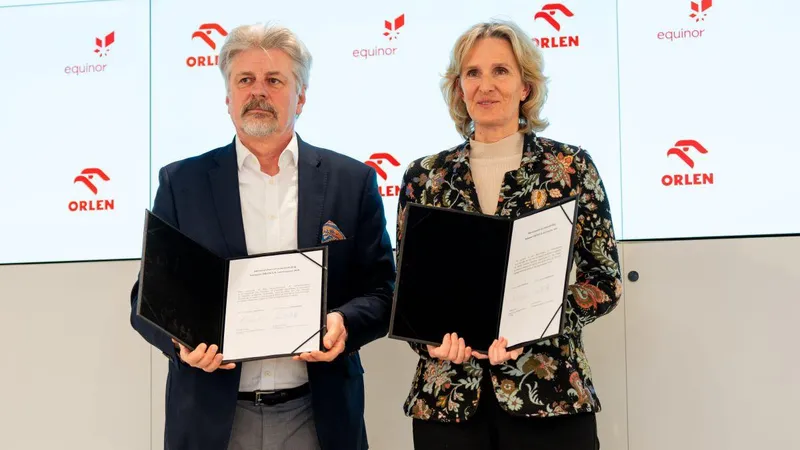
Orlen, together with Norway’s Equinor—one of Europe's leading energy companies—will develop expertise in carbon capture and storage (CCS) technologies. The management boards of both companies have signed an agreement to cooperate in the areas of CO2 transport and storage in Poland. This initiative aims to reduce CO2 emissions into the atmosphere, supporting industrial decarbonization.
In brief
Orlen and Norway's Equinor have signed a cooperation agreement on CCS technology covering the transport and storage of carbon dioxide in Poland. Both companies will identify potential CO2 storage sites onshore and in the Polish part of the Baltic Sea. Orlen has declared in its new strategy that it will achieve the capacity to capture, transport and store 4 million tonnes of CO2 per year by 2035. Equinor has been storing carbon dioxide in the Sleipner field since 1996 and is a shareholder in the Northern Lights project with a capacity of 1.5 million tonnes of CO2 per year.
Under the agreement, Orlen and Equinor will identify potential CO2 storage sites, considering both onshore locations and the Polish sector of the Baltic Sea. In the next phase, the partners will analyze the feasibility of joint projects based on the identified storage sites within the country.
– The collaboration with Equinor marks a milestone in achieving Orlen Group’s strategic goals. We are joining forces with an experienced and motivated partner to develop unique know-how in CCS technologies. Leveraging these competencies, we aim to establish a new, forward-looking business sector that will strengthen Orlen Group’s decarbonization potential. At the same time, this initiative will stimulate the development of an entire ecosystem of companies that, through cooperation with Orlen, will grow, create value, and generate new jobs. This is how we fulfill our role as a leader in energy transition, emphasized Wiesław Prugar, Orlen Management Board Member for Upstream.
– Today, Orlen and Equinor are entering a new phase of cooperation, building on a strong foundation of their existing energy partnership. Both companies are determined to ensure energy security for their customers while implementing low-emission solutions and expanding renewable energy. The agreement signed today paves the way for joint efforts to explore CO2 storage opportunities in Poland. By working together, Equinor and Orlen will complement each other’s expertise to effectively achieve their objectives, stated Irene Rummelhoff, Executive Vice President for Marketing, Midstream, and Processing at Equinor.
Orlen’s new strategy includes achieving a carbon capture, transport, and storage capacity of 4 million tons of CO2 annually by 2035. A portion of this capacity will be utilized for decarbonizing Orlen Group’s operations, including its petrochemical and refining assets. The remaining capacity will be offered as a service to other companies.
Equinor is one of Europe’s most experienced companies in CO2 storage. Since 1996, the company has been storing CO2 in the Sleipner field structures. Currently, Equinor is engaged in several large-scale CCS projects across Northwest Europe and the United States. The company is also a stakeholder in Northern Lights, the first cross-border CCS project offering CO2 storage as a service.
In September 2024, a CO2 transshipment terminal was commissioned, and the first customers are expected to deliver CO2 by mid-2025. In its initial phase, Northern Lights will offer the capacity to inject 1.5 million tons of CO2 annually. Furthermore, Equinor holds multiple CO2 storage licenses on the Norwegian Continental Shelf, as well as in Denmark, the UK, and the US. Last year, in partnership with TotalEnergies and BP, the company secured a final investment decision (FID) for the Northern Endurance Partnership—a CO2 transport and storage solution—and Net Zero Teesside, a gas-fired power plant equipped with post-combustion carbon capture.
Orlen’s CCS plans and its collaboration with the Norwegian partner align with the company’s ambitious decarbonization objectives and the latest European regulations. In June 2024, the EU’s Net-Zero Industry Act (NZIA) came into effect, aiming to enhance the competitiveness of European companies in low-emission technologies and improve access to such technologies. NZIA sets specific CCS capacity targets, requiring the EU to establish the capability to store 50 million tons of CO2 annually by 2030. This obligation falls on companies engaged in natural gas and oil extraction within the EU, including Orlen.
According to NZIA, CCS is expected to enable decarbonization in industries where significant CO2 emission reductions are technologically challenging, such as cement production, metallurgy, and the chemical industry. For these sectors, capturing CO2 and transporting it to designated storage sites for deep geological sequestration will be essential to continuing operations within the EU despite increasingly stringent CO2 reduction targets.
We are on Google News! Join us and follow Gazeta Morska. Get daily updates straight from the sea. Follow us at gazetamorska.pl!
Source: Orlen / Gazeta Morska · Compiled by: Kamil Kusier
Related articles
 Energy and offshore Orlen Neptun deploys V-LiDAR buoys at Baltic West ahead of Poland's 2027 offshore wind auction
 Energy and offshore Equinor takes over Bałtyk 2 and 3 O&M base in Łeba. Port to serve 1.44 GW of offshore wind for 30 years
 Navy and defence Port Gdański Eksploatacja secures NATO NCAGE code. Gdańsk port company lines up for defence tenders
 Shipbuilding industry Ex-Enterprise towed to Mobile under $418.5m contract. Test case for Nimitz-class disposal begins
 Energy and offshore Energa renames Gdańsk gas plant company as foundations for 6,000-tonne turbine and boiler are laid
 Equipment and technology WB Group takes Polish drones from Tokyo to SOFEX in Jordan in a single week
Comments (0)
The discussion is moderated by the editors: a comment appears after review. Your e-mail address is not published.
Nobody has commented on this article yet.