









Orka submarine programme at a critical juncture. Between strategic choice and negotiation leverage
Poland’s long-delayed Orka submarine programme has entered a decisive and increasingly unstable phase. Recent statements by Deputy Defence Minister Stanisław Wziątek indicate that, despite selecting Sweden as the preferred partner, Warsaw is prepared to reopen the competition if ongoing negotiations fail to deliver satisfactory terms. In practice, this signals that the programme remains far from final resolution.
In brief
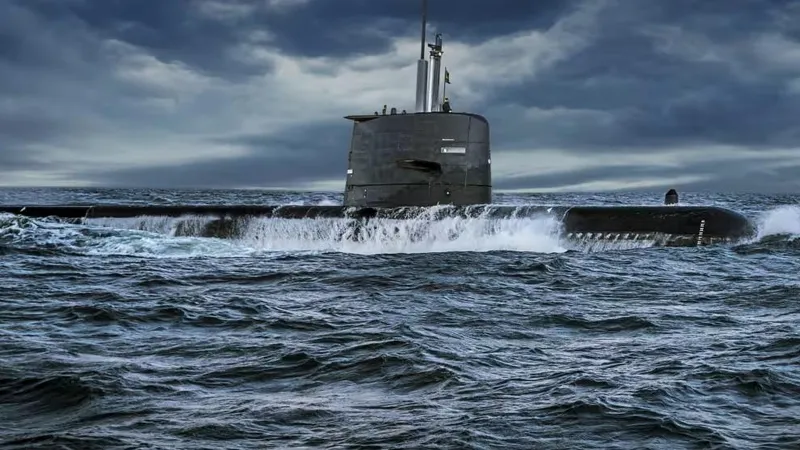
The Orka programme for acquiring new submarines for the Polish Navy has returned to public debate following statements by representatives of the Ministry of National Defence, including Deputy Minister Stanisław Wziątek, indicating that the choice of Sweden is not final. The absence of a signed contract for A26 submarines from the Swedish group Saab leaves the door open for the return of offers from TKMS, Naval Group and Hanwha Ocean. The integration of cruise missiles remains contentious, and without them the new submarines would be limited to the role of defensive platforms. Negotiations have already lasted almost thirty years in total.
Preferred partner, but no final commitment
The designation of Sweden’s Saab and its A26 submarine design as the preferred bidder was widely interpreted as a de facto conclusion of the selection process. However, the absence of a signed contract and the evolving tone from the Ministry of National Defence suggest that this preference remains conditional.
Poland is effectively maintaining leverage by keeping alternative options viable. German (TKMS), French (Naval Group), Italian (Fincantieri), and South Korean (Hanwha Ocean) offers-previously sidelined-may yet re-emerge if negotiations with Sweden stall.
This approach, while unconventional, reflects a deliberate strategy: maximise bargaining power across key parameters, including price, industrial participation, delivery timelines, and-most critically-combat capability.
The core dispute: strike capability
At the heart of current tensions lies the question of armament, specifically the potential integration of land-attack cruise missiles (LACM). Within defence circles, there is broad consensus that without such capability, Poland’s future submarines would fall short of providing credible deterrence, limiting their role to defensive and surveillance missions.
Reports suggesting that the Swedish offer may not fully address this requirement-at least in initial configurations-have triggered concern among analysts and policymakers alike. The Ministry’s reluctance to provide clear confirmation only reinforces uncertainty.
The issue is inherently complex, spanning:
- technological integration challenges,
- export control constraints,
- and significant cost implications.
Nevertheless, it is precisely this capability that will define the strategic value of the Orka programme.
Platform maturity versus industrial opportunity
Another key consideration is the developmental status of the A26 design. While technologically advanced, the platform has yet to enter operational service. For Poland, this implies participation in a programme still in its maturation phase.
From an industrial standpoint, this may translate into broader technology transfer and deeper cooperation. Operationally, however, it introduces risk:
- potential schedule slippage,
- cost escalation,
- early-life integration issues.
In contrast, competing designs-such as Germany’s Type 212/214 family or France’s Scorpène-offer proven, in-service platforms, a factor that continues to resonate within parts of the naval community.
Competition not over
Wziątek’s remarks have effectively reopened the competitive landscape. What was perceived as a near-final selection now appears reversible, placing pressure on the Swedish side while simultaneously reviving alternative bids.
In this context, non-European suppliers-particularly South Korea-could regain relevance. Their proposals have emphasised rapid delivery and extensive industrial cooperation. However, their prospects may be constrained by financing mechanisms and the broader political push to prioritise European defence solutions.
Strategic context: the Baltic dimension
The urgency of the Orka programme must be understood against the evolving security environment in the Baltic Sea. Submarine capabilities remain a key component of deterrence, offering stealth, intelligence-gathering, and-if properly equipped-long-range strike options.
For Poland, future submarines are expected to fulfil multiple roles:
- anti-submarine and anti-surface warfare,
- intelligence, surveillance, and reconnaissance,
- support to allied operations,
- and potentially strategic strike.
A reduced or delayed capability would have long-term implications for Poland’s position within NATO’s northern flank.
Conclusion: deterrence at stake
The Orka programme has once again reached a crossroads. Whether through a revised agreement with Sweden or a return to competing offers, the coming months will be decisive.
The stakes, however, go beyond procurement. At issue is whether Poland will establish a credible undersea deterrent in the Baltic-or continue to operate with limited, largely symbolic capabilities.
Source: Gazeta Morska · Compiled by: Kamil Kusier
Related articles
 Energy and offshore Equinor takes over Bałtyk 2 and 3 O&M base in Łeba. Port to serve 1.44 GW of offshore wind for 30 years
 Navy and defence Port Gdański Eksploatacja secures NATO NCAGE code. Gdańsk port company lines up for defence tenders
 Shipbuilding industry Ex-Enterprise towed to Mobile under $418.5m contract. Test case for Nimitz-class disposal begins
 Energy and offshore Energa renames Gdańsk gas plant company as foundations for 6,000-tonne turbine and boiler are laid
 Equipment and technology WB Group takes Polish drones from Tokyo to SOFEX in Jordan in a single week
 Ports and logistics PGE books Gdańsk’s T5 terminal for the long haul: Baltica 2 first, then more offshore wind farms
Comments (0)
The discussion is moderated by the editors: a comment appears after review. Your e-mail address is not published.
Nobody has commented on this article yet.