









Ocean Winds delivers first power from EFGL floating offshore wind farm in France
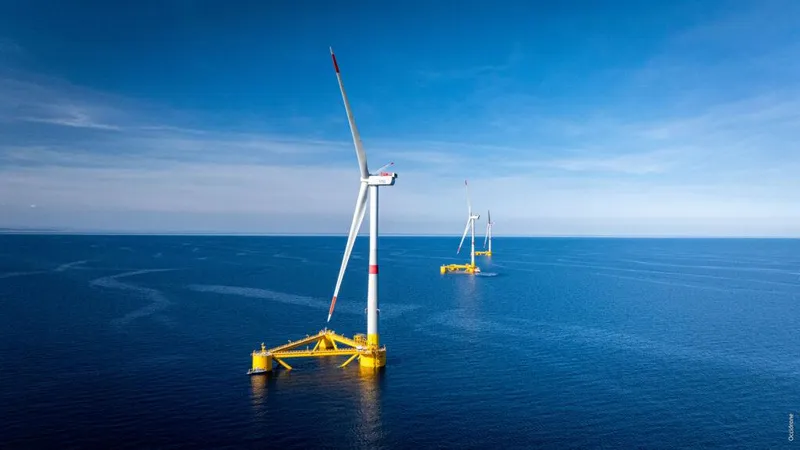
Ocean Winds has started electricity production at the 30 MW Éoliennes Flottantes du Golfe du Lion (EFGL) floating offshore wind farm off the coast of France, marking another milestone for Europe’s floating wind sector and the commercial maturation of floating offshore technologies.
In brief
Ocean Winds has started generating electricity from the 30 MW Éoliennes Flottantes du Golfe du Lion floating wind farm, the first project of its kind in France. The EFGL farm lies about 16 kilometres off the Mediterranean coast and consists of three 10 MW turbines, with annual output expected to reach about 110 thousand MWh, equivalent to the demand of about 50 thousand residents of southern France. About 85 percent of direct suppliers were French companies, and more than 99 percent of partners came from Europe. Ocean Winds, together with Banque des Territoires, is developing the 250 MW EFLO project.
Located around 16 kilometres off the Mediterranean coast near Port-La Nouvelle, the pilot project consists of three 10 MW turbines installed on floating foundations designed for deeper-water conditions, where conventional bottom-fixed solutions are less viable.
According to the company, the wind farm is expected to generate approximately 110,000 MWh of renewable electricity annually — enough to supply around 50,000 inhabitants in southern France over a projected 20-year operational period.
The project was developed by Ocean Winds in partnership with Banque des Territoires and represents the company’s second operational floating wind farm following WindFloat Atlantic offshore Portugal.
Floating wind moves closer to industrial scale
The commissioning of EFGL is viewed as another important step toward large-scale deployment of floating offshore wind, a segment increasingly seen as critical for expanding offshore renewable energy into deeper waters worldwide.
Unlike traditional bottom-fixed offshore wind farms, floating platforms allow turbines to be deployed in areas with significant water depths, opening new opportunities for countries with limited shallow-water resources, including France, Norway, Japan and South Korea.
Ocean Winds CEO Craig Windram said the project demonstrates the company’s capability to deliver complex offshore wind assets across different technologies and marine environments.
The launch of EFGL comes during a broader acceleration of floating wind development globally, with Europe positioning itself as a key industrial hub for the sector despite increasing competition from Asian markets.
Strong European supply chain participation
Ocean Winds highlighted the extensive involvement of regional suppliers throughout the project lifecycle. Around 85% of direct suppliers were French companies or firms operating in France, while more than 99% were based in Europe. Approximately 60% of participating companies were small and medium-sized enterprises (SMEs).
The assembly and installation campaign was centred around Port-La Nouvelle, underlining the growing role of Mediterranean ports in supporting future floating offshore developments.
The project is also expected to support long-term local employment through operations and maintenance activities during its operational phase.
Biodiversity integration at sea
EFGL additionally stands out for its environmental integration measures. Ocean Winds describes the facility as the world’s first “nature-inclusive” floating wind farm, featuring Biohut® artificial marine habitats developed by French company Ecocean.
The habitats are intended to promote biodiversity around offshore infrastructure and reflect a broader industry trend toward combining renewable energy deployment with marine ecosystem enhancement.
Next phase already underway
EFGL is intended as a pilot-scale development paving the way for larger floating offshore projects in France. Ocean Winds and Banque des Territoires are already advancing the 250 MW EFLO (Éoliennes Flottantes d’Occitanie) project awarded in late 2024.
While floating offshore wind remains more expensive than conventional offshore solutions, the industry expects costs to decline as deployment scales up and supply chains mature. Projects such as EFGL are increasingly viewed as critical demonstration assets for proving the technical and industrial viability of the technology ahead of wider commercial rollout.
Source: Gazeta Morska · Compiled by: Kamil Kusier
Related articles
 Energy and offshore Equinor takes over Bałtyk 2 and 3 O&M base in Łeba. Port to serve 1.44 GW of offshore wind for 30 years
 Navy and defence Port Gdański Eksploatacja secures NATO NCAGE code. Gdańsk port company lines up for defence tenders
 Shipbuilding industry Ex-Enterprise towed to Mobile under $418.5m contract. Test case for Nimitz-class disposal begins
 Energy and offshore Energa renames Gdańsk gas plant company as foundations for 6,000-tonne turbine and boiler are laid
 Equipment and technology WB Group takes Polish drones from Tokyo to SOFEX in Jordan in a single week
 Ports and logistics PGE books Gdańsk’s T5 terminal for the long haul: Baltica 2 first, then more offshore wind farms
Comments (0)
The discussion is moderated by the editors: a comment appears after review. Your e-mail address is not published.
Nobody has commented on this article yet.