New maritime threat horizon: Russia tests kamikaze drones in the Baltic Sea
In late July 2025, the Baltic Sea—typically a strategic but relatively stable maritime theatre—witnessed a significant shift in the nature of emerging threats. During the large-scale Russian naval exercise Letochny Shtorm (“July Storm”), the Russian Navy reportedly tested unmanned surface kamikaze drones capable of delivering high-impact strikes over extended distances.
security navy worldwide news28 july 2025 | 14:56 | Source: Gazeta Morska | Prepared by: Kamil Kusier | Print
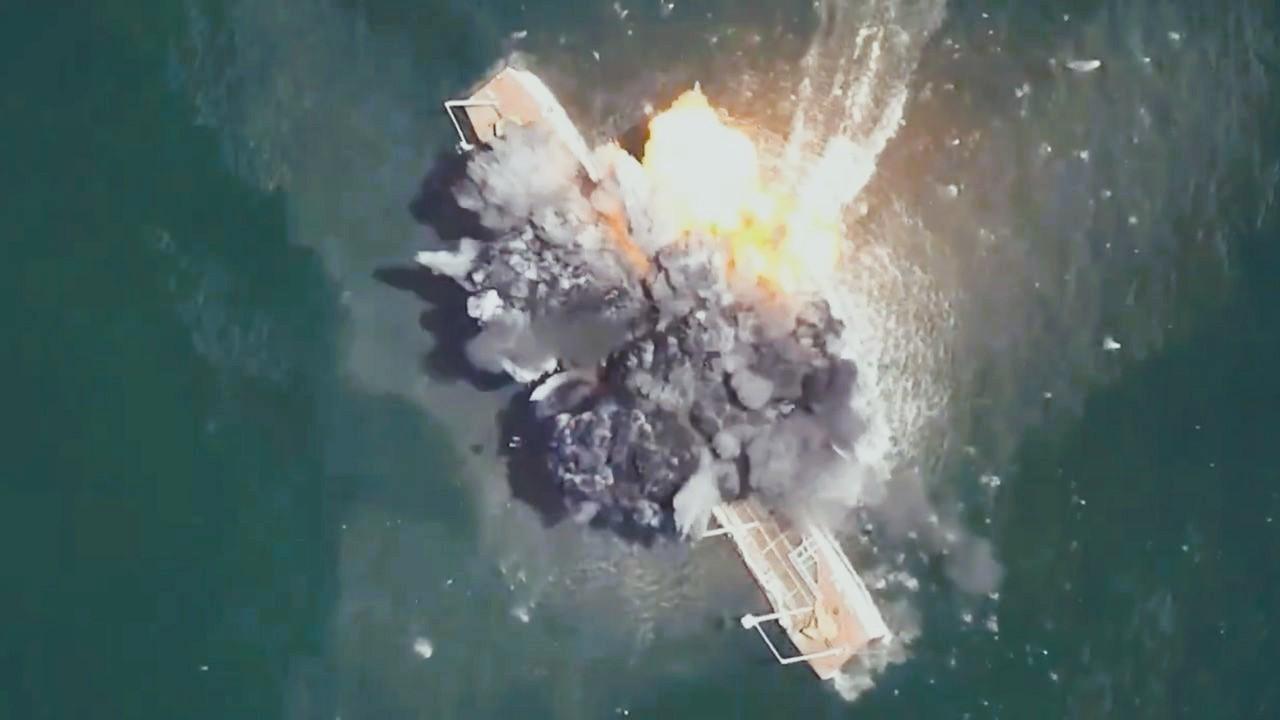
fot. x.com
A blast at sea raises alarms
Footage circulating on pro-Russian Telegram channels and defense monitoring platforms shows what appears to be a drone equipped with a live video feed approaching and striking a maritime target. The explosion, recorded from the drone’s perspective, suggests the system was carrying a live warhead. Analysts estimate the drone’s range at over 300 kilometers—well within reach of commercial shipping routes, offshore infrastructure, and coastal naval assets.
This marks one of the first documented instances of Russia employing kamikaze drones in a maritime setting within the Baltic Sea region.
From land to sea: a tactical evolution
Until recently, loitering munitions such as the ZALA Lancet, Italmas (Izdeliye‑54), and Garpiya were used primarily in land operations, especially in Ukraine. Their deployment at sea suggests a doctrinal shift: Russia appears to be extending asymmetric drone warfare into the littoral and open-water domains.
Given the Baltic’s shallow depth, dense shipping traffic, and concentration of critical maritime infrastructure, this type of capability introduces a new layer of complexity for regional defense and civil maritime operations.
Geostrategic tension in contested waters
The July Storm drills, which involved dozens of Russian Navy ships, submarines, and aircraft, took place near NATO’s eastern maritime flank. Though officially described as routine, the scope and proximity of the exercises, coupled with drone testing, signal Moscow’s continued interest in high-impact, low-cost deterrence in sensitive waters.
According to analysts at RUSI and CSIS, kamikaze drones offer a low-signature, cost-effective alternative to conventional missile systems. Their modular design enables a variety of mission profiles—from kinetic strikes to reconnaissance and electronic disruption.
Implications for Baltic security
The emergence of kamikaze drones at sea demands a recalibration of regional security postures. Standard maritime awareness tools are often ill-equipped to detect small, autonomous surface threats—especially in congested areas such as the Gulf of Finland or the approaches to Gdańsk, Klaipėda, and Stockholm.
Ports, coastal energy terminals, and naval facilities may need to invest in early-warning systems, passive acoustic barriers, and counter-drone technologies. NATO's maritime doctrine may also evolve to address rules of engagement for unmanned threats in contested but non-war conditions.
Conclusion: the sea is now contested
The Baltic Sea is no longer just a zone of strategic friction—it is becoming a testbed for autonomous and asymmetric warfare. The introduction of kamikaze drones into this environment may redefine future maritime conflict dynamics, from conventional warfare to grey-zone operations.
For NATO allies, Baltic navies, and commercial maritime operators alike, the message is clear: drone warfare is no longer confined to land. The sea is now in play—and it requires a response.
see also
Buy us a coffee, and we’ll invest in great maritime journalism! Support Gazeta Morska and help us sail forward – click here!
Kamil Kusier
redaktor naczelny
comments
Add the first comment
see also
Dublin Civil Defence volunteers helped Kraków victims. Polish SAR director Sebastian Kluska once served with them
HMS Prince of Wales takes on ammunition in Norway. First resupply outside the UK
Poland’s constitutional crisis is also a maritime story
Norwegian submarine Utstein completes NATO patrol guarding offshore oil and undersea infrastructure
Polish SAR’s new rescue vessel Mistral launched at Kewatec in Finland
Icelandic Coast Guard and police delegation visits Polish Border Guard’s Maritime Division
Polish Navy helicopter evacuates man from Baltic platform 100 km off Władysławowo
SNMG2 joins Allied warships in PASSEX as Italy's Mare Aperto 2026 gets under way
From lightships to solar power: 160 years of the Grundkallen light station
254 people, manikins and life rafts: Maritime University of Szczecin joins national CPR record attempt
ADVERTISEMENT
ADVERTISEMENT