









MSC wants to buy Meyer Werft. The sole bidder in Gdynia is negotiating to take over the German yard
Mediterranean Shipping Company, the world's largest container carrier, is negotiating to acquire around 80 per cent of Meyer Werft, the German shipbuilding group that owns the yard in Papenburg and Neptun Werft in Rostock on the Baltic. The stake is held by the federal government and the state of Lower Saxony, which rescued the yard in 2024 by injecting 200 million euros of capital each and granting 2.6 billion euros of credit guarantees. According to Bloomberg the talks are ongoing, other suitors may still emerge, and the governments do not want to sell below the 400 million they invested.
In brief
Mediterranean Shipping Company is negotiating to acquire about 80 percent of German shipbuilding group Meyer Werft, which owns the Papenburg yard and Neptun Werft in Rostock. The Meyer Werft stake belongs to the federal government and the state of Lower Saxony, which in 2024 each contributed 200 million euros of capital and provided guarantees of 2.6 billion euros. According to Bloomberg, the government side does not want to sell below 400 million. MSC-controlled TiL submitted the only bid for the Outer Port in Gdynia on 30 September.
For Poland the news has two addresses. The first is Gdynia, where Terminal Investment Limited, a company controlled by MSC, submitted on 30 September the only bid in the tender for the Outer Port. The second is Rostock, where Neptun Werft builds ferries, cruise ship modules and specialised vessels on the same Baltic where Polish yards look for orders.
A yard rescued by the state
Meyer Werft, a family firm with more than 230 years of history, is one of Europe's three builders of large cruise ships, alongside Fincantieri and Chantiers de l'Atlantique. It lost liquidity during the pandemic and banks began questioning its creditworthiness; in 2024 the yard needed 2.8 billion euros to complete ships on order and could not borrow it. Berlin and Hanover stepped in with capital and guarantees, taking 80 per cent and declaring the arrangement temporary. The Meyer family kept 20 per cent and a right of first refusal on the state stake, but gave up management.
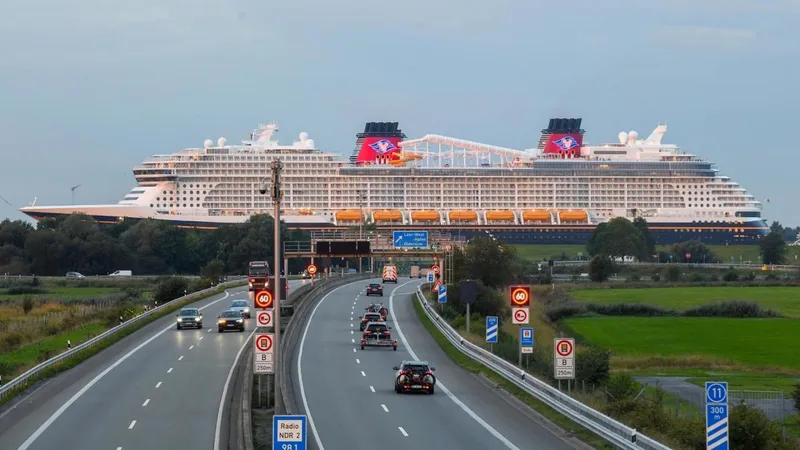
The yard employs around five thousand people directly, and more than twenty thousand jobs in the region depend on it and its suppliers, which makes its future ownership a political matter in Lower Saxony. Its finances are now considered stable, and its order book includes ships for Disney, Royal Caribbean and Carnival.
The largest customer wants to be the owner
MSC Cruises is Meyer Werft's largest customer. This year the two sides signed a letter of intent for four next-generation cruise ships with options for two more, a package worth up to 10 billion euros, with deliveries every year from 2030 that would fill Papenburg through 2035. The contract has not yet been finalised. Acquiring the yard would give MSC something no other cruise operator has: its own building slots for the next decade and control over who else gets one.
It is the model MSC has followed for years: instead of buying services, it buys suppliers. Terminals through TiL, logistics through Medlog, cargo airlines, ports, and now a shipyard. The Geneva group, private and unlisted, is today the world's largest container carrier, the second-largest terminal operator and the third-largest cruise line, and in each segment it moves towards owning the whole chain.
What it means for Gdynia and for Polish yards
In Gdynia the same owner is already a shareholder in the Baltic Container Terminal and the sole bidder for the 5-billion-zloty Outer Port. We wrote after the bids were opened that the question of MSC's concentration in both Gdynia terminals is a question about the contract's terms. The news from Papenburg adds context: a port that signs a 44-year agreement with a group simultaneously buying shipyards and terminals across Europe is signing with a partner for whom Gdynia is one of several dozen assets.
For Polish yards the relevant site is Rostock. Neptun Werft builds ferries and hull modules for Papenburg, as well as vessels for the German navy, and competes for the same orders that Remontowa, Crist or Gryfia pursue. If the yard passes to MSC, with capital the German government did not want to provide and with orders from its own shipping line, Polish yards will gain a Baltic competitor that does not need to look for customers, because it is one.
The talks may still collapse, as Bloomberg stresses. But the direction is clear: the party that submitted the only bid in Gdynia is buying a shipyard in Germany, while in Venice, as we wrote about Vespucci, the Italian government is teaching Europe that a tall ship can be a promotional instrument. Everyone plays at sea with what they have. MSC has money.
Source: Gazeta Morska · Compiled by: Kamil Kusier
Related articles
 Energy and offshore Equinor takes over Bałtyk 2 and 3 O&M base in Łeba. Port to serve 1.44 GW of offshore wind for 30 years
 Navy and defence Port Gdański Eksploatacja secures NATO NCAGE code. Gdańsk port company lines up for defence tenders
 Shipbuilding industry Ex-Enterprise towed to Mobile under $418.5m contract. Test case for Nimitz-class disposal begins
 Energy and offshore Energa renames Gdańsk gas plant company as foundations for 6,000-tonne turbine and boiler are laid
 Equipment and technology WB Group takes Polish drones from Tokyo to SOFEX in Jordan in a single week
 Ports and logistics PGE books Gdańsk’s T5 terminal for the long haul: Baltica 2 first, then more offshore wind farms
Comments (0)
The discussion is moderated by the editors: a comment appears after review. Your e-mail address is not published.
Nobody has commented on this article yet.