









Maritime industry returns to the classroom. Offshore wind, shipbuilding and drone classes open on Poland's coast
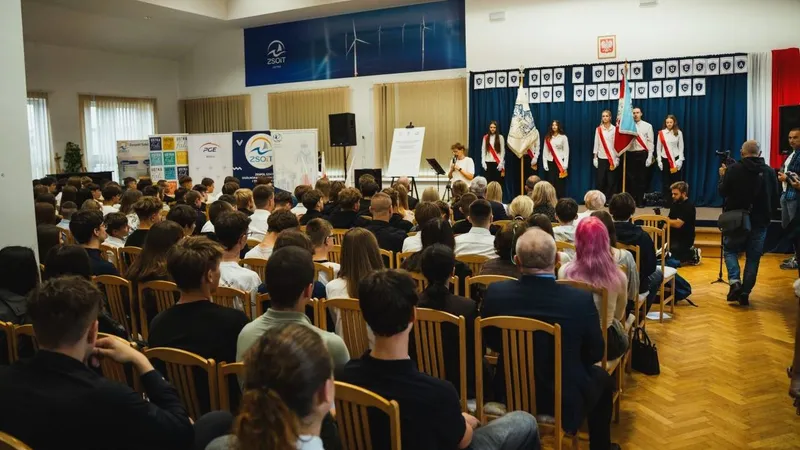
On 1 September the first school bell of the year rang on the Polish coast not only for pupils, but for the entire maritime industry. In Ustka, a renewable energy class of 27 students began the year under the patronage of offshore wind developer PGE Baltica; in Gdynia, the PGZ Naval Shipyard opened a marine automation class at the Zespół Szkół Chłodniczych i Elektronicznych technical school; and at the same school a drone class is launching, created with the Maritime Technology Centre (OBR CTM) and the Polish Naval Academy. It is a return to a model on which Poland's maritime economy was once built - and a welcome one.
In brief
PGE Baltica has taken patronage of a renewable energy equipment and systems technician class at the Zespół Szkół Ogólnokształcących i Technicznych in Ustka, where 27 students began their studies on 1 September. Students in Ustka will receive internships, study visits, textbooks and scholarships for the best from PGE Baltica. PGZ Stocznia Wojenna opened a ship automation class on 1 September at the Zespół Szkół Chłodniczych i Elektronicznych in Gdynia. The Gdynia school is also launching a drone systems class with the Polish Naval Academy and OBR Centrum Techniki Morskiej, and an electrical class under the patronage of Siemens Gamesa.
Poland was built on schools like these
Vocational education is nothing new on the Polish coast. It was with a school - the Maritime School opened in 1920 in Tczew and moved a decade later to Gdynia - that the building of Polish crews for the merchant fleet began, before the country had ports and shipyards worthy of the name. In the following decades, shipyards and ports ran their own factory schools, where welders, hull fitters, marine electricians and mechanics learned their trade on the shop floor rather than only at a desk, and maritime and energy technical schools were a natural route to a good job.
That system was largely dismantled after the education reforms of 1999. Vocational schools were wound down and stripped of prestige, and a fashion for general secondary schools and university degrees for everyone swept through the system. The industry feels the effects to this day: a generation gap in shipyards, ports and the energy sector, a rising average age of welders and fitters, and a growing reliance on workers from abroad. That is why what is happening now is a reversal of a bad trend. Technical schools are back in favour, vocational education is rebuilding its position, and companies have stopped waiting for the system to produce workers - they have walked into the schools themselves. A patronage class is, in essence, the modern version of the factory school: the company provides equipment, internships, experts and a real prospect of employment, and in return gets a workforce tailored to its needs.
Ustka: 27 students and scholarships from PGE Baltica
At the secondary school complex in Ustka, the school year opened with the long-announced class training renewable energy systems technicians under the patronage of PGE Baltica. Twenty-seven students from Ustka, Słupsk and the region, and even from outside the Pomeranian province, began their studies. The company is offering them study visits, internships, expert support, textbooks and school supplies, as well as a scholarship programme for the best students. The inauguration was attended by PGE Baltica's chief executive Bartosz Fedurek, who had earlier declared that the company's ambition is to create the best offshore wind school in Poland in Ustka.
– I am immensely proud that in Ustka we are investing not only in concrete, steel and infrastructure connected with offshore wind. We are also investing in people – said Bartosz Fedurek after the inauguration, stressing that the point is for young people to be able to find their professional future in a few years' time in the region they come from, without having to leave in search of opportunities.
– The energy transition is not only turbines, foundations and cables. It is above all people who will be able to build, develop and maintain this new energy sector. That is why I believe that good vocational and technical education is one of the foundations of regional development and of Polish energy. And this, too, is local content – added Bartosz Fedurek.
The context is very tangible: a few hundred metres from the school, the company's operations and maintenance base is rising, from which PGE Baltica will service its offshore wind farms for decades. The company has been working with the Ustka school for three years - it earlier took mechanical and mechatronics technician classes under its wing and co-funded a workshop equipped with the tools used by wind turbine service technicians.
Gdynia: the naval shipyard opens a marine automation class
The PGZ Naval Shipyard, part of the state-owned Polska Grupa Zbrojeniowa defence group, also launched its patronage class on 1 September - at the Zespół Szkół Chłodniczych i Elektronicznych in Gdynia, in a niche trade that is crucial for shipbuilding: automation technician specialising in marine air conditioning and ventilation. It is the shipyard's second such school partnership, after an analogous class opened a year ago at the Conradinum shipbuilding schools in Gdańsk. The shipyard's chief executive Marcin Ryngwelski speaks openly of a renaissance of the shipbuilder's trade and of the need, at a time of rapid growth in the shipbuilding industry, to remember the generation that will replace today's specialists in a few years.
– Choose technical schools and universities, come to work at the shipyard, at the port, or serve in the Navy – Marcin Ryngwelski appealed to young people during the christening of the future frigate ORP Wicher, and he repeated the appeal on the occasion of the Gdynia inauguration.
– The heart rejoices when you see so many young, talented people at the opening of the school year at a technical school – said the head of the PGZ Naval Shipyard, inviting the students to the yard for their practical vocational training.
A drone class with the Maritime Technology Centre and the Naval Academy
The Gdynia school has in fact opened as many as three new patronage profiles in a single year: alongside the shipbuilding class, it is launching an electronics technician class specialising in drone systems and an electrical technician class under the patronage of Siemens Gamesa. The drone class is being created together with the Polish Naval Academy and the Maritime Technology Centre (OBR CTM), an R&D company in the PGZ group - a letter of intent was signed in the spring by the Mayor of Gdynia Aleksandra Kosiorek, school head Dorota Kotwicka and OBR CTM's chief executive Marcin Wiśniewski. The programme will cover electronics, automation, programming and the operation and servicing of uncrewed systems used in, among others, the maritime sector, energy, logistics and search and rescue, and the graduate's path is meant to lead through university studies, including at the Naval Academy, to a job at CTM. Dorota Kotwicka has made no secret of the fact that the impulse for the class was the war in Ukraine and the scale on which uncrewed systems have changed both the battlefield and civilian applications.
The Maritime School in Gdynia, or those who never waited for the fashion
One more address deserves an honest mention on this map: Polska 13A in Gdynia. Long before patronage classes came back into favour, the Maritime School in Gdynia had been practising vocational education in its purest form for three decades - close to the market, geared to the real requirements of employers and international conventions. It is here that merchant navy seafarers obtain and renew their STCW certificates, here that future officers train, and in recent years GWO certificates for offshore wind technicians have been added - precisely the competences that Poland's emerging offshore sector is waiting for. Without galas or letters of intent, year after year, successive cohorts of graduates go from here to ships under all flags and to companies serving the maritime economy. It is the best proof that the model of a school close to industry never died in Poland - it was simply waiting for the rest of the system to return to it.
Because local content does not begin on a construction site or in a shipyard hall. It begins in a school workshop. And on 1 September 2026, on the Polish coast, that could be seen exceptionally clearly.
Source: Gazeta Morska · Compiled by: Kamil Kusier
Related articles
 Energy and offshore Equinor takes over Bałtyk 2 and 3 O&M base in Łeba. Port to serve 1.44 GW of offshore wind for 30 years
 Navy and defence Port Gdański Eksploatacja secures NATO NCAGE code. Gdańsk port company lines up for defence tenders
 Shipbuilding industry Ex-Enterprise towed to Mobile under $418.5m contract. Test case for Nimitz-class disposal begins
 Energy and offshore Energa renames Gdańsk gas plant company as foundations for 6,000-tonne turbine and boiler are laid
 Equipment and technology WB Group takes Polish drones from Tokyo to SOFEX in Jordan in a single week
 Ports and logistics PGE books Gdańsk’s T5 terminal for the long haul: Baltica 2 first, then more offshore wind farms
Comments (0)
The discussion is moderated by the editors: a comment appears after review. Your e-mail address is not published.
Nobody has commented on this article yet.